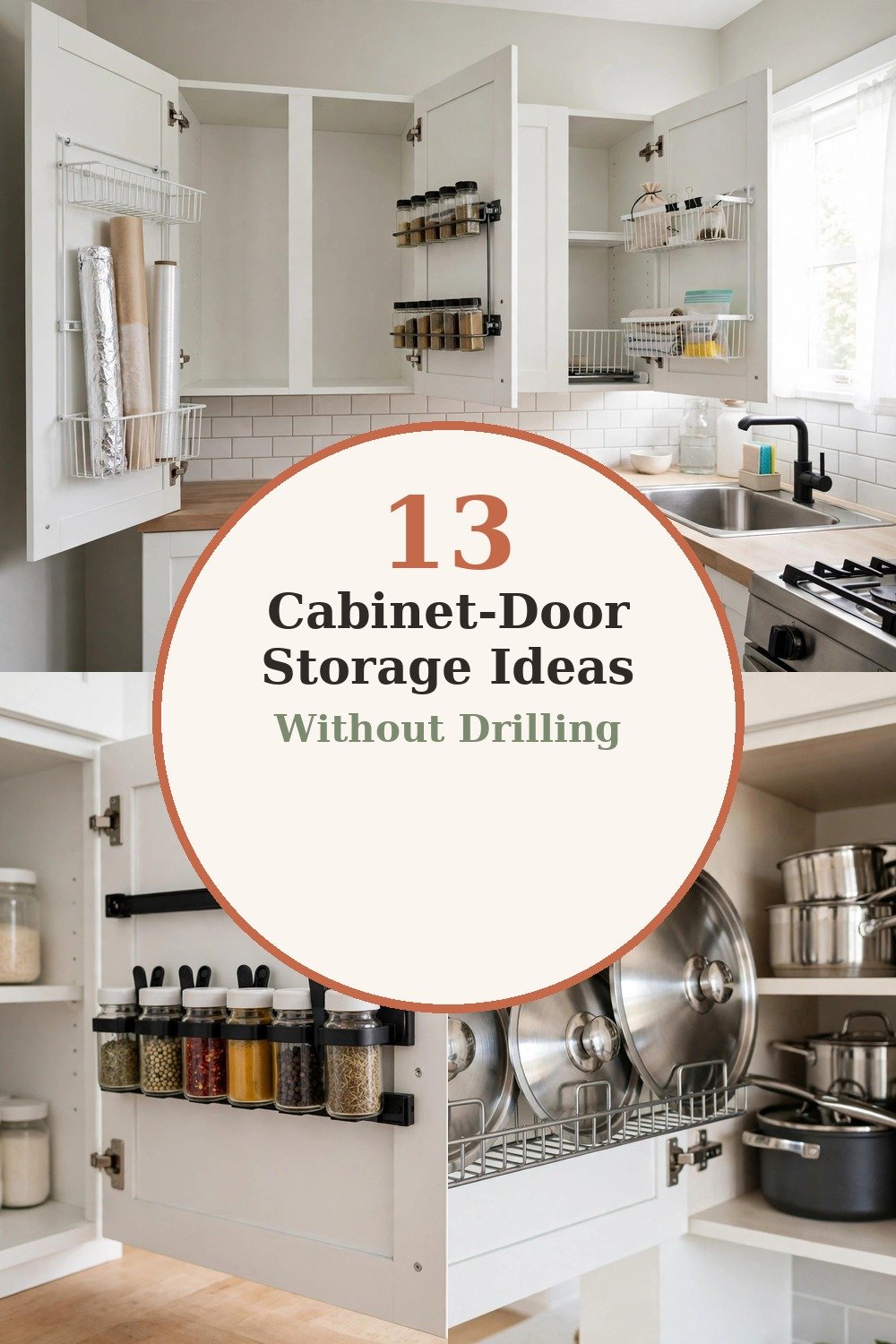

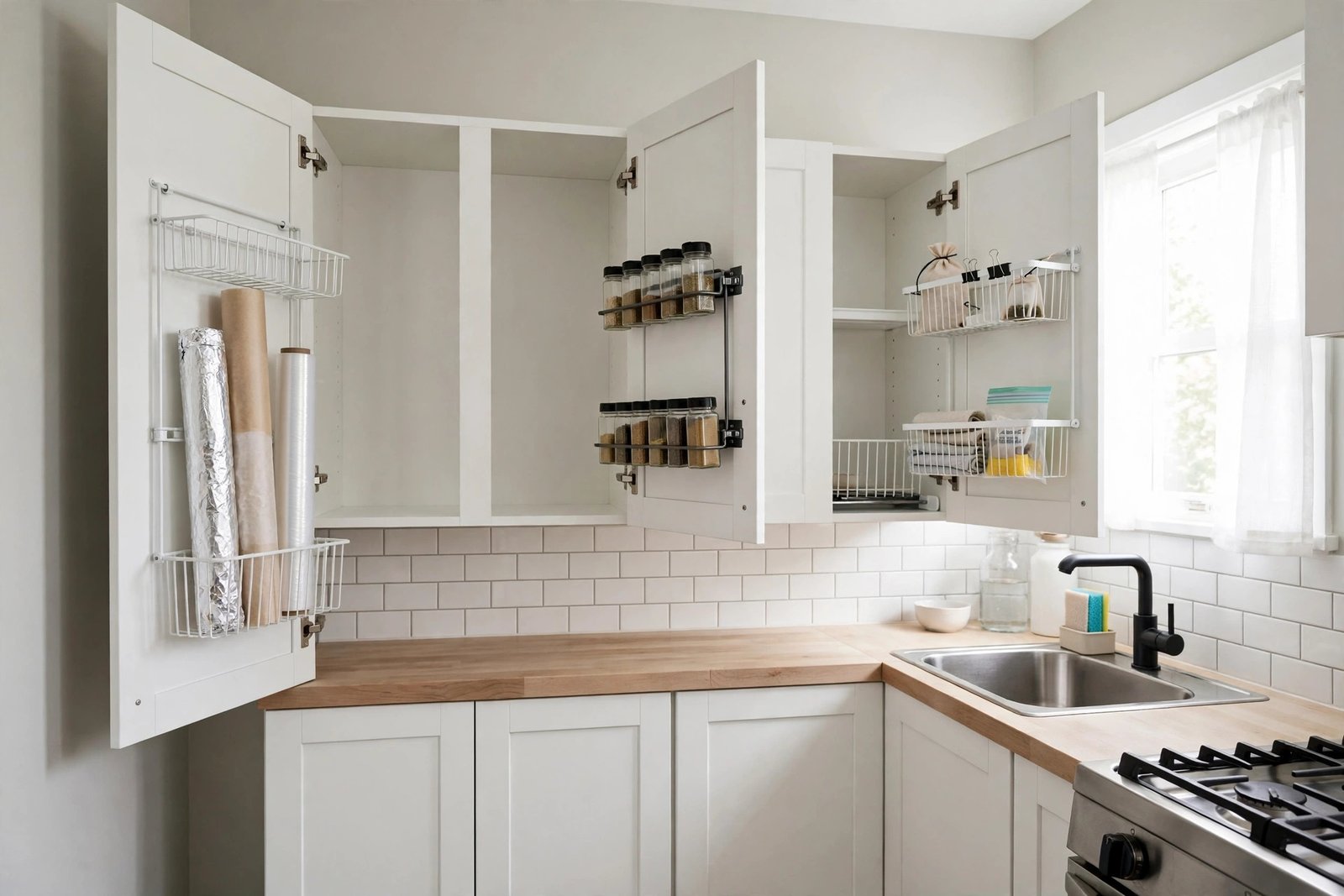
Every cabinet door in a rental is a blank wall you are allowed to use, as long as nothing is screwed into it. These cabinet door storage ideas hang over the door, clip on, or stick on with removable adhesive, so the door becomes storage for cleaning bottles, spices, lids and wraps. Nothing drills, nothing damages, and everything lifts off on moving day.
The rule that makes it work: measure the gap, then close the door and test it. A rack that stops a door closing flush is not storage, it is damage waiting to happen. This extends our small kitchen storage ideas and under-sink storage post; the same thinking works in our small bathroom storage post.
In this post
About 11 min read · 100% renter-friendly — no drills, no nails, no paint.
The 30-second version
- Do these 3 first, in order: an over-door basket under the sink (idea 1), spice clip strips (idea 4), and a lid rack (idea 7). About $30 to $55 together.
- 13 ideas, zero drills, zero screws. Everything hooks over a door, clips on, or sticks on with removable strips and comes off cleanly.
- Typical cost: most renters need 5 to 7 ideas, about $70 to $120 total. Measure door thickness, hinge clearance and the gap behind the door first; free worksheets are in the Free Renter Printables hub.
Cleaning doors: under the sink
1. An over-door wire basket for spray bottles
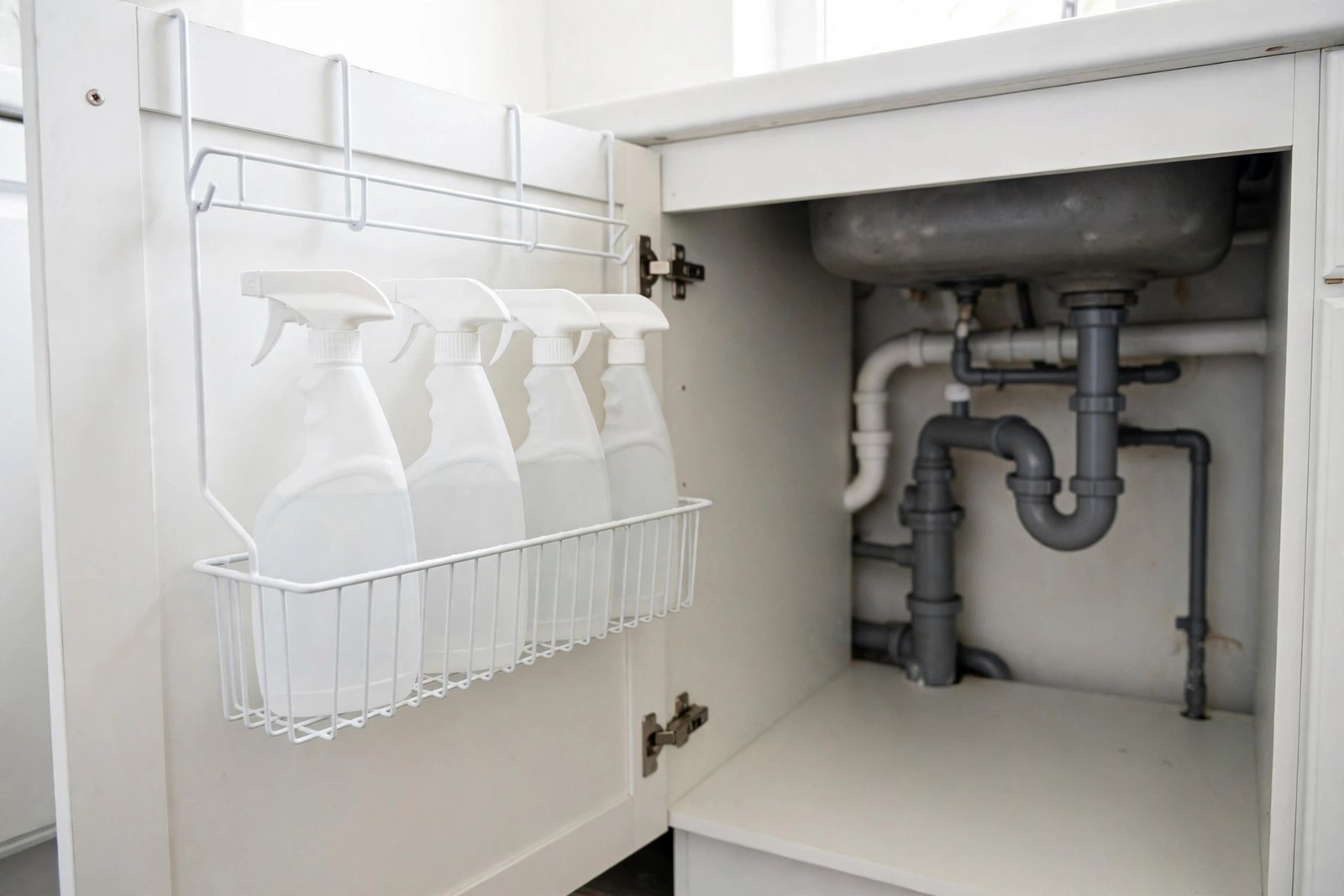
A wire basket hooked over the top of the under-sink door turns the most wasted surface in the kitchen into bottle storage. Spray bottles stand upright instead of toppling behind the pipes. Choose flat, padded hooks, and keep tall bottles in the middle, where the door is strongest.
Cost: ~$10-18 • Best for: spray bottles and cleaning refills under the sink • Measure first: door thickness, usually about 2 cm (0.8 in), and basket depth, about 10 to 12 cm (4 to 5 in), against pipe clearance behind the door • Watch out: close the door slowly first; full bottles lean and can catch the pipes.
2. A slim caddy for the sponge and dish soap

A narrow over-door caddy on the sink door holds the sponge, washing-up liquid and a small brush at the sink, off the worktop. That reclaimed strip of counter is worth more than the caddy costs. Look for drainage slots so the sponge dries instead of sitting in water.
Cost: ~$8-14 • Best for: sponge, dish soap and brush at the sink, off the counter • Measure first: caddy width, usually 20 to 25 cm (8 to 10 in), and depth of about 8 cm (3 in) so it clears the sink bowl behind • Watch out: drips can mark the door finish below; wring the sponge and empty the tray weekly.
3. Adhesive hooks inside the door for gloves and a brush
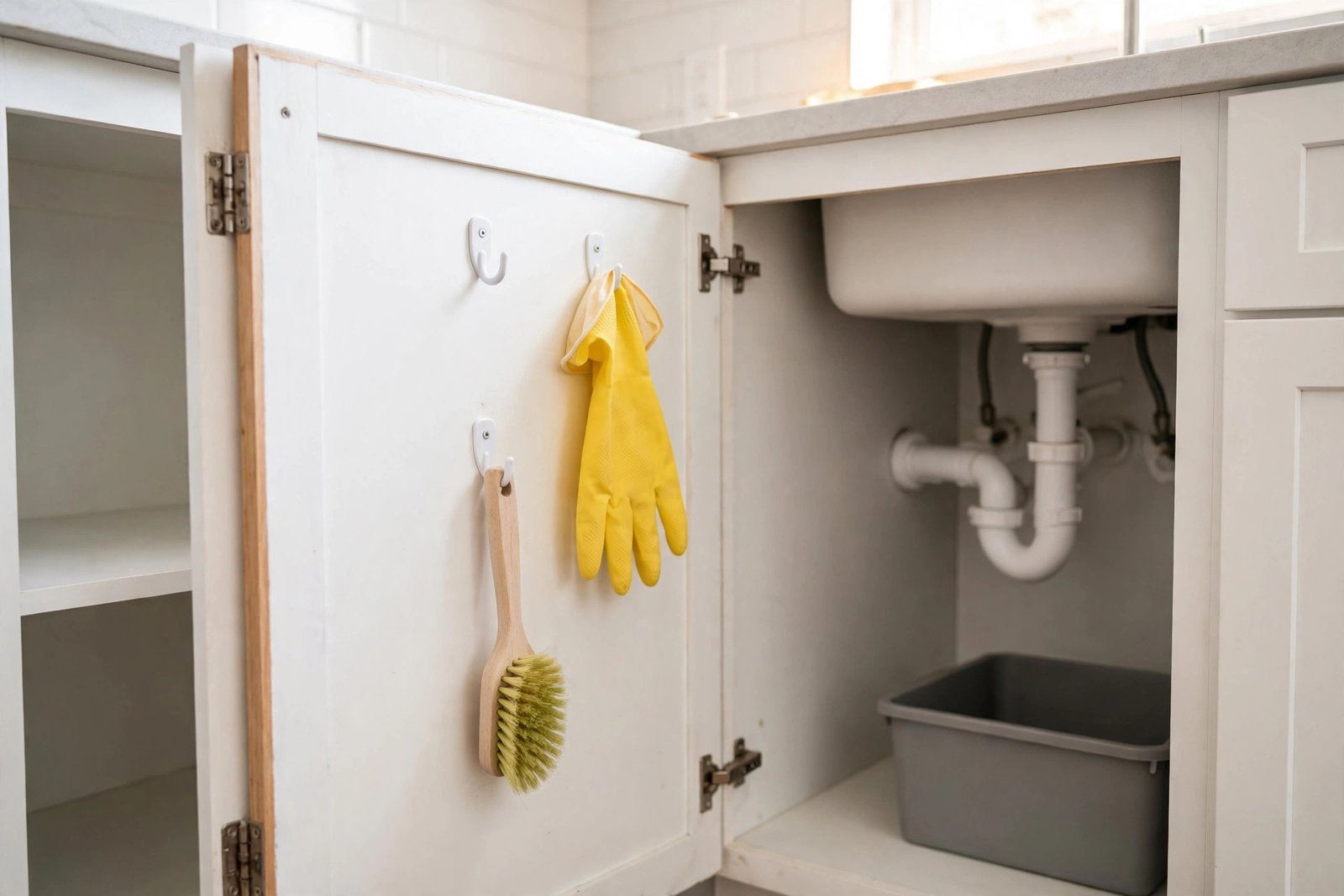
Two removable adhesive hooks inside the under-sink door hold rubber gloves by their cuffs and a scrub brush by its handle, so both dry instead of going sour under the pipes. It is the cheapest idea here. Set the strips for a full 24 hours before hanging anything.
Cost: ~$6-10 for hooks • Best for: rubber gloves and a scrub brush, drying inside the sink door • Measure first: a flat, sound patch of door, about 8 cm (3 in) square per hook, clear of the frame and hinges • Watch out: strips fail on flaking paint or damp doors; test one hook first and remove with the pull tab, never a twist.
Spices, packets and wraps
4. Clip strips for spice jars inside a cupboard door
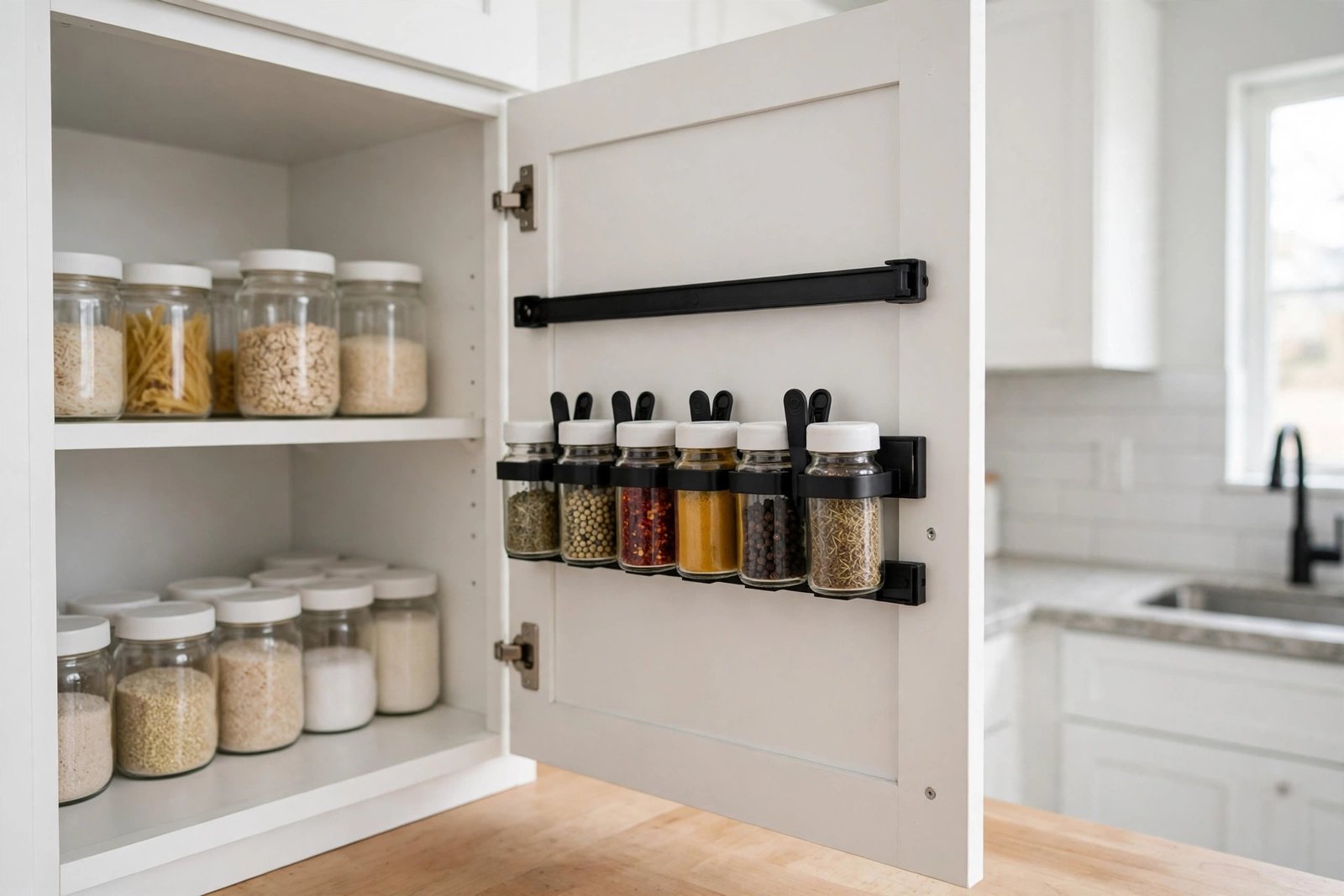
Adhesive clip strips grip standard spice jars in a row inside a food cupboard door, so daily spices sit at eye level and the shelf behind stays free. One strip usually holds four to six jars. Order them by how often you cook with them. This pairs well with our no-pantry storage post.
Cost: ~$8-13 for a pack of strips • Best for: everyday spice jars at eye level inside a food cupboard • Measure first: jar diameter, commonly 4 to 5 cm (1.6 to 2 in), against the clip size, and clearance so jars pass the shelf edge behind by at least 1 cm (0.4 in) • Watch out: clips lose grip on oversized jars; keep the biggest jars on the shelf.
5. Clear pockets for seasoning packets and stock cubes
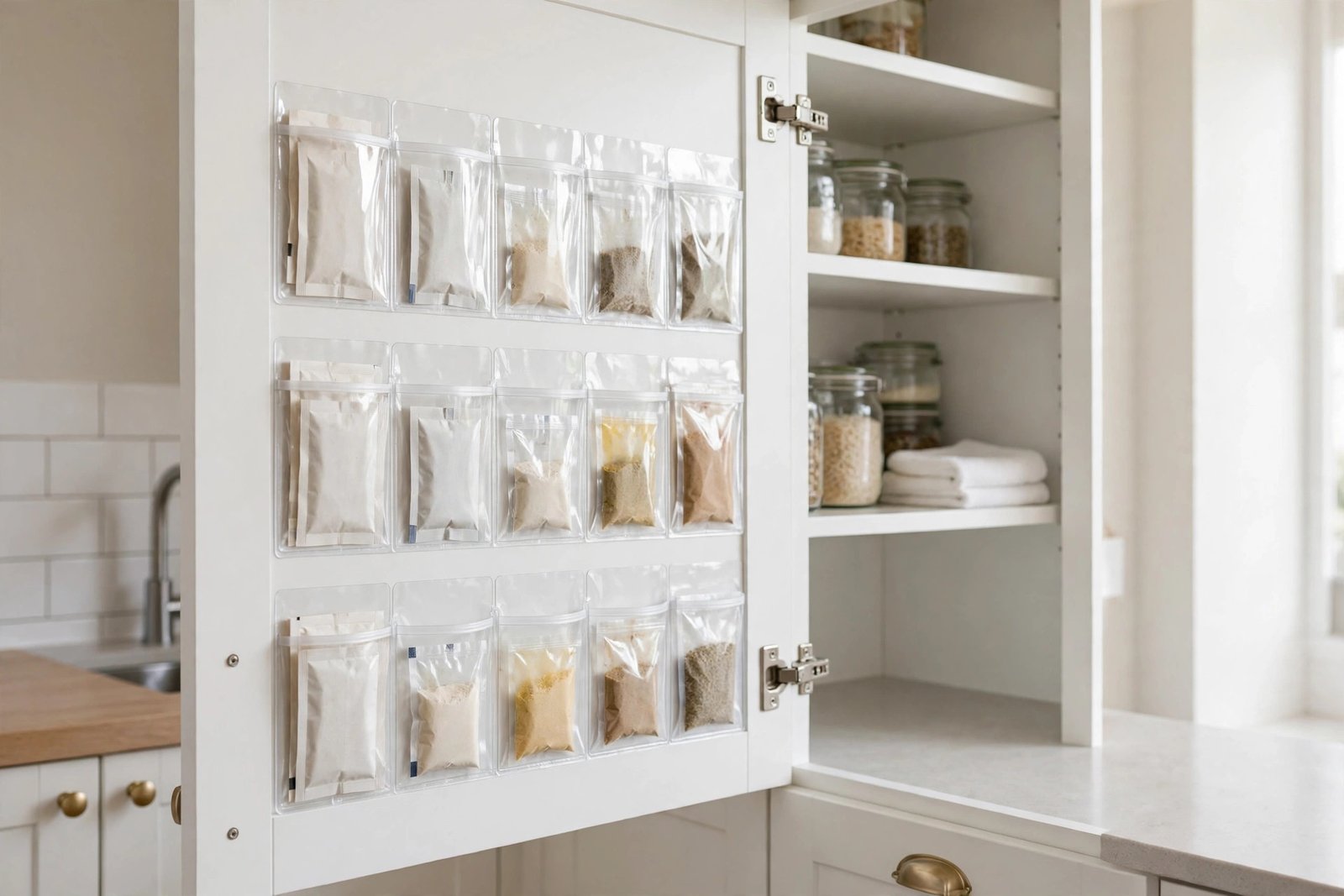
Clear adhesive pockets inside a cupboard door file the flat things that otherwise vanish: seasoning mixes, stock cubes and sachets. You see the whole stock at once and stop buying duplicates. Keep one pocket for open packets, clipped shut, so half-used mixes get finished first.
Cost: ~$9-15 for a set • Best for: seasoning packets, stock cubes and sachets that get lost on shelves • Measure first: pocket size, commonly about 15 by 20 cm (6 by 8 in), and the flat door area between the hinges • Watch out: pockets peel if overloaded; they are for flat, light packets only.
6. A slim rack for foil, film and parchment rolls

A wire rack inside a wide cupboard door holds foil, cling film and parchment in slots instead of jamming a drawer. Tear edges face out, so each roll is a one-hand grab. Use the widest door, ideally beside the hob or oven.
Cost: ~$12-20 • Best for: foil, cling film and parchment rolls that jam drawers • Measure first: roll length, usually 30 cm (12 in), against rack width, plus clearance so roll ends clear the cabinet frame as the door closes • Watch out: serrated foil edges can scratch the door; choose a rack that holds rolls clear of the surface.
Shopping for these? Measure first.
Door thickness, hinge side, and the gap behind the closed door decide what fits.
Lids, boards and small tools
7. An over-door rack for pot lids
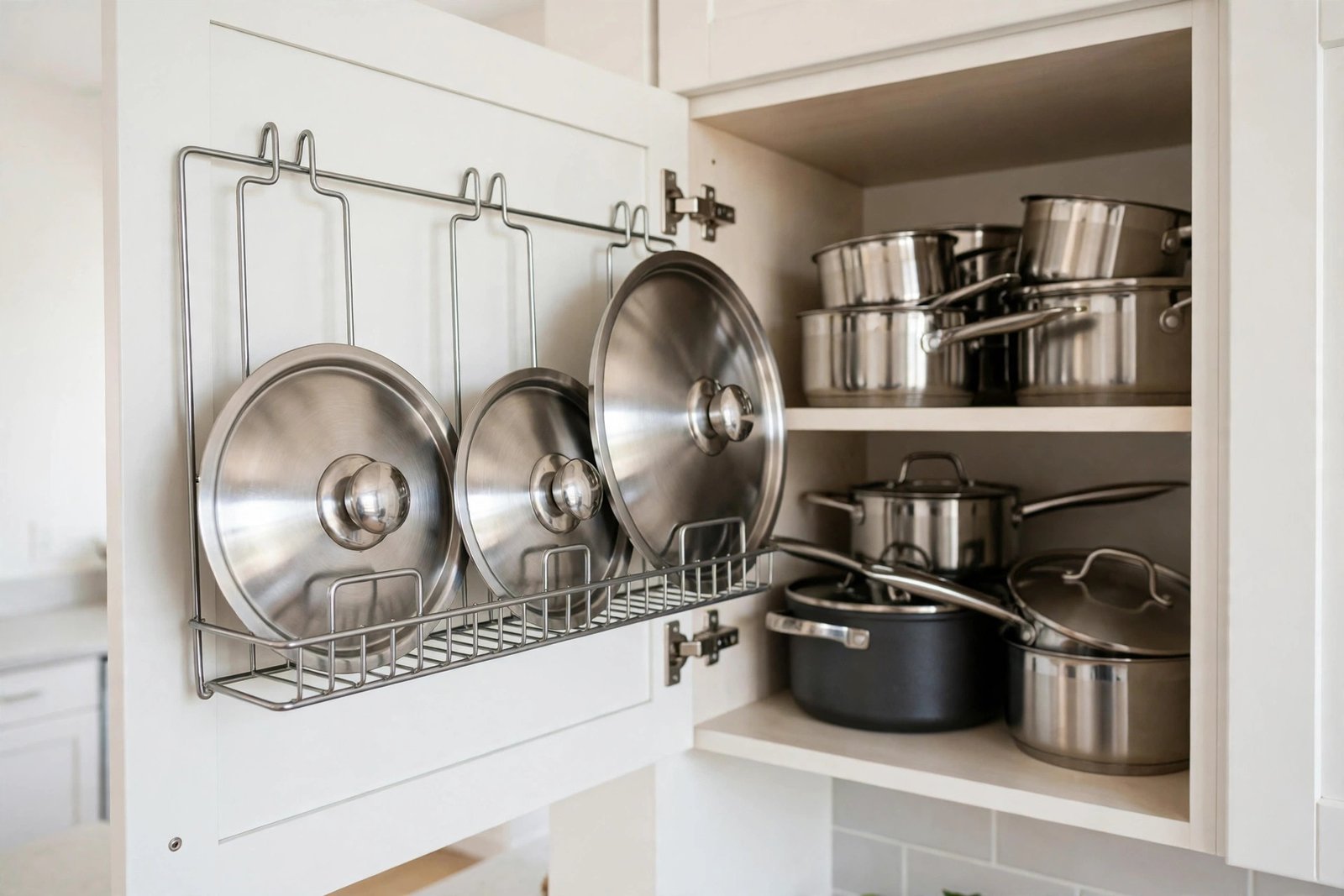
Pot lids are the worst-shaped things in a small kitchen: too wide for drawers, too slippery to stack. A wire rack hooked over a cupboard door holds three to five lids upright in slots. Put it on the door of the cupboard that holds the pots, so lid and pot live together.
Cost: ~$11-18 • Best for: pot and pan lids that will not stack or fit a drawer • Measure first: your widest lid, commonly 26 to 30 cm (10 to 12 in) across, against the rack slots, and rack depth of about 8 to 10 cm (3 to 4 in) against the shelf behind • Watch out: heavy glass lids belong in the lowest slots; a top-heavy rack can bow the hooks.
8. A vertical file rack for boards and trays

A file-style rack inside a tall cupboard door, or standing just inside it, files cutting boards and baking trays on edge like books. Boards filed upright get used daily and dry properly; boards stored flat never get used. Keep the everyday board in front.
Cost: ~$13-22 • Best for: cutting boards and baking trays stored upright and easy to grab • Measure first: board height, commonly 30 to 40 cm (12 to 16 in), against door height, and slot width of about 4 to 6 cm (1.6 to 2.4 in) per board • Watch out: a loaded rack is heavy for adhesive alone; prefer over-door hooks or a rack that stands inside the cupboard.
9. Adhesive hooks for measuring cups and spoons

Small adhesive hooks inside a baking cupboard door hang measuring cups and spoons in size order, where the flour and scales live. No more digging through a drawer with floury hands. Hang the set by its ring so it lifts off in one move.
Cost: ~$6-11 for hooks • Best for: measuring cups, spoons and small baking tools inside the baking cupboard • Measure first: a flat door patch about 25 cm (10 in) wide, clear of the hinge swing, with about 3 cm (1.2 in) clearance behind so cups do not rattle against shelves • Watch out: let strips set for 24 hours before hanging the metal set.
Towels, rolls and waste
10. An over-door towel bar for tea towels
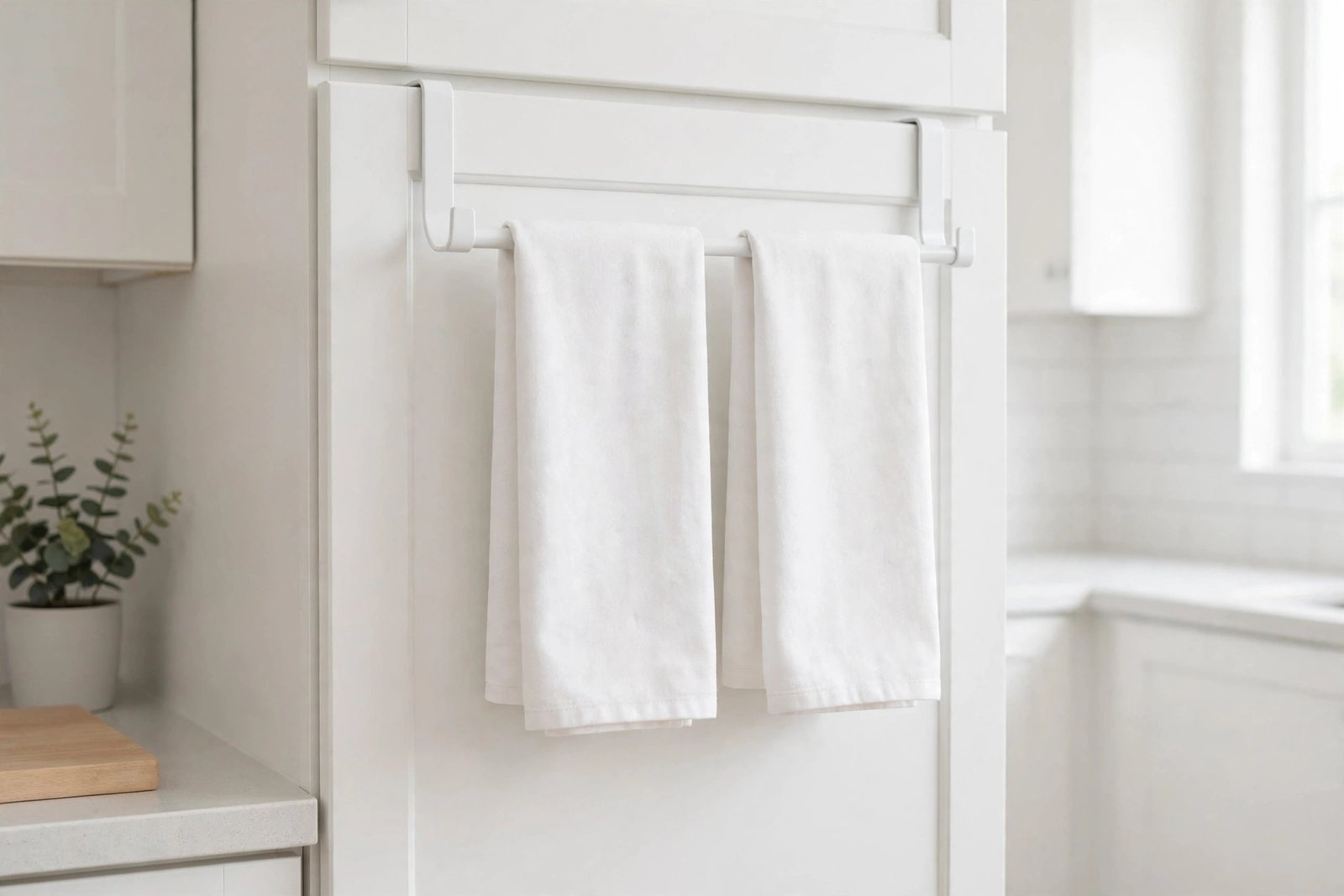
A bar hooked over a cabinet door gives tea towels a proper drying rail instead of a bunched handful on the oven handle. Two towels hang flat and dry between uses. Choose padded hooks and a slight stand-off, so wet cotton does not sit against the finish.
Cost: ~$9-15 • Best for: tea towels drying flat on a cabinet door • Measure first: bar width, usually 23 to 36 cm (9 to 14 in), against the door, and door thickness of about 2 cm (0.8 in) for the hooks • Watch out: a bar on a high-traffic door gets knocked; the sink door is usually the calmest spot.
11. A kitchen roll holder over the door
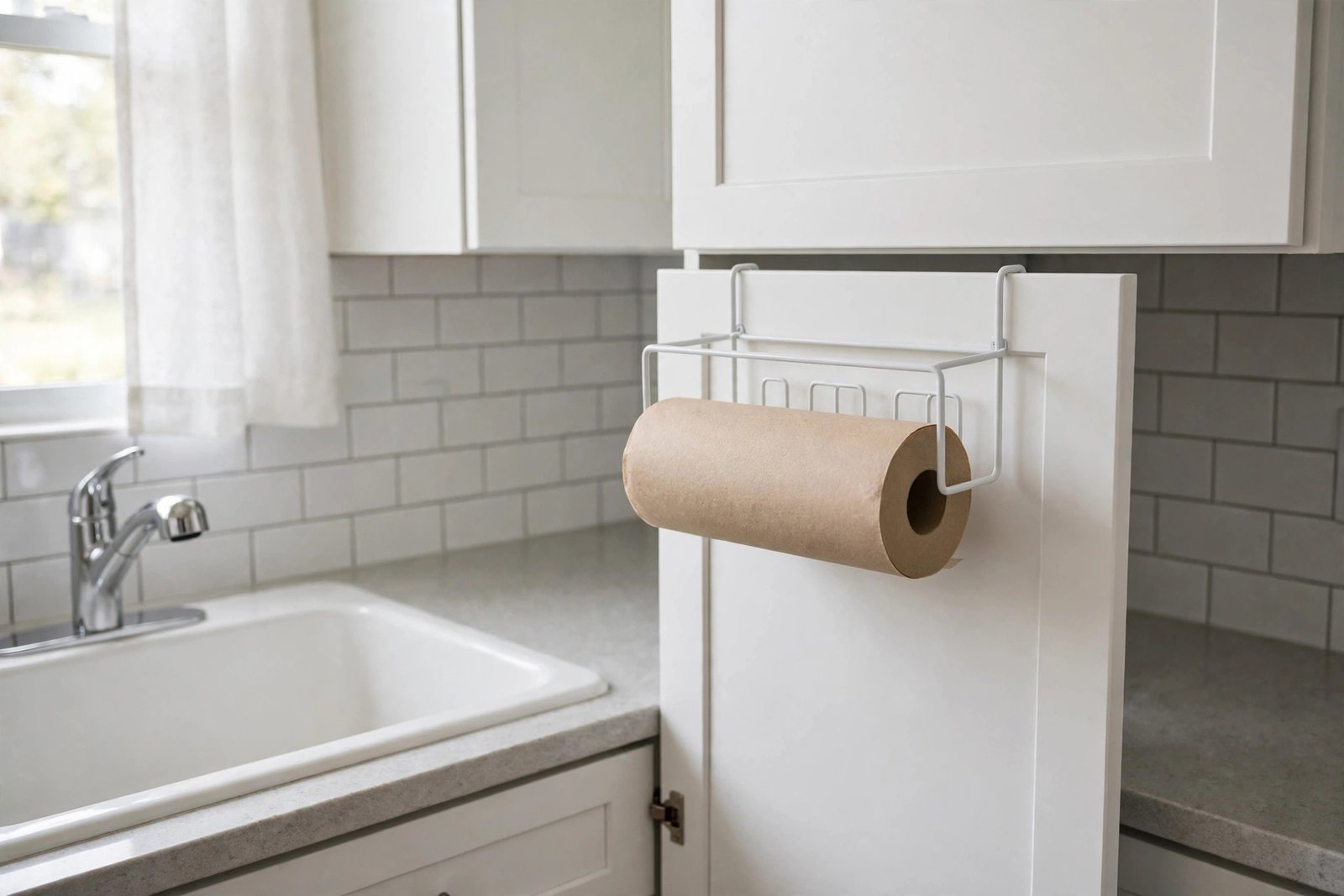
An over-door kitchen roll holder puts paper towels at the sink or hob, where spills happen, without a freestanding holder eating worktop space. The roll spins and tears one-handed. In the smallest kitchens, hang it inside the under-sink door instead.
Cost: ~$8-14 • Best for: kitchen roll at the sink or hob with no counter space used • Measure first: roll width, usually about 23 cm (9 in) plus holder ends, and clearance so a full roll, about 12 cm (5 in) across, clears the frame as the door closes • Watch out: a fresh, fat roll can rub the frame; do the close test with a new roll, not a half-used one.
12. A slim hanging bin inside the sink door

A small bin hanging over the inside of the under-sink door catches peelings and tea bags while you prep, then lifts out to empty. The main bin across the room stays for dry recycling. Line it with the bags from idea 13.
Cost: ~$10-17 • Best for: food scraps and peelings while you cook, at the sink • Measure first: bin depth, about 12 to 15 cm (5 to 6 in), against pipe and shelf clearance behind the sink door; this is the tightest fit in the post • Watch out: if the door does not close fully and quietly with the bin loaded, it is too deep; swap it for idea 1’s basket.
13. A slim basket for bin liners and spare bags
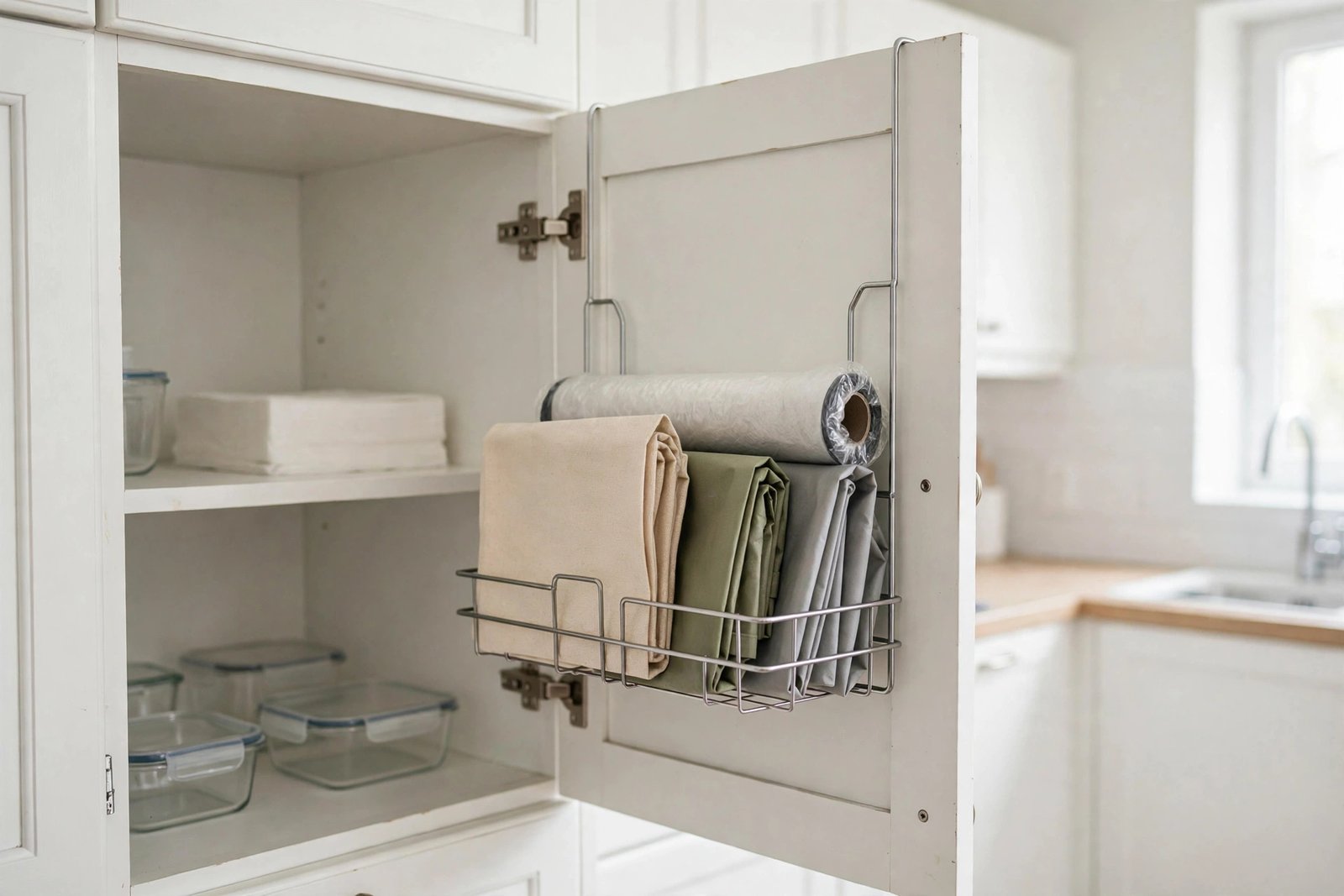
Finish with the least glamorous, most useful door: a slim over-door basket inside a low cupboard holding bin liners, folded spare bags and bag clips. Liners live beside the bin they serve, and the basket lifts out on cleaning day.
Cost: ~$9-15 • Best for: bin liners, spare bags and clips beside the bin • Measure first: basket depth of about 10 cm (4 in) against what sits behind that door, and door thickness of about 2 cm (0.8 in) • Watch out: do not store cleaning chemicals in this basket within a child’s reach; keep it for liners and bags only.
Common mistakes we’d skip
- Skipping the close test. Hang the rack empty, close the door, then load it one item at a time. Scrapes show up loaded, not empty.
- Ignoring the hinges. The hinge side has the least usable width. Keep racks centred or toward the handle side.
- Trusting adhesive with real weight. Adhesive is for packets, hooks and light tools. Heavy lid and board racks should hook over the door or stand inside the cupboard.
- Filling every door. Leave the doors you open fifty times a day light and quiet. Two or three well-chosen doors beat thirteen rattling ones.
The short version
Treat each cabinet door as a shallow shelf you already own: bottles under the sink, spices and wraps in the food cupboard, lids and boards filed upright, towels on the quiet doors. Measure the gap behind the door first; every idea lifts off without a mark.
Questions renters ask
Will over-door hooks damage my cabinet doors?
Padded hooks sized to the door, usually about 2 cm (0.8 in) thick, lift off without a mark. The real risk is a loaded rack scraping the shelf or pipes behind the door, which is why the close test matters.
How much weight can an inside-door rack hold?
Over-door wire racks typically hold about 3 to 5 kg (7 to 11 lb). Adhesive strips hold far less per point, commonly 0.5 to 2 kg (1 to 4 lb), so save adhesive for light items.
My doors have raised panels, not flat fronts. Will these still work?
Over-door hooks work on almost any door, because they grip the top edge. Adhesive strips and pockets need a flat, sound patch, so use the flat centre panel or the flat inside face, and test one strip first.
Which door should I start with?
The under-sink door. The basket (idea 1) and glove hooks (idea 3) cost under $30 together, fix the messiest cupboard, and teach you the measuring routine every other door needs.
Found this useful?
Save it to Pinterest for later, or tell us your smallest-space problem in the comments — the best posts here started as a reader’s awkward cabinet.
📌 Pin this post🖨 Print this post
Tell us your smallest-space problem in the comments.
📌 PIN THIS FOR LATER