
The counter is the hardest-working bit of a rental kitchen, and right now yours is working as an appliance car park. Toaster, kettle, microwave, air fryer, mixer, plus the blender you use twice a month, all sitting there because putting them away feels like admitting defeat. These small appliance storage ideas start from the opposite logic: the appliance is never the problem, the appliance without a home is.
Only two things earn permanent counter space: daily use, and genuine heaviness. Everything else gets a real home in a cupboard or on a cart. Small appliances only here, the plug-in crew. The rest of the kitchen: our small kitchen storage ideas for renters, spice storage ideas, kitchen drawer organisation, over-sink dish racks and small freezer organisation.
Before buying anything: if the cupboards hold gadgets you never use, storage is not the first problem. Our 7-day declutter plan is the honest pre-step.
In this post
- The 30-second version
- On the counter, but corralled
- Put away between uses
- Heavy, hot and tall
- Cords, attachments and the system
- Common mistakes we’d skip
- The short version
- Questions renters ask
The 30-second version
- Do these 3 first, in order: the daily-three rule (idea 1, free), the cord wrap-up (idea 12), and one in, one out (idea 15, free). Combined cost: about $5 to $12 for velcro ties and a label pack.
- 15 ideas, zero drills. Typical cost: $60 to $150 if you bought everything, but most renters need 5 to 8 of the systems, about $25 to $60.
- The appliance inventory worksheet is in our Free Renter Printables hub.
On the counter, but corralled
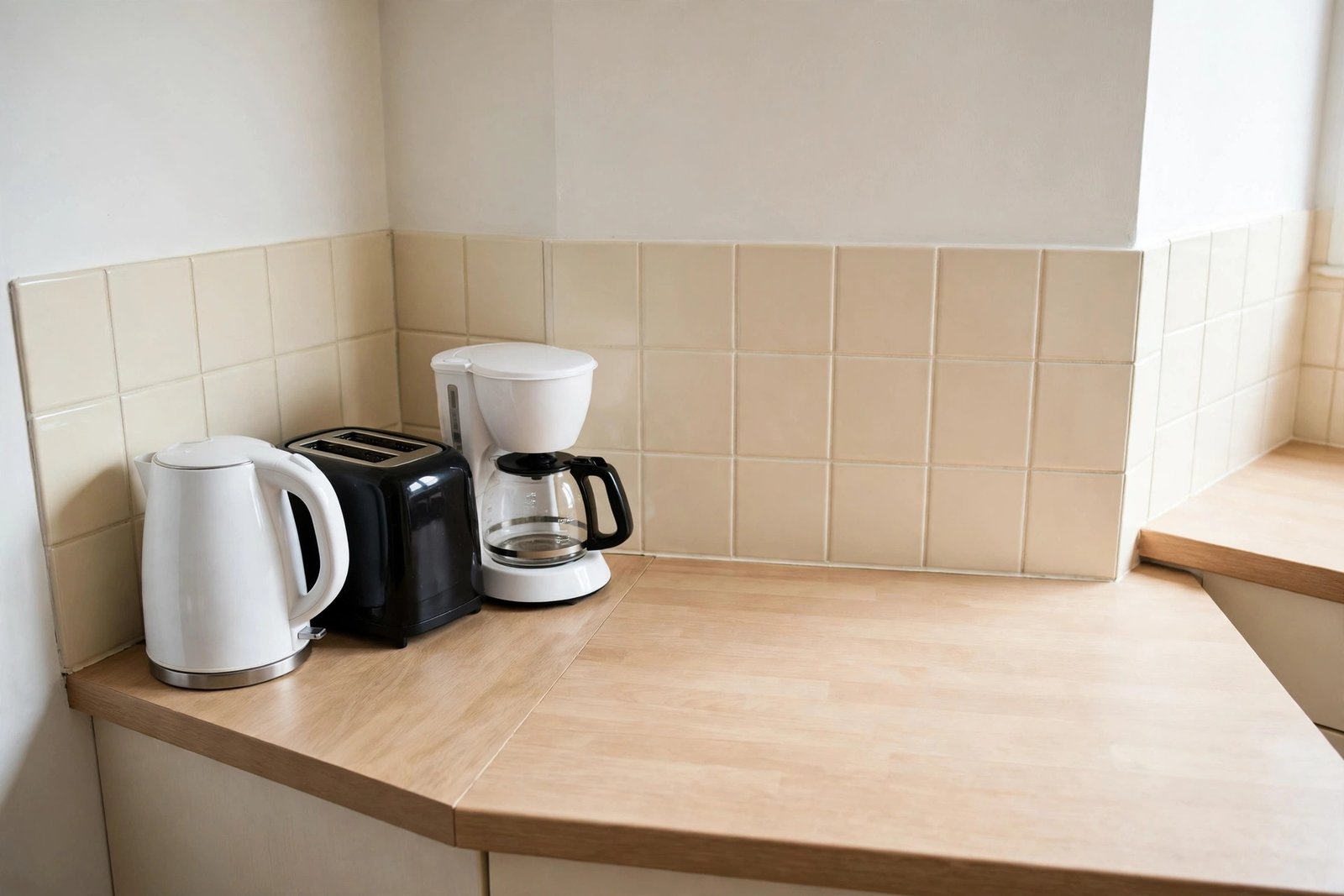
1. The daily-three rule

Audit every plug-in appliance: used in the last seven days? Only the three that pass keep their counter spots; the rest get real homes in ideas 4 through 7.
Be honest about “daily”: the Saturday waffle maker is weekly, and weekly appliances live in cupboards. Three look intentional; eight look overwhelmed.
Cost: ~$0 • Best for: every rental kitchen • Measure first: none, count your daily uses first • Watch out: three is the discipline; five is the old counter.
2. The countertop appliance garage
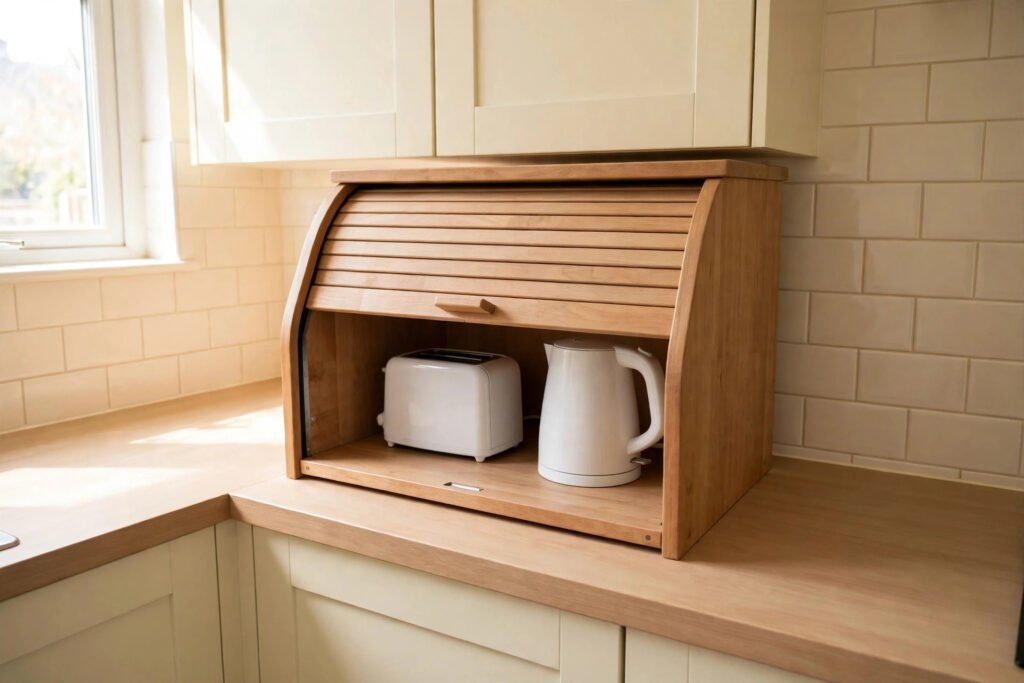
A box with a roll-top or shutter front that sits on the counter: toaster and kettle go in, the door pulls down, and the counter reads as empty. No install, no screws, no landlord conversation.
It only pays off swallowing two small appliances, since walls and door track eat counter too. Check the door clears your wall cabinets: most need 40 to 45 cm (16 to 18 in).
Cost: ~$30-60 • Best for: a daily toaster-and-kettle pair • Measure first: counter depth before wall cabinets, most run 30 to 40 cm (12 to 16 in) • Watch out: a shutter that jams on the cabinet annoys daily.
3. A tray as the appliance corral

One large tray holding your daily three: the eye sees one object with a border, and wiping the counter means lifting one tray instead of shuffling three appliances.
Raised edge, wipeable surface, roughly tea-tray size. It is the cheapest test of the daily-three rule: a tray collecting a fourth appliance means your three are really four.
Cost: ~$8-20 • Best for: testing the daily-three rule • Measure first: it must fit all three with space between, about 45 by 30 cm (18 by 12 in) • Watch out: lift and wipe under it weekly.
Put away between uses
4. One box per appliance in the cupboard
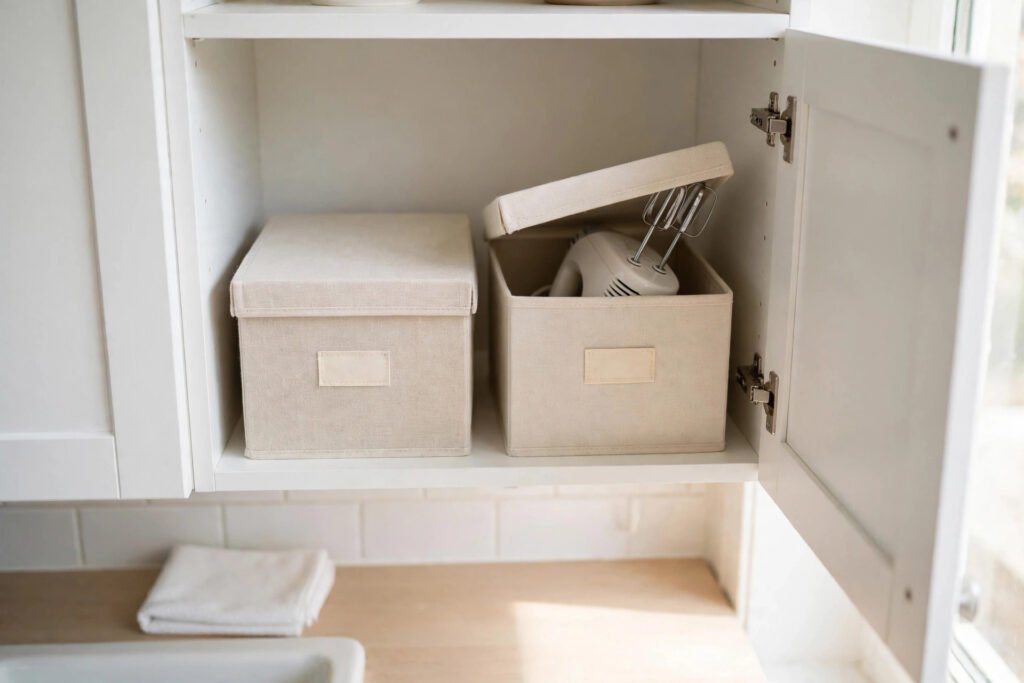
One lidded box with a blank label per put-away appliance. The boxes stack, the labels face out, and the cupboard stops being a dark cave.
Boxes eat volume, so this is for cupboards with depth to spare. Use blank labels you can rewrite; a collection changes.
Cost: ~$4-9 per box, most renters need 3 to 5 • Best for: deep cupboards • Measure first: inside height with the door closed, boxes run 25 to 35 cm (10 to 14 in) • Watch out: never box the daily three.
5. Stacking shelves that double a deep cupboard
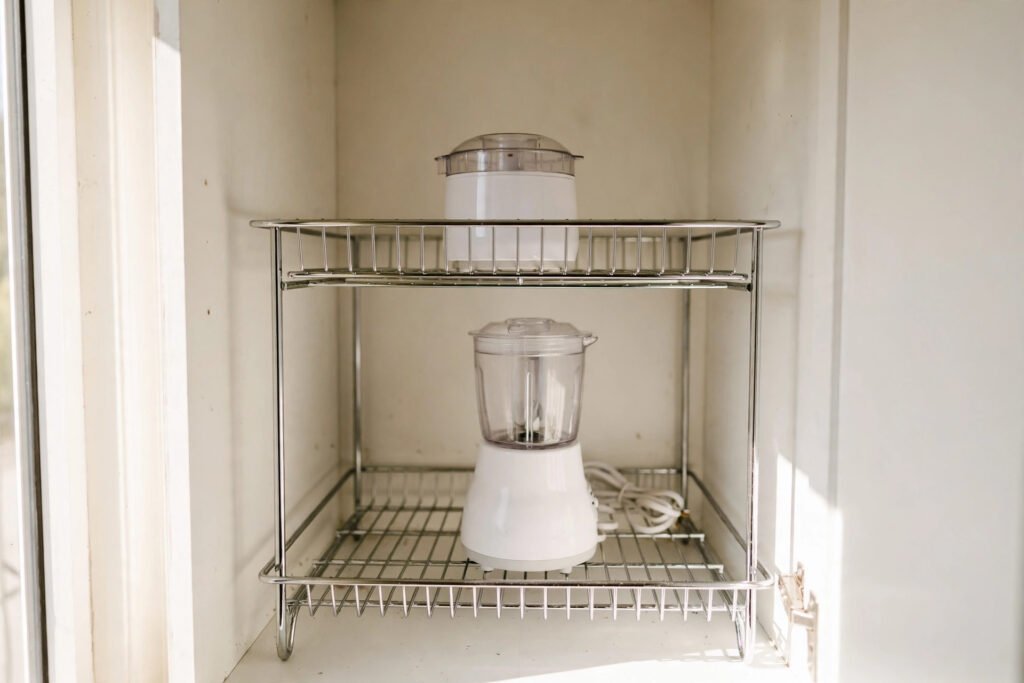
A wire or metal stacking shelf turns one deep cupboard into two levels: the weekly appliance on top at hand height, the rarer one underneath. No screws; it just unfolds and stands there.
Check the weight rating before loading it, and shove it once loaded: if it rocks, the floor is uneven and it needs felt pads.
Cost: ~$12-25 • Best for: cupboards with over 30 cm (12 in) of wasted height • Measure first: inside height minus the appliance underneath, plus lifting room • Watch out: heavy appliances live on the cupboard floor, never on the shelf.
6. The felt-slider board
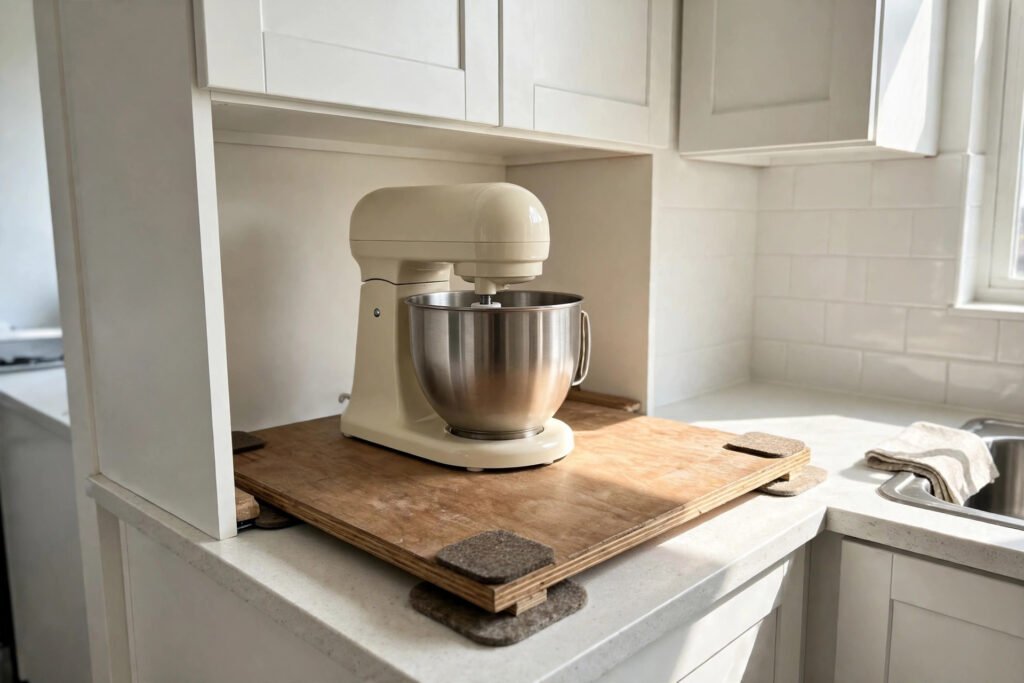
A low board about the mixer’s footprint plus a border, with felt furniture pads underneath. The mixer lives on it under the wall cabinets and slides out smoothly when you bake.
Use proper adhesive pads and a fabric cover: a slider dragging through sticky residue stops sliding.
Cost: ~$5-12 for board and pads • Best for: stand mixers under wall cabinets • Measure first: footprint plus 3 to 5 cm (1 to 2 in) of border, and clearance under the cabinets • Watch out: slides on smooth counters, not rough stone.
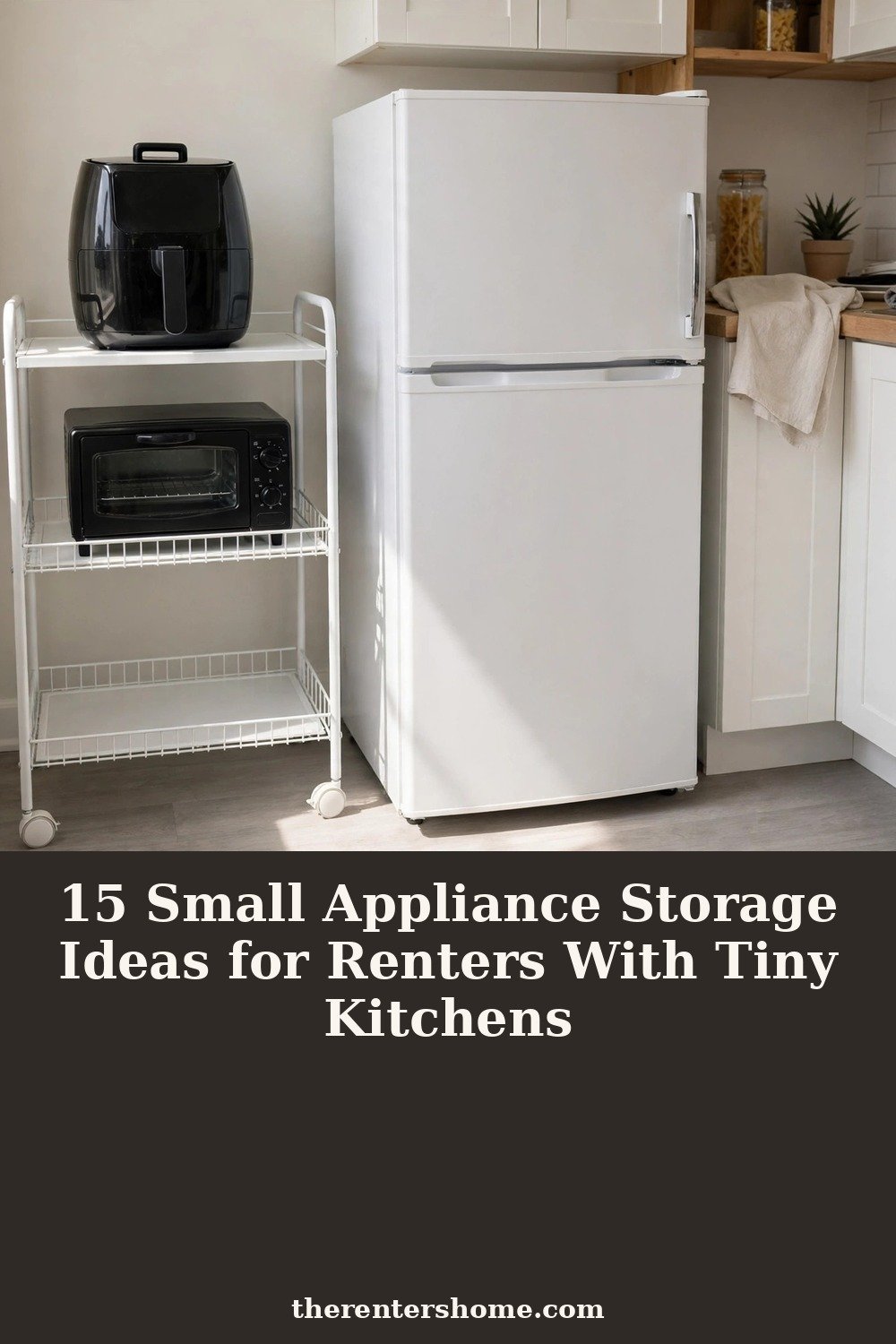
7. The rolling cart appliance station

A slim rolling cart parked in the gap beside the fridge: air fryer on one shelf, toaster oven on another, slow cooker below. It rolls out when needed and parks out of sight after.
Best for weekly appliances; daily roll-outs get old. Buy locking castors, and measure the gap first: gaps that look 20 cm (8 in) often measure 17 cm (7 in).
Cost: ~$20-45 • Best for: the bulky weekly crew beside the fridge • Measure first: gap width at floor and counter height, they often differ • Watch out: never run the air fryer on the cart; use a clear stable counter (idea 9).
Heavy, hot and tall
8. The stand mixer gets the bottom shelf

A stand mixer weighs about 10 to 11 kg (22 to 24 lb): a controlled lift from knee height, a dangerous one from overhead. Bottom shelf, never above shoulder height, cover on.
The trade-off is prime shelf space, hence the declutter step first. The cover is non-negotiable: a mixer you must wash before using is one you will not use.
Cost: ~$8-15 for a cover • Best for: any stand mixer over about 8 kg (18 lb), nearly all of them • Measure first: the opening must clear the covered height, commonly 40 to 45 cm (16 to 18 in) • Watch out: never store it overhead to “save” the bottom shelf.
9. The air fryer’s heat rule

The air fryer runs hot and vents hot air out the back or sides. Store it wherever is convenient, but RUN it with clear space all round, on a heat-safe mat, nothing touching the vents.
Give it 12 to 15 cm (5 to 6 in) of clearance and let it cool on the mat before it goes back.
Cost: ~$8-15 for a heat-safe mat • Best for: every air fryer • Measure first: the mat should exceed the footprint by 5 cm (2 in) all round • Watch out: never run it against a wall or under low cabinets.
10. The microwave moves off the counter
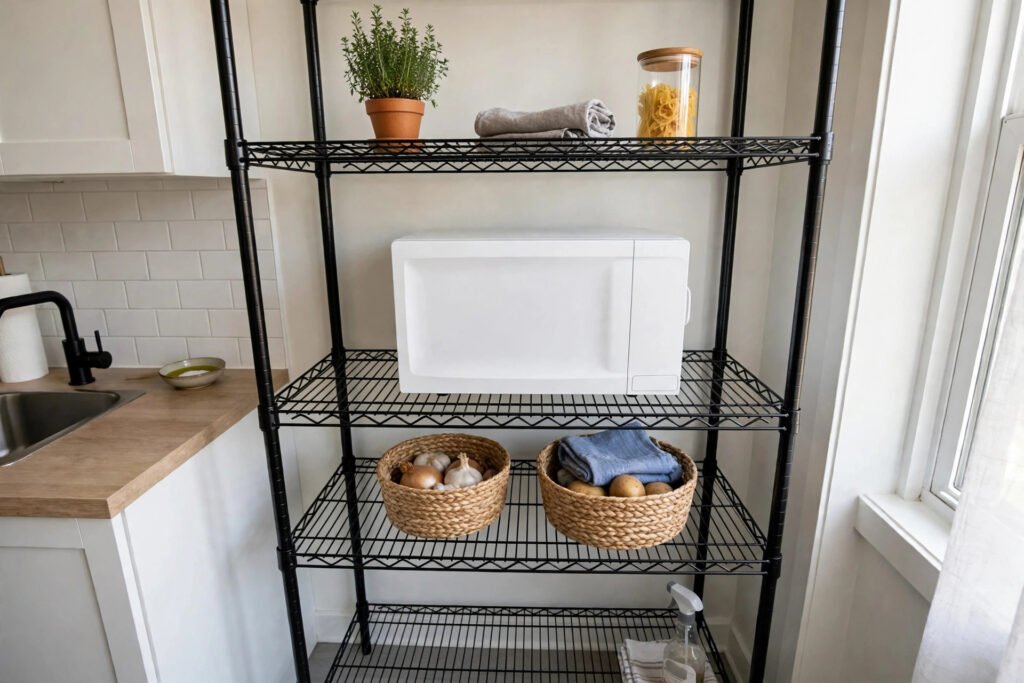
The microwave is the biggest counter thief in most rental kitchens. A freestanding shelf unit gives it a home with proper ventilation: about 10 cm (4 in) clear at the sides, 15 cm (6 in) on top.
Two things: the shelf must be rated for the weight (12 to 16 kg, 26 to 35 lb, plus food), and it must sit near an outlet.
Cost: ~$25-50 for a sturdy freestanding shelf unit • Best for: any microwave eating a third of the counter • Measure first: the microwave’s dimensions plus the ventilation gaps • Watch out: a wobbly bargain shelf under 15 kg (33 lb) is a disaster waiting.
Shopping for these? Measure first. Every system in this post is sized to a cupboard, a gap or a footprint, and the tape measure is cheaper than the return trip. Our Free Renter Printables hub has the measuring checklist and the appliance inventory sheet.
Cords, attachments and the system
11. The blender tower

Do the vertical maths first. Jar on the base: 40 to 45 cm (16 to 18 in) tall. Nested: roughly 25 cm (10 in) of height, twice the footprint.
The assembled tower survives; a blender in two pieces gets used half as often. A blender in pieces is a donation-box candidate.
Cost: ~$0; a riser shelf is ~$12-20 • Best for: tall-jar blenders, kitchens short on tall cupboards • Measure first: assembled height with the lid on, and every candidate cupboard’s height • Watch out: leave room to lift it out cleanly.
12. Cord wraps and velcro ties

Every appliance leaves the counter with its cord wrapped short: a velcro tie or silicone wrap, ten seconds, turning a tangle into a neat loop. Keep the tie on the appliance.
The cheapest idea in the post, because cord chaos is half of what makes stored appliances feel like a hassle. One pack does the whole collection.
Cost: ~$5-10 for a multipack • Best for: every put-away appliance • Measure first: nothing to measure; count appliances and buy spares • Watch out: never wrap a hot cord; let it cool first.
13. The attachment pouch

Blender blades, mixer attachments, processor discs: one lidded pouch with a blank label, kept with the appliance’s box. They stop migrating into drawers, which belong to our kitchen drawer organisation ideas post.
The pouch needs a lid or a zip, blades in blade-down. An attachment unused for a year is a donation signal, not a storage problem.
Cost: ~$6-14 for a lidded pouch • Best for: appliances with more than two attachments • Measure first: the largest attachment, then buy a couple of centimetres longer • Watch out: the pouch lives with its appliance’s box.
14. Seasonal rotation

Twice a year the shelves swap: the waffle maker goes up high for summer, the slow cooker comes down for winter. Seasonal appliances do not need year-round prime real estate.
Tie the swap to the weekly reset routine nearest the season change. Label what went up high: a forgotten slow cooker is expensive cupboard filler.
Cost: ~$0, a habit not a purchase • Best for: waffle makers, ice cream makers, slow cookers, anything seasonal • Measure first: the high shelf’s depth against the footprint • Watch out: nothing heavy up high; the mixer stays low per idea 8.
15. One in, one out

The rule that protects all fourteen before it: every new appliance must earn its spot, and something leaves to make room. Without it, the collection grows back to the old car park within a year.
The outgoing appliance goes to the donation box the day the new one arrives. New appliances re-trigger the daily-three audit.
Cost: ~$0, the discipline is the price • Best for: anyone who has owned two toasters • Measure first: the outgoing spot is the incoming one’s budget • Watch out: gifts count; a gifted appliance still has to earn its place.
Common mistakes we’d skip
- Boxing the daily three. A labelled box you open every morning is a chore you invented. Daily means on the counter, corralled.
- Running the air fryer where it is stored. The cart or cupboard is home; the open counter with clearance all round is the work site. Stored separate, run separate.
- Storing the mixer overhead. Above shoulder height is a lifting injury and a dropped mixer. Heavy lives low, always.
- Buying systems before the audit. The daily-three rule and the declutter step come first; storage bought for donated appliances is money in the donation box too.
The short version
Fifteen ideas, one principle: every appliance has a home that matches how often it is used. Daily things live on the counter, corralled. Weekly things live in boxes, on shelves or on a cart, cords tied and attachments pouched. Heavy things live low, hot things run with clearance, tall things get measured first. Nothing new arrives without something leaving.
Questions renters ask
Is it safe to run an air fryer in a small rental kitchen?
Yes, with the heat rule from idea 9: clear space all round the vents, a heat-safe mat underneath, never against a wall or under low cabinets, and let it cool before it goes back.
Where should I store a stand mixer in a rental?
On the bottom shelf of a cupboard, never above shoulder height. At 10 to 11 kg (22 to 24 lb) it is a controlled lift from knee height and a dangerous one from overhead; keep a cover on it.
How many appliances should live on the counter?
Three, per the daily-three rule: only daily-use appliances earn counter space. Weekly and seasonal ones get real homes in cupboards, on a cart, or up high.
What if my rental kitchen has no pantry and tiny cupboards?
The rolling cart (idea 7) and the freestanding microwave shelf (idea 10) add storage without touching the walls. Declutter first, so every centimetre holds something you use.
Found this useful?
Save it to Pinterest for later, or tell us your smallest-space problem in the comments — the best posts here started as a reader’s awkward kitchen.
📌 Pin this post for later🖨️ Print this post
Tell us your smallest-space problem in the comments.