
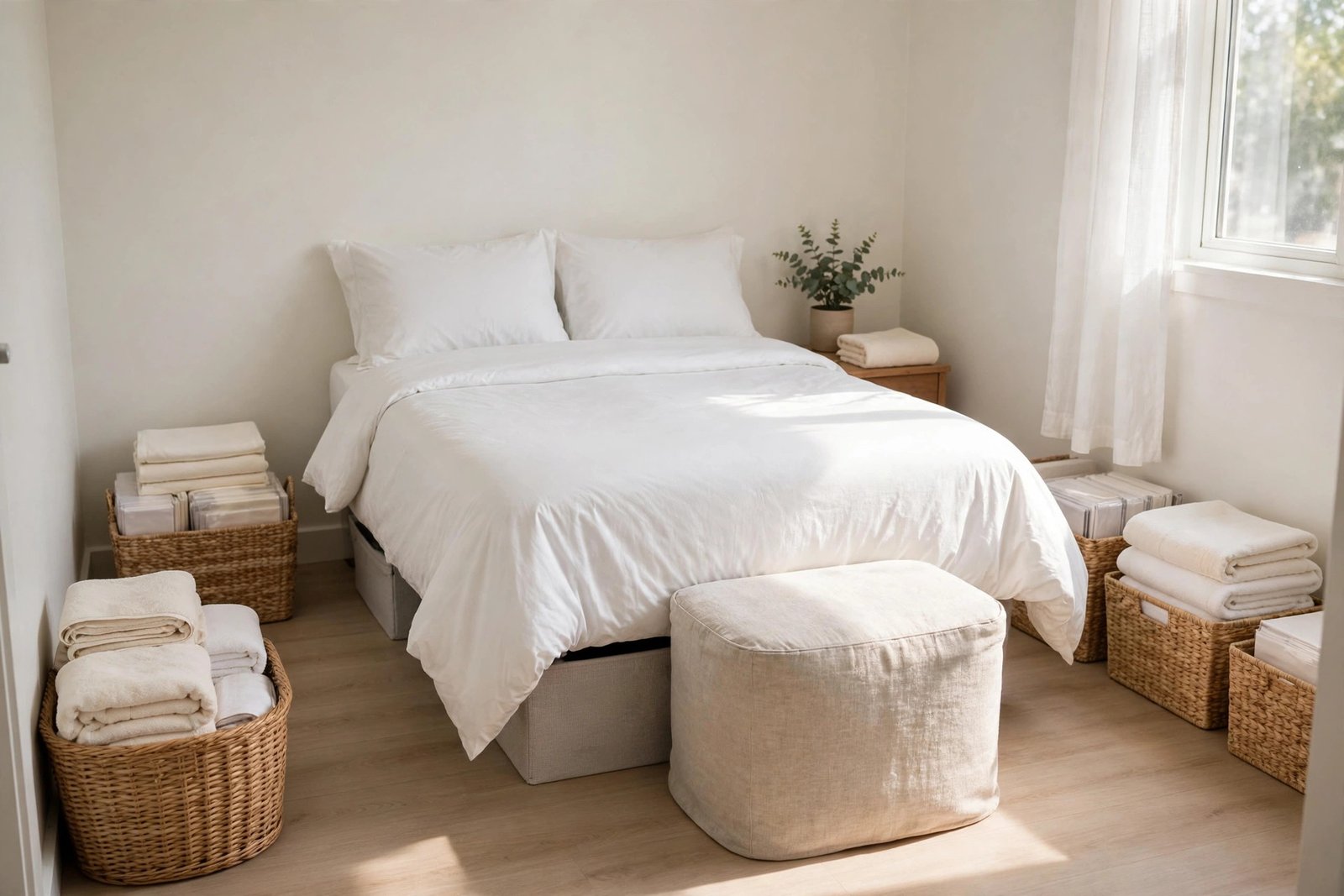
No linen closet shows up every wash day: clean sheets with nowhere to go, towels on a chair, a spare duvet on top of the wardrobe by default rather than by plan. These linen storage ideas no closet give every set a deliberate home instead, across the bed, the wardrobe, the bathroom and the gaps most renters overlook. Nothing needs drilling or landlord permission, and every idea names the measurement that decides whether it fits.
Zone by frequency: daily towels within reach of the bathroom, weekly sheet sets near the bed, bulky spares somewhere untouched for months. Our tiny closet organization ideas and no-closet bedroom storage ideas cover clothes in the same rooms; this post is linens only, so the systems stack rather than compete.
In this post
- The 30-second version
- Under and around the bed (ideas 1 to 3)
- Inside and on top of the wardrobe (ideas 4 to 6)
- Bathroom and door storage (ideas 7 to 9)
- Forgotten gaps and the finishing system (ideas 10 to 13)
- Common mistakes we’d skip
- The short version
- Questions renters ask
The 30-second version
- Do these 3 first, in order: under-bed flat bins for sheet sets (idea 1), an over-toilet shelf for daily towels (idea 8), and the pillowcase bundle system (idea 13). Combined cost: about $25 to $50.
- 13 ideas, zero drills. Daily towels in the bathroom, weekly sheets by the bed, bulky spares compressed or up high.
- Typical cost: about $60 to $140 for all zones. Most renters need 5 to 8 ideas. Checklist in our Free Renter Printables hub.
Under and around the bed
1. Keep sheet sets in flat bins under the bed

Under the bed is the closest thing most rentals have to a linen closet: wide, flat and right where sheets are changed. Use low, lidded bins, one per bed, with each set folded inside its pillowcase so a change never becomes a hunt. This extends our under-bed storage ideas, narrowed to linens only. Label the bin ends facing the side you approach from.
Cost: ~$10–20 per bin • Best for: weekly sheet sets for the bed directly above • Measure first: under-bed clearance height; many rental beds allow only 15 to 20 cm (6 to 8 in) • Watch out: skip wheeled bins on thick carpet; they snag and stop sliding.
2. Compress spare duvets and quilts in vacuum bags
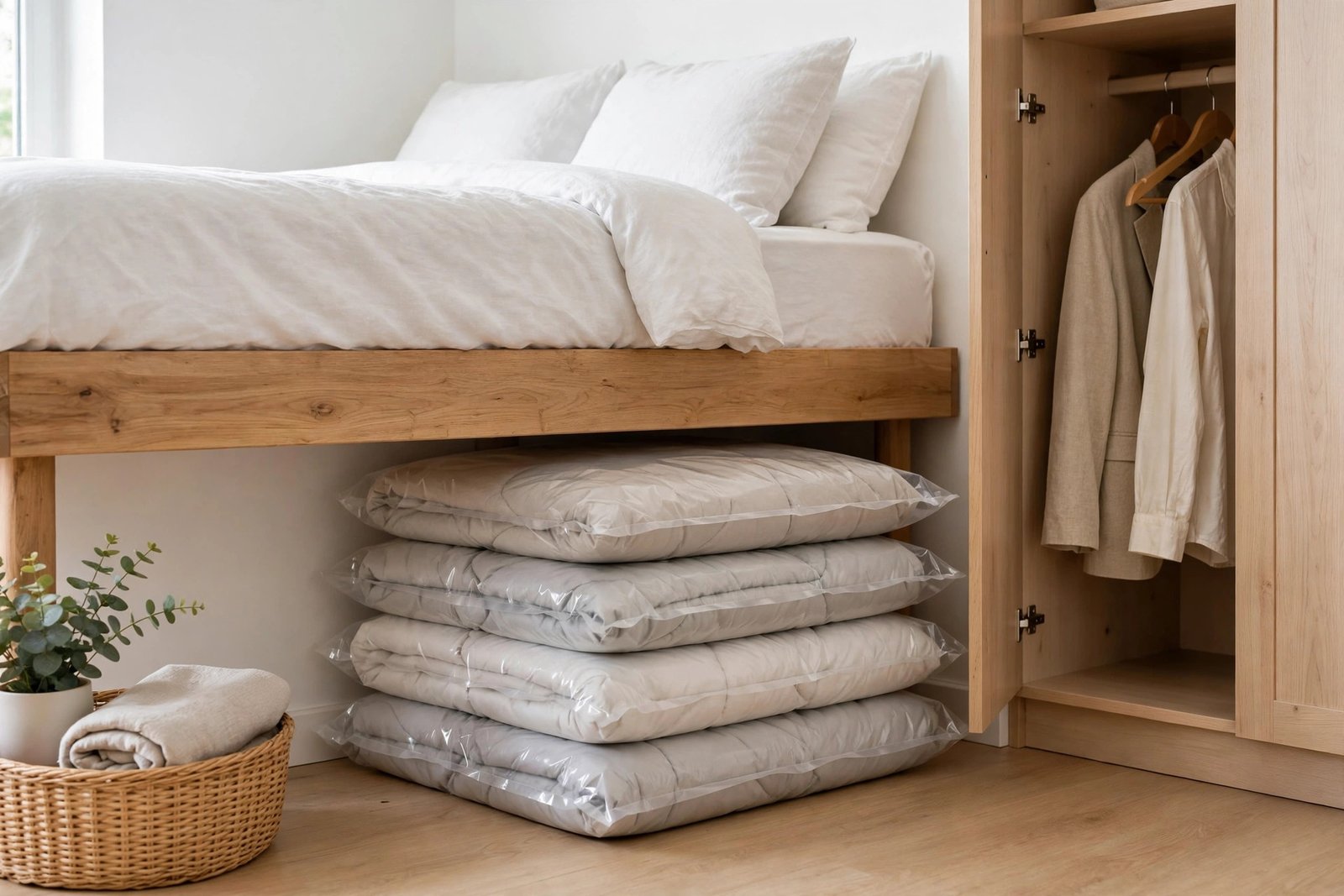
A spare duvet takes more room than three sheet sets and is used the least. A vacuum bag shrinks it to roughly a third of its loft, flat enough to slide under the bed or stand at the back of a wardrobe floor. Wash and fully dry it before sealing, or trapped damp becomes a musty smell. Keep one guest set compressed and labelled by size.
Cost: ~$10–18 for a multi-pack • Best for: guest duvets, winter quilts and spare blankets • Measure first: the sealed flat size, not the bag size on the packet; check it fits your under-bed clearance • Watch out: over-compressing feather and down for months can damage loft; ease off the vacuum for natural fills.
3. Use a storage ottoman at the foot of the bed
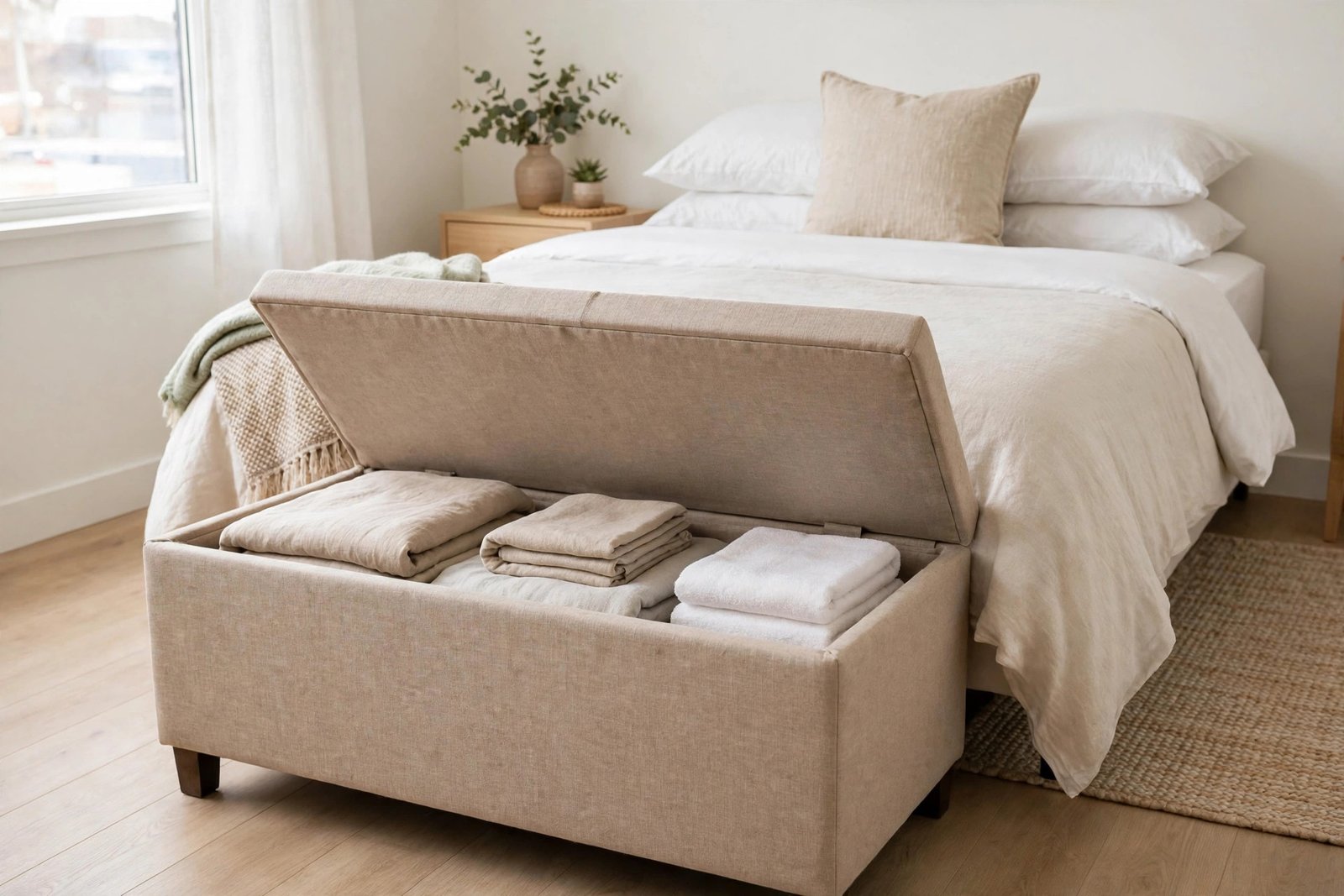
A lidded ottoman earns its floor space twice: a seat while dressing, and a dry, dust-free box for bedding not currently on the bed. Guest sheets, the spare blanket and extra pillowcases live here happily because the box opens weekly, not daily. Choose a wipe-clean fabric and a lid that opens fully without hitting the mattress.
Cost: ~$35–70 • Best for: guest bedding and the spare blanket in one-bed and studio rentals • Measure first: foot-of-bed width and walkway left over; keep at least 45 cm (18 in) to pass comfortably • Watch out: do not store damp or just-worn linens in a closed ottoman; only clean, fully dry sets go in.
Inside and on top of the wardrobe
4. Put the least-used linens in baskets on top of the wardrobe shelf
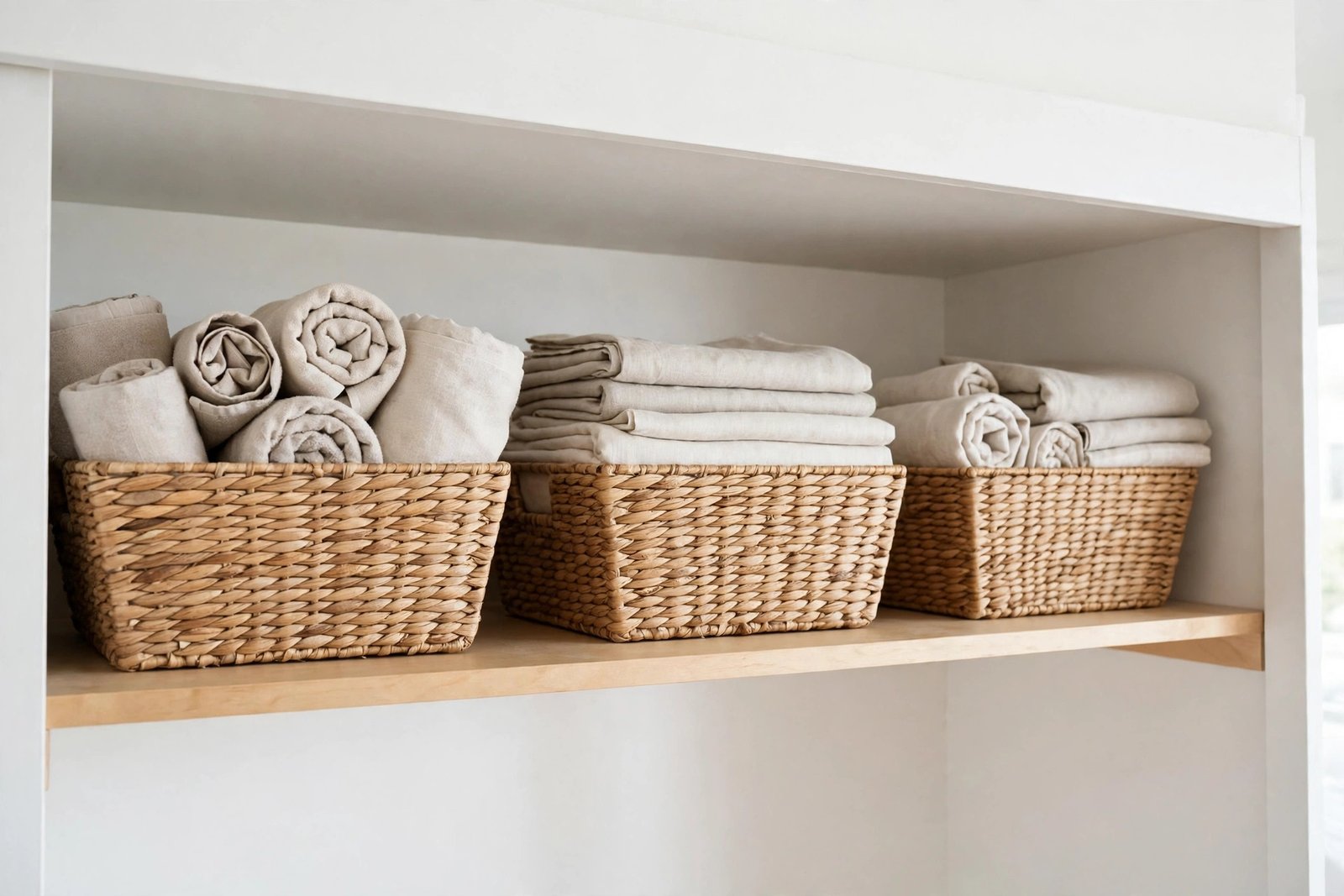
Most rental wardrobes have one high shelf collecting odds and ends. Claim it for linens with two or three matching baskets: spare towels, guest sheets, seasonal blankets. High storage suits monthly items, and baskets stop soft stacks toppling when the door opens. Keep a step stool nearby if the shelf sits above shoulder height.
Cost: ~$8–15 per basket • Best for: guest and seasonal linens you use monthly or less • Measure first: shelf depth and the height from shelf to ceiling; baskets commonly need 25 to 30 cm (10 to 12 in) • Watch out: this is the wrong home for everyday towels; daily items belong at waist height.
5. Hang a fabric shelf organiser for folded towels and sheets
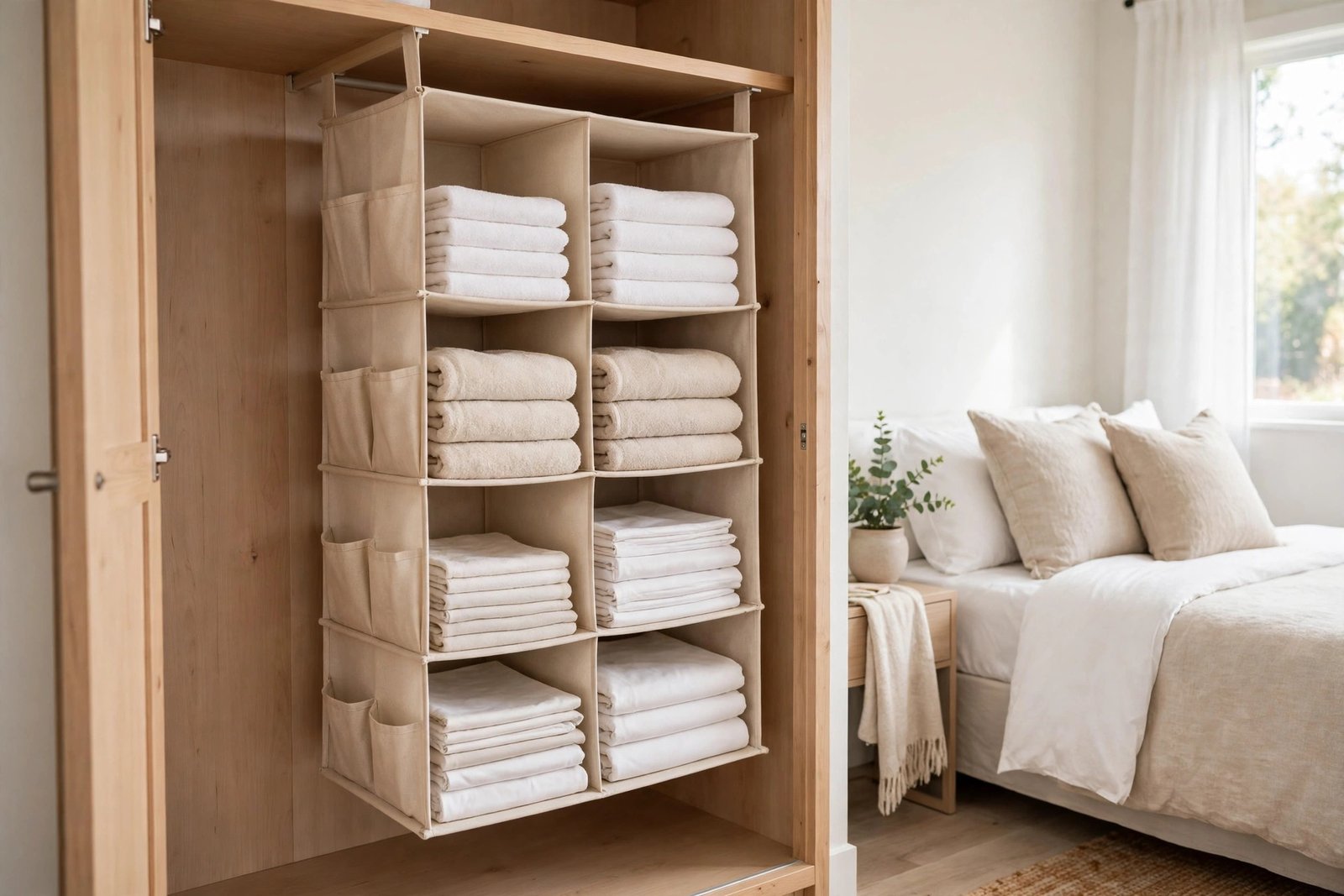
A hanging fabric organiser turns a 30 cm slice of spare rail into five or six linen cubbies. Fold to the cubby width, one category per shelf: bath towels, hand towels, sheet sets, pillowcases. It needs no fixings, moves with you, and keeps linens visible, which stops the double-buying that happens when spares hide in bags.
Cost: ~$12–22 • Best for: renters with spare hanging rail but no shelf space • Measure first: rail-to-floor drop; most organisers hang about 110 to 120 cm (43 to 47 in) • Watch out: fabric shelves sag under heavy bath sheets; keep the bulkiest items on a solid shelf instead.
6. Divide one shelf with risers and dividers instead of stacking higher

One deep shelf fails as a single tall stack: pull from the bottom and the pile leans. A riser doubles the surface, and upright dividers keep sets, towels and pillowcases in separate bays you can pull from cleanly. This is the cheapest fix in the post. Measure shelf thickness first, because clip-on dividers only grip standard board depths.
Cost: ~$10–20 for a riser and divider set • Best for: one over-stuffed wardrobe shelf that will not stay tidy • Measure first: shelf width, depth and board thickness, usually 1.5 to 2 cm (about 3/4 in) • Watch out: acrylic dividers can slide on glossy shelves; add a non-slip liner underneath.
Measuring before you buy? Print the checklist. Clearance, shelf depths and door swings on one page, in our Free Renter Printables hub.
Bathroom and door storage
7. Hang hand towels and washcloths in an over-door organiser

The back of a door is free storage needing no screws: a fabric over-door organiser holds rolled hand towels, washcloths and spare pillowcases flat against it. It suits the small, light end of the linen cupboard, not heavy bath towels. Check the door still closes fully, and add felt pads where hooks touch to protect the paintwork.
Cost: ~$12–20 • Best for: washcloths, hand towels and flannels in a small bathroom • Measure first: door thickness and the gap above the door; most hooks fit doors 3.5 to 4.5 cm (1.4 to 1.8 in) thick • Watch out: overloaded pockets bow the organiser and rub the door; keep each pocket to two or three light items.
8. Stand a freestanding shelf over the toilet for daily towels

The space above the cistern is dead space in most rental bathrooms, and a freestanding over-toilet unit claims it without a fixing. Roll bath towels rather than folding them: rolls sit securely, air better in steam, and show when laundry is due. Bottom shelf for daily towels, top for spares, alongside our small bathroom storage ideas.
Cost: ~$25–45 • Best for: the daily towel supply in a bathroom with no airing cupboard • Measure first: cistern height and width, plus ceiling clearance; most units stand 150 to 165 cm (59 to 65 in) tall • Watch out: check the unit clears the flush and pipework, and that you can still lift the cistern lid for the landlord’s plumber.
9. Tuck a slim rolling cart beside the vanity or washer
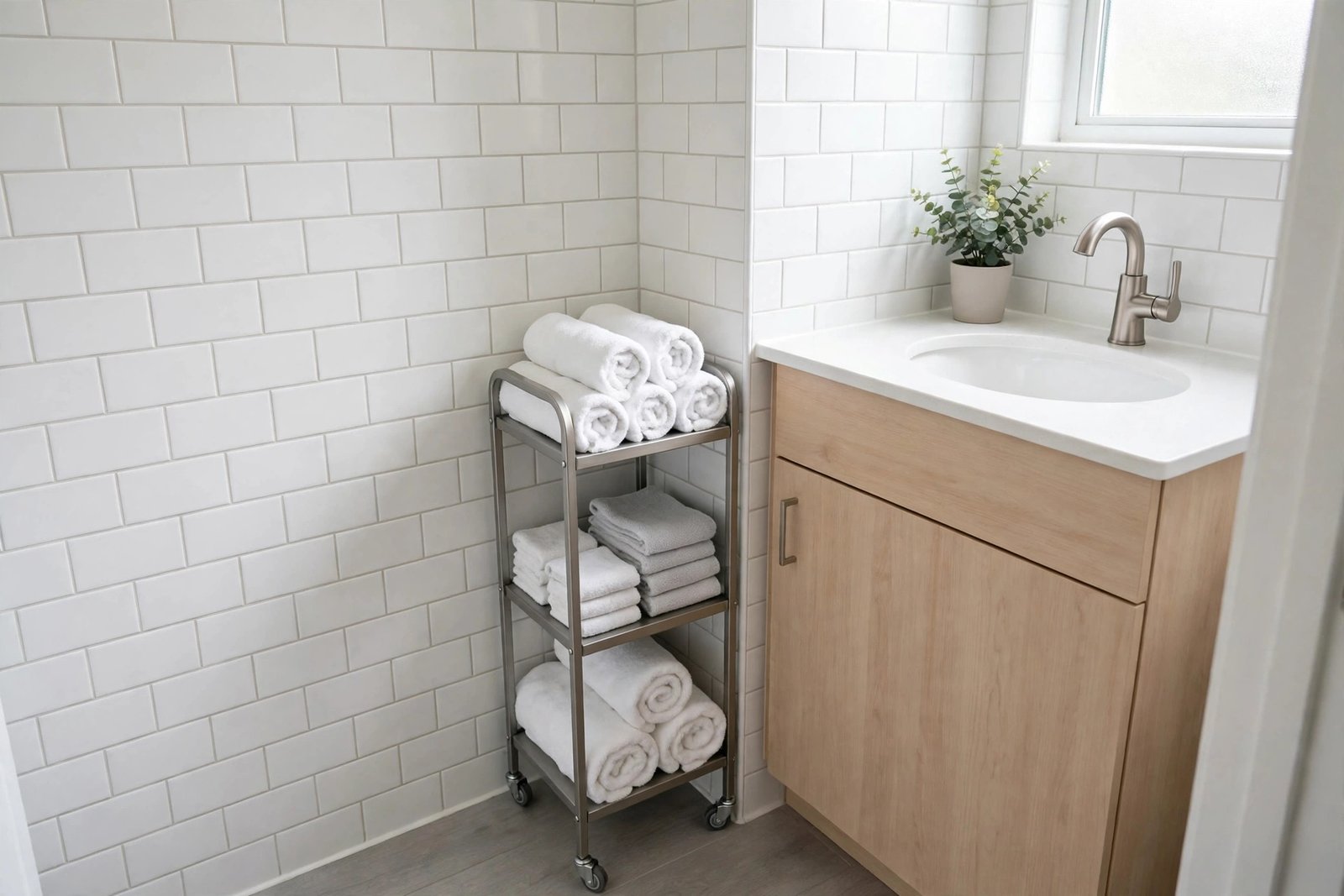
A narrow three-tier cart fills the 15 to 20 cm gap beside a vanity, washer or bath, and rolls out when needed. Top tier for hand towels, middle for washcloths, bottom for spares. Because it is small and visible, it cannot become a dumping ground. Wipe the tiers weekly; bathroom fibres gather fast.
Cost: ~$15–28 • Best for: daily hand towels and washcloths in the gap nothing else fits • Measure first: the gap width at its narrowest point, including skirting boards • Watch out: carts tip if top-loaded; heaviest tier goes at the bottom.
Forgotten gaps and the finishing system
10. Store spare sets inside your empty suitcases
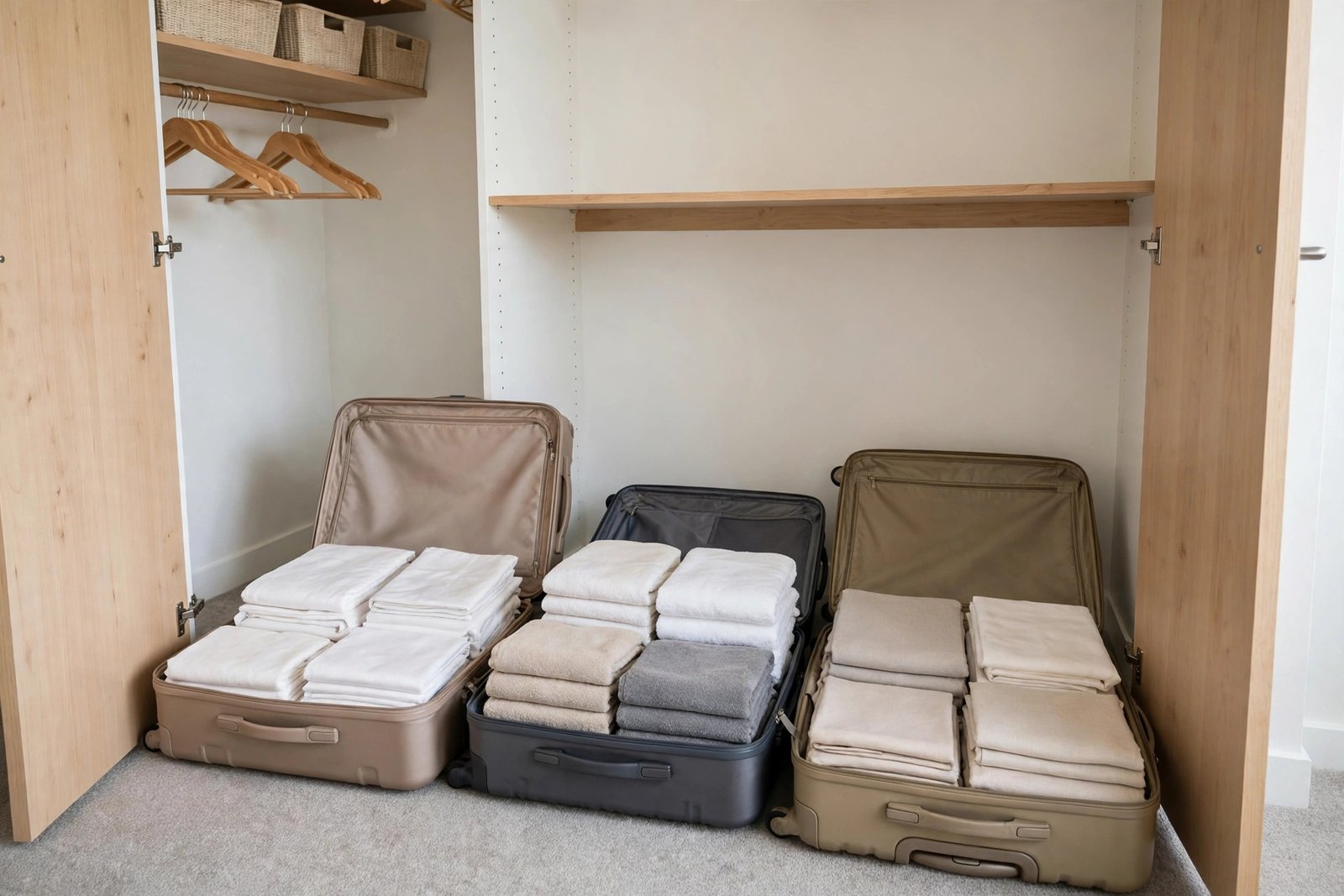
Suitcases sit empty most of the year, taking up the exact floor space linens need. Fill them instead: a large case holds two or three spare sets, dust-free and easy to pull out whole for guests. Note the contents on a card inside the lid. It is free storage you already own.
Cost: ~$0 • Best for: spare and guest sets in rentals where suitcases already live indoors • Measure first: the case interior; a 70 cm (28 in) case swallows a folded double set with room to spare • Watch out: never seal slightly damp linens in a closed case; dry fully and air the case open for a day first.
11. Line up lidded baskets on a high shelf or armoire top
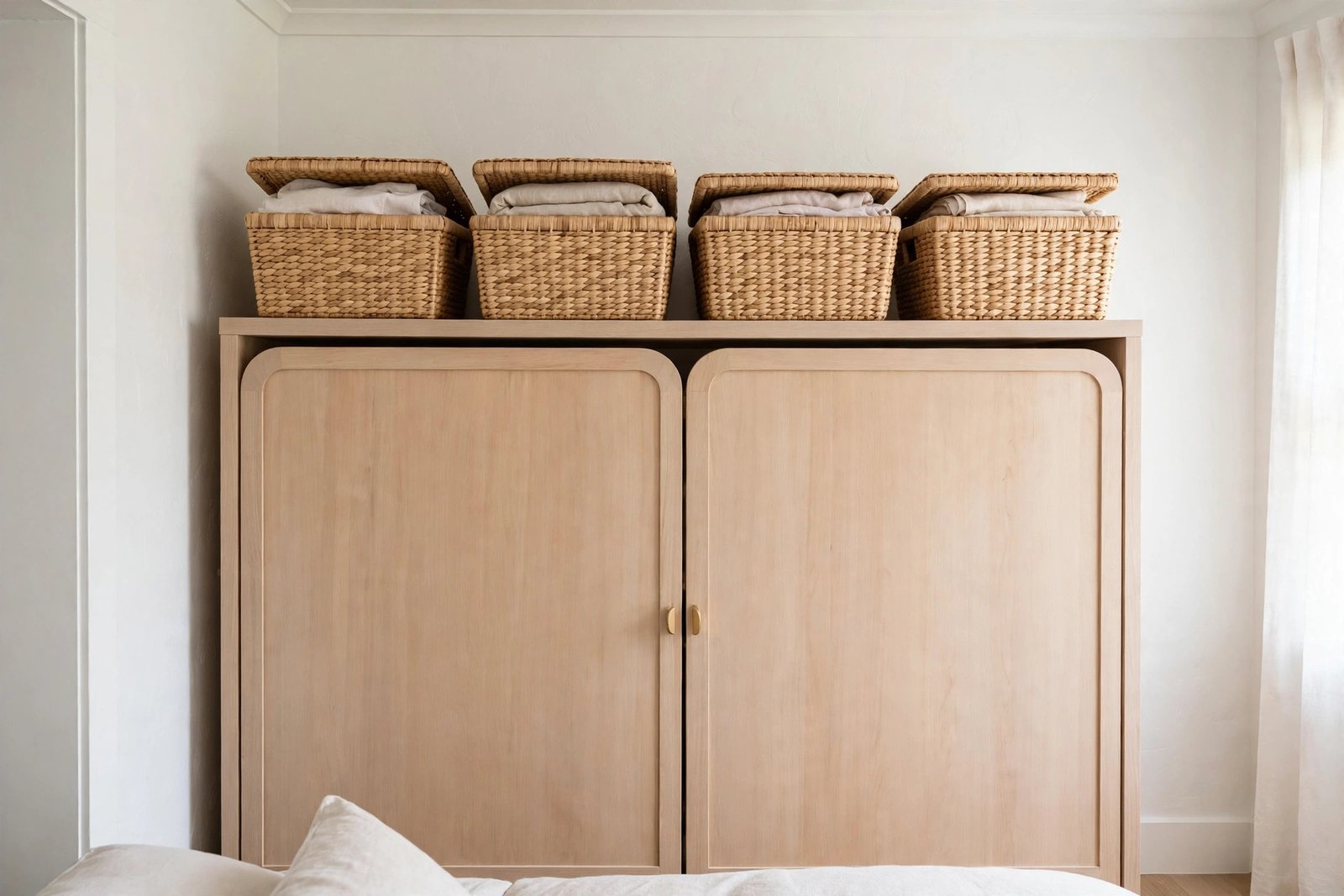
Where no wardrobe top shelf exists, a bedroom shelf or armoire top can hold a row of lidded baskets. Lids matter up high: they keep dust off and look intentional. Reserve this home for the lightest category, such as spare pillowcases and guest towels, so you never haul heavy baskets overhead. It pairs with our small bedroom decor ideas.
Cost: ~$10–18 per lidded basket • Best for: light, rarely used linens in a bedroom with high furniture • Measure first: the depth of the surface and headroom above it; keep baskets under about 35 cm (14 in) tall • Watch out: no heavy stacks overhead; if you need two hands and a stretch, the contents are too heavy.
12. Clip wire baskets under a shelf to double it
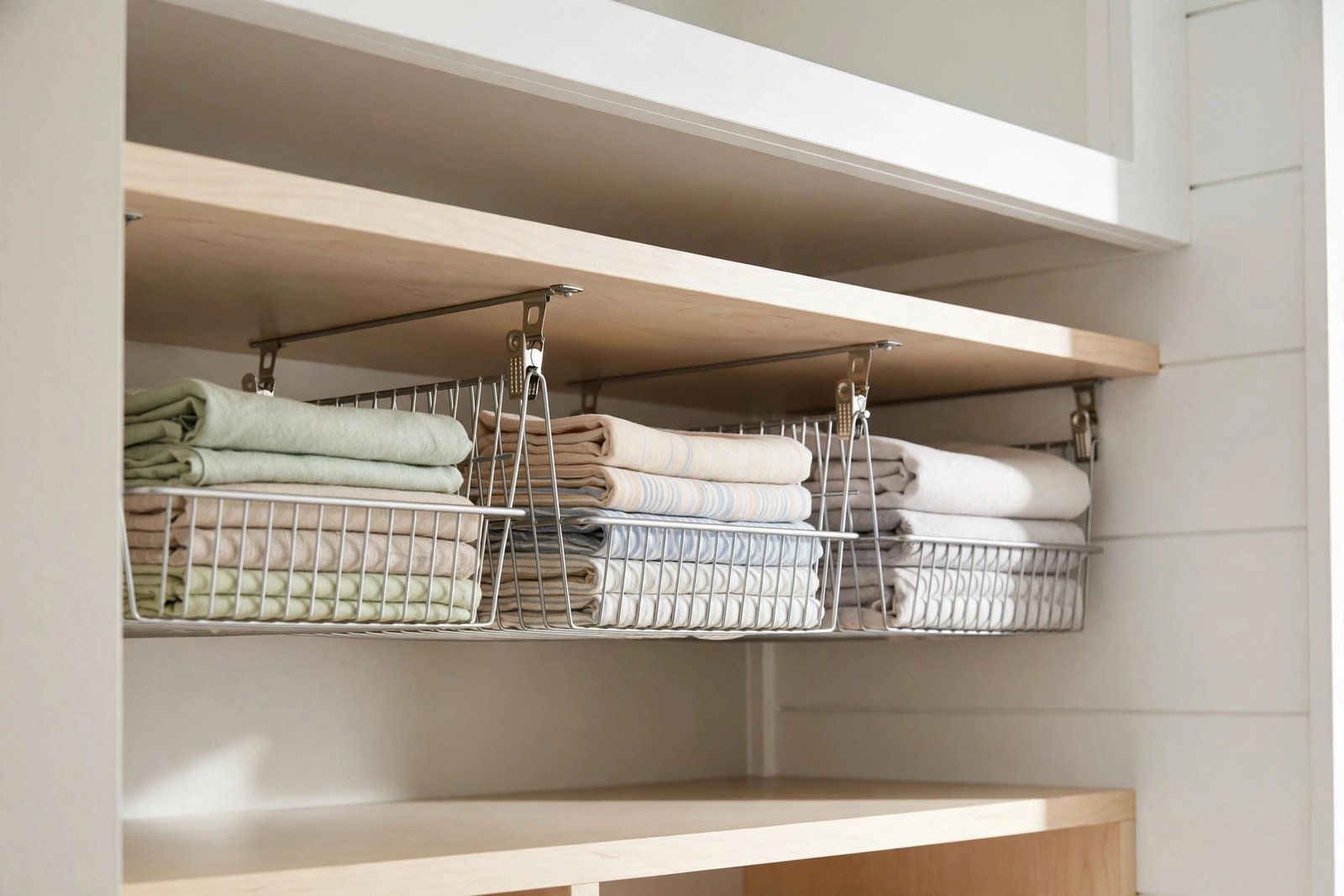
Under-shelf wire baskets hook over a shelf and hang below it, turning one shelf into two without tools. They suit flat, light linens: tea towels, pillowcases, hand towels. The gain is modest, roughly one extra folded layer per basket, so use two side by side. Slide them fully on and test with a gentle pull before loading.
Cost: ~$8–14 each • Best for: flat linens on a tall shelf with wasted air beneath it • Measure first: shelf thickness and the clear height below it; most baskets hang 12 to 15 cm (5 to 6 in) deep • Watch out: they flex under weight; keep to about 2 kg (4.5 lb) of linens per basket.
13. Bundle every sheet set inside its own pillowcase

This final idea is a system, not a product, and it makes every other idea work better. Fold the fitted sheet, flat sheet and second pillowcase inside the remaining pillowcase. Each bundle is one complete bed change, grabbable with one hand, and nothing separates in the wash-day shuffle. Stack bundles upright like files, not piles.
Cost: ~$0 • Best for: every renter, in whichever storage this post has given you • Measure first: nothing to measure; fold to the pillowcase width, about 50 cm (20 in) for a standard case • Watch out: duvet covers bundle separately; forcing one in stretches the case and creases the set.
Common mistakes we’d skip
- Storing all linens in one place. Daily towels bury the guest sheets. Zone by frequency: daily in the bathroom, weekly by the bed, rare spares high or compressed.
- Buying storage before measuring. Clearance, door thickness and shelf depth decide what fits. Guessing is how bins end up beside the bed instead of under it.
- Storing linens slightly damp. Closed bins and bags trap moisture. Dry fully, then store.
- Keeping far too many sets. Two sets per bed and per person is enough. Extras are the storage problem, not the solution.
The short version
Once linens are zoned, the missing cupboard stops mattering: sheet sets in flat under-bed bins, bundled in their pillowcases, daily towels on an over-toilet shelf and slim cart, small items behind a door, bulky spares compressed, cased or basketed up high. Measure first, store everything bone dry.
Questions renters ask
How many sheet and towel sets do I actually need without a linen closet?
Two per bed and two towel sets per person: one in use, one clean and ready. A third set is worth it only for regular guests. Extras are the first thing to donate when space is tight.
How do I stop stored linens smelling musty in bins and cases?
Store them fully dry, leave lids ajar for a day if the room is humid, and add a sachet per container. Air spares on the bed for an hour every couple of months. Mustiness is trapped moisture, not the container.
Where should guest bedding live in a one-bedroom rental?
In a vacuum bag or suitcase if guests are rare, or in the foot-of-bed ottoman if they stay often. Keep one complete guest bundle, so hosting is a single grab, not a search.
Can I use the airing cupboard or boiler cupboard if my rental has one?
Only with clear space around the boiler or tank, and only if your tenancy allows it. Never stack linens against a boiler or vents, or block access panels. If in doubt, ask the landlord in writing; the ideas above need no permission.
Pin this post for later
Save it to Pinterest for later, or tell us your smallest-space problem in the comments — the best posts here started as a reader’s awkward space.
📌 Pin this post for later 🖨 Print this post