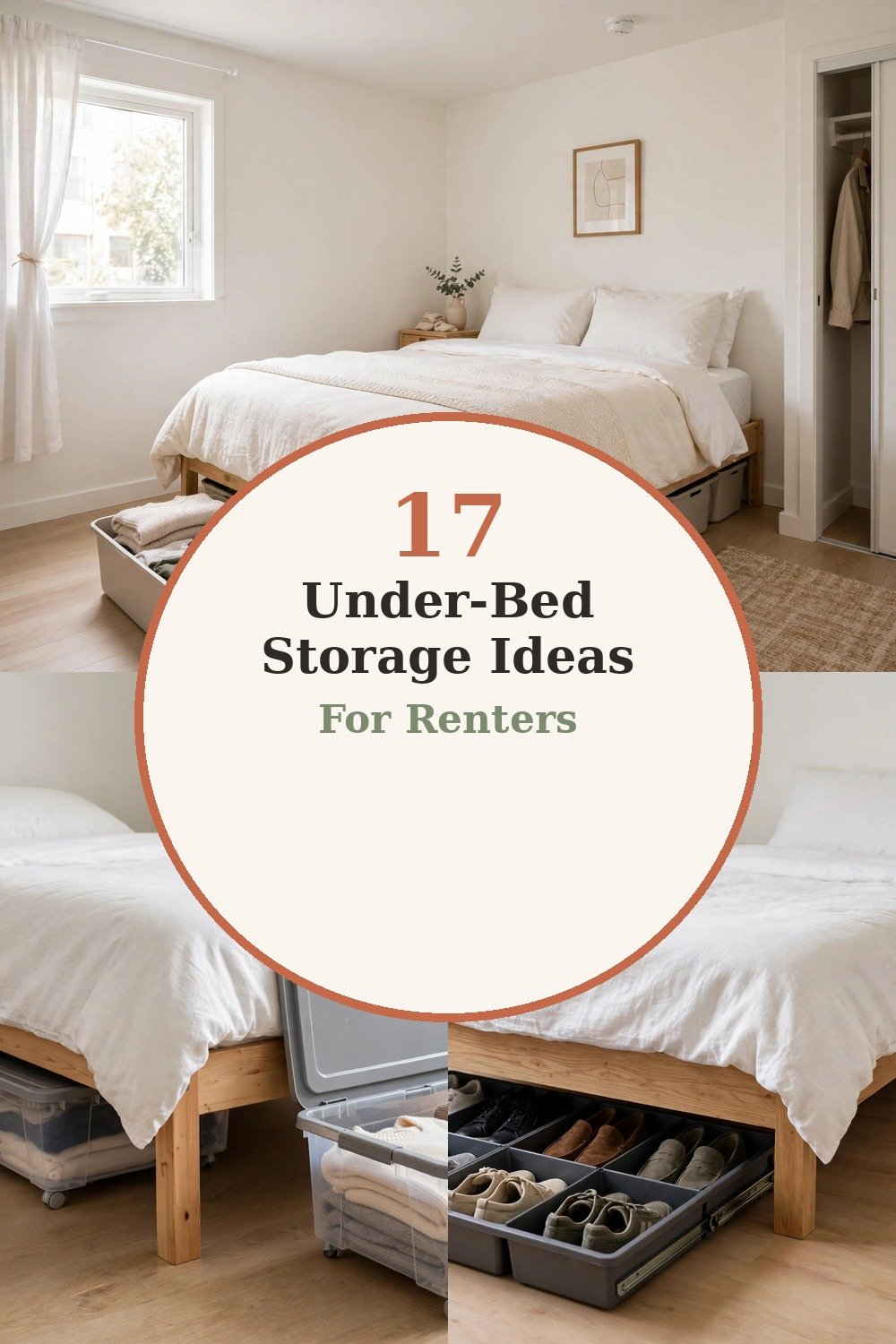


A double bed hides roughly two square metres of floor that, in most small bedrooms, holds nothing but dust. These under bed storage ideas turn it into a working system: weekly things at the edge on wheels, soft bulk compressed in the middle, flat things in trays, nothing stored loose. Measure your clearance first; under-bed storage fails on height more than anything else. This is the companion to our no-closet bedroom storage ideas and our tiny closet organization ideas.
In this post
- The 30-second version
- Everyday access, at the edge (ideas 1 to 4)
- Soft bulk, compressed and contained (ideas 5 to 9)
- Flat and long things, in trays (ideas 10 to 13)
- Fit, security and keeping it clean (ideas 14 to 17)
- Common mistakes we’d skip
- The short version
- Questions renters ask
The 30-second version
- Do these 3 first, in order: low rolling bins at the edge (idea 1), vacuum bags for the spare duvet and off-season clothes (idea 5), and a divided shoe tray (idea 10). Combined cost: about $45 to $80.
- 17 ideas, zero drills, zero fixings. Everything slides, rolls, zips or lifts; nothing touches the landlord’s floor or frame.
- Typical cost: most renters need 5 to 8 of these, about $60 to $120 total. The measuring checklist lives in our Free Renter Printables hub.
Everyday access, at the edge
1. Low lidded rolling bins

Start here. A shallow bin on small casters slides one-handed, the lid keeps dust off, and two or three side by side hold the jumpers and gym kit that overflow a small wardrobe. Hard plastic survives daily dragging.
Cost: ~$12–20 each • Best for: weekly everyday overflow • Measure first: clearance 15 to 25 cm (6 to 10 in); bin 2 cm lower, casters included • Watch out: cheap casters crack; test one loaded first.
2. Soft fabric under-bed drawers

Fabric boxes flex where rigid bins jam, which suits uneven clearance or a low middle rail. With a handle and a zip top, they hold folded T-shirts and knitwear, and fold flat when empty, as in our no-closet bedroom storage ideas.
Cost: ~$10–18 each • Best for: low or uneven clearance • Measure first: the lowest point, usually the middle rail • Watch out: no stacking; heavy contents sag and stick.
3. One weekly grab bin at the edge
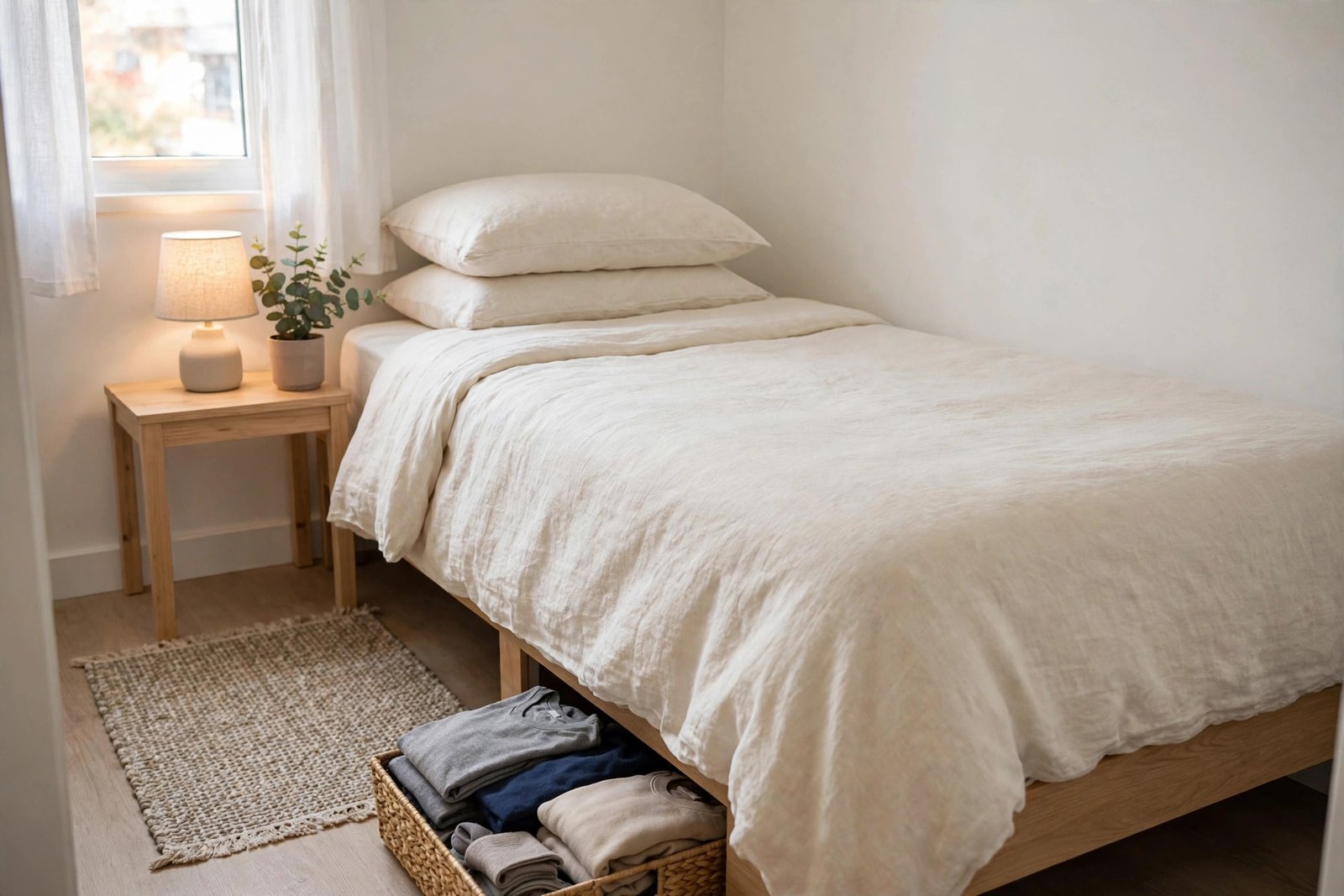
Keep one small open bin where you stand to get dressed, run as this week’s bin: clothes in rotation, tomorrow’s gym kit, the scarf you keep reaching for. Overflow is the signal to put things away, not buy another bin. It is the bedroom version of the launch pad in our nightly closing shift.
Cost: ~$8–14 • Best for: stopping the clothes chair • Measure first: one bin only, 40 by 30 cm (16 by 12 in) • Watch out: open bins gather dust; sort this one weekly.
4. A slim rolling bedside drawer
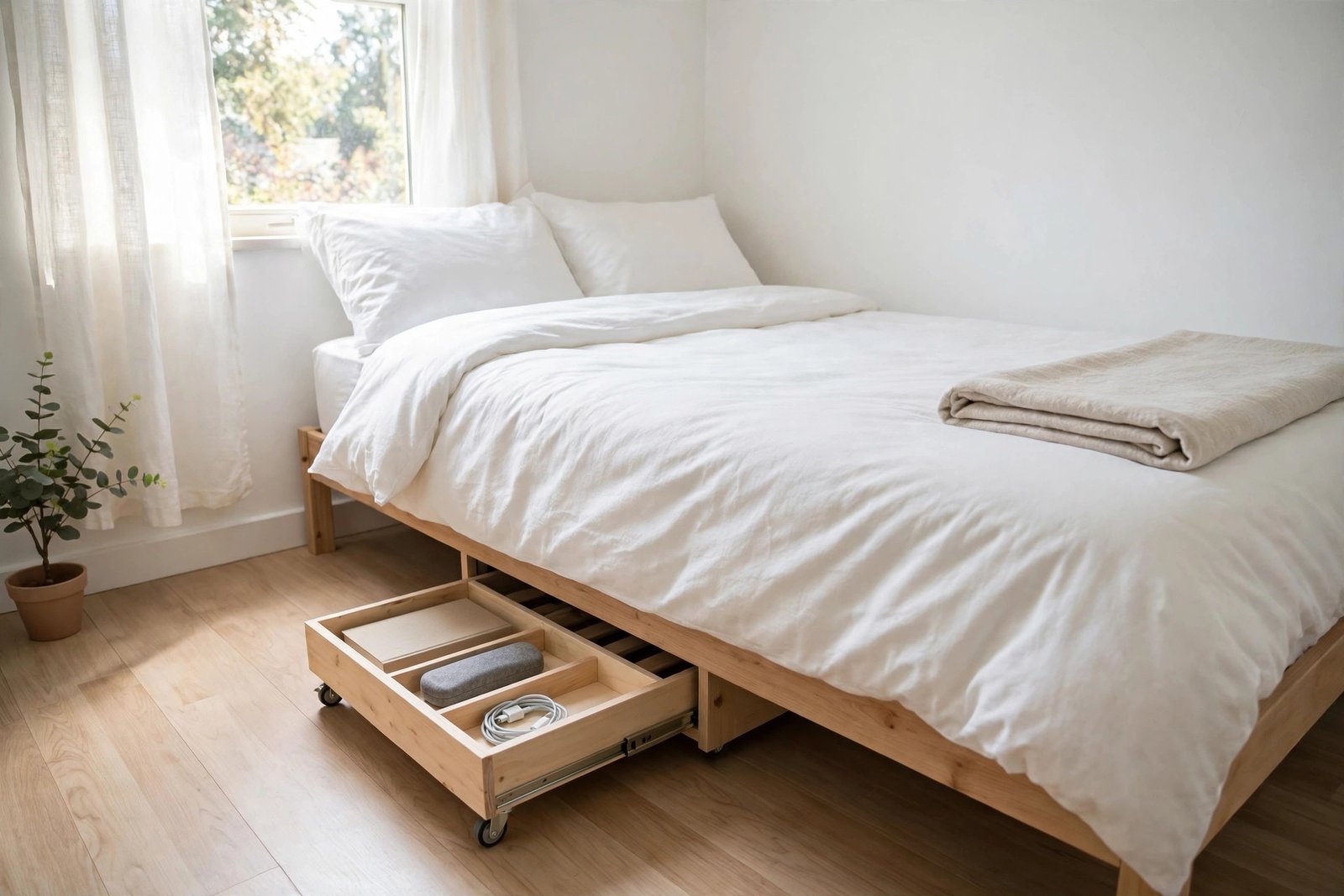
A narrow drawer on casters under the bedside edge holds what a tiny bedroom has no nightstand drawer for: a book, glasses case, charger, hand cream. It disappears in the morning and pulls out at night.
Cost: ~$18–30 • Best for: bedrooms with no nightstand drawer • Measure first: bedside clearance and nearby door swing • Watch out: cables only; nothing that warms up enclosed.
Soft bulk, compressed and contained
5. Vacuum bags inside a flat tote
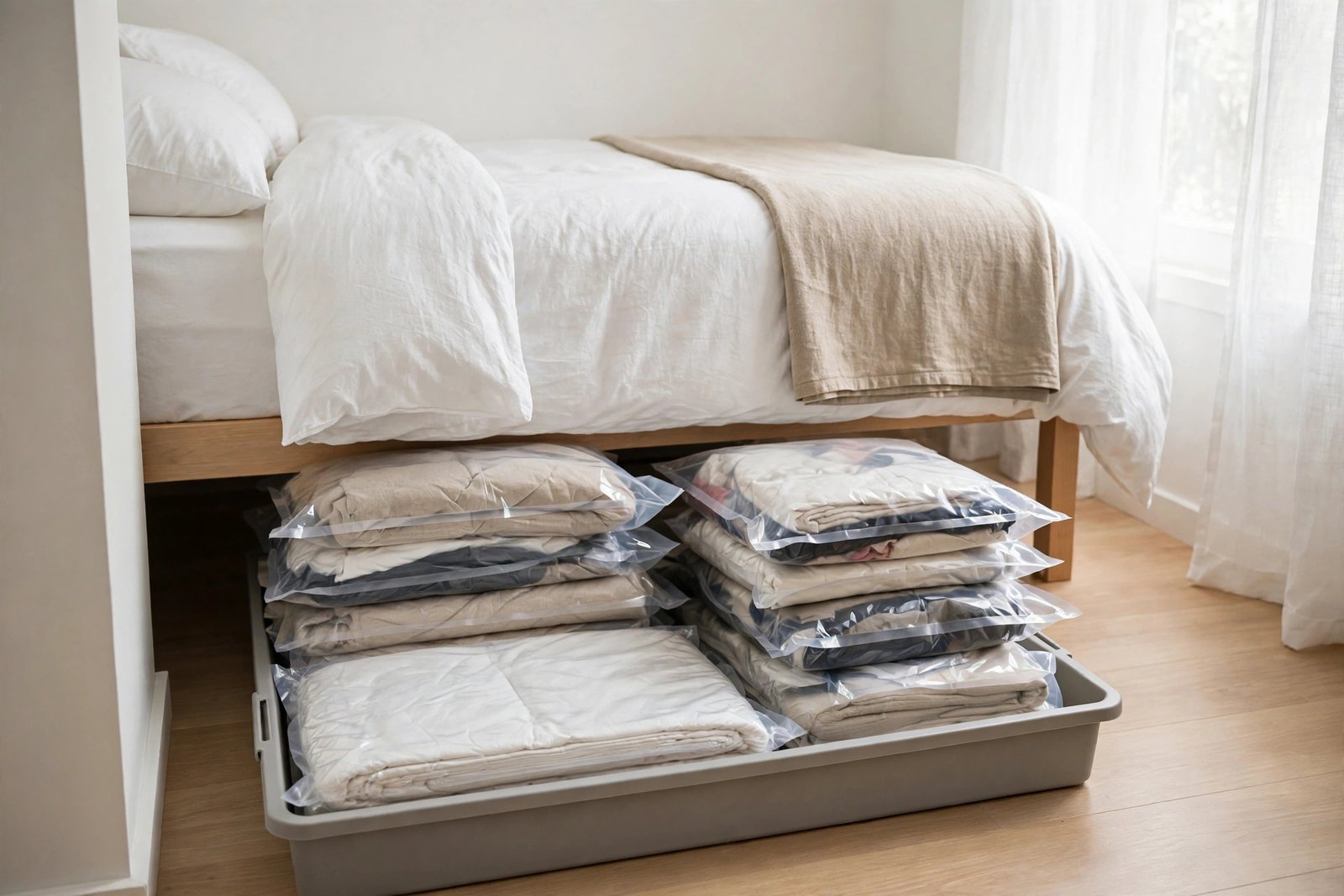
Vacuum bags do the biggest job under a bed: a winter duvet compresses to a third of its size. The discipline is the tote. Bags alone slide, snag and re-inflate; inside one flat lidded tote they stay a tidy, liftable block.
Cost: ~$15–25, bags plus tote • Best for: spare duvets and off-season knitwear • Measure first: tote height compressed, about 15 cm (6 in) • Watch out: no leather or good feathers under long compression.
6. Clear zip cases for spare bedding sets

Store each spare bedding set complete (duvet cover, sheet, pillowcases) in one clear zip case, and a bed change becomes a single grab instead of a linen hunt. Clear beats fabric: you can see which set is which without opening anything.
Cost: ~$8–14 each • Best for: spare bedding, no linen closet • Measure first: one double set per case, 40 by 30 by 12 cm • Watch out: dry bedding fully before zipping it away.
7. A breathable bag for guest bedding

Guest bedding is bulky, rarely used, and exactly what the deep middle of the bed is for. Keep it in one breathable fabric bag, not a vacuum bag: you want it lofted and fresh, not compressed flat.
Cost: ~$12–20 • Best for: a spare duvet and pillow • Measure first: uncompressed, roughly 60 by 45 by 20 cm • Watch out: under 20 cm clearance, vacuum it instead.
8. Two seasonal swap boxes

Run the changeover as a swap, not a sort. Two matching low boxes live under the bed all year: one holds the season you are not wearing, the other stands ready. Twice a year they trade contents with the wardrobe, as in our tiny closet organization ideas, shrunk to fit under a bed.
Cost: ~$20–30 for two • Best for: wardrobes too small for two seasons • Measure first: both boxes, usually 60 by 40 cm each • Watch out: wash everything before it goes into the off-season box.
9. A suitcase doing double duty

Most renters already own a large, flat, wheeled container: a suitcase. Parked under the bed, packed with the travel things themselves (packing cubes, wash bag, holiday clothes), it stops being dead weight and comes out half packed.
Cost: ~$0, a case you own • Best for: renters with nowhere to keep a suitcase • Measure first: case depth; cabin cases run 20 to 23 cm deep • Watch out: store slightly ajar in damp-prone rooms.
Measuring under your bed? Take the checklist. Clearance, rail height and bin sizes on one printable page, in our Free Renter Printables hub.
Flat and long things, in trays
10. A divided shoe organiser
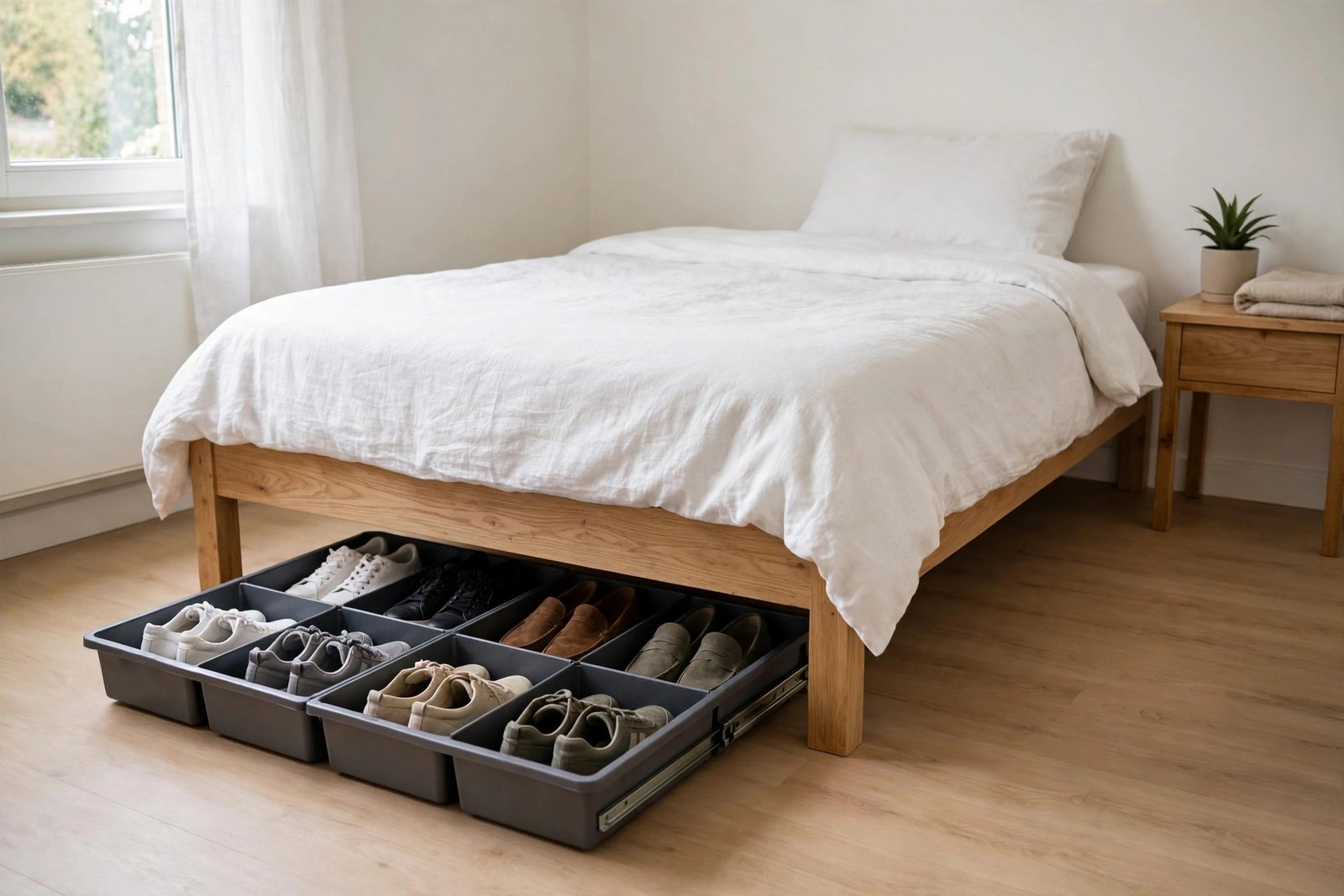
Out-of-season shoes belong flat in a divided tray, not in a heap by the door. Compartments keep pairs together, and the tray slides out like a drawer. Everyday shoes stay at the entryway, as in our small entryway storage ideas; this tray holds the second string: boots in summer, sandals in winter.
Cost: ~$12–18 • Best for: second-string shoes at the entryway • Measure first: tray height 12 to 15 cm (5 to 6 in) • Watch out: tall boots rarely fit flat; store them upright.
11. A long flat gift-wrap station
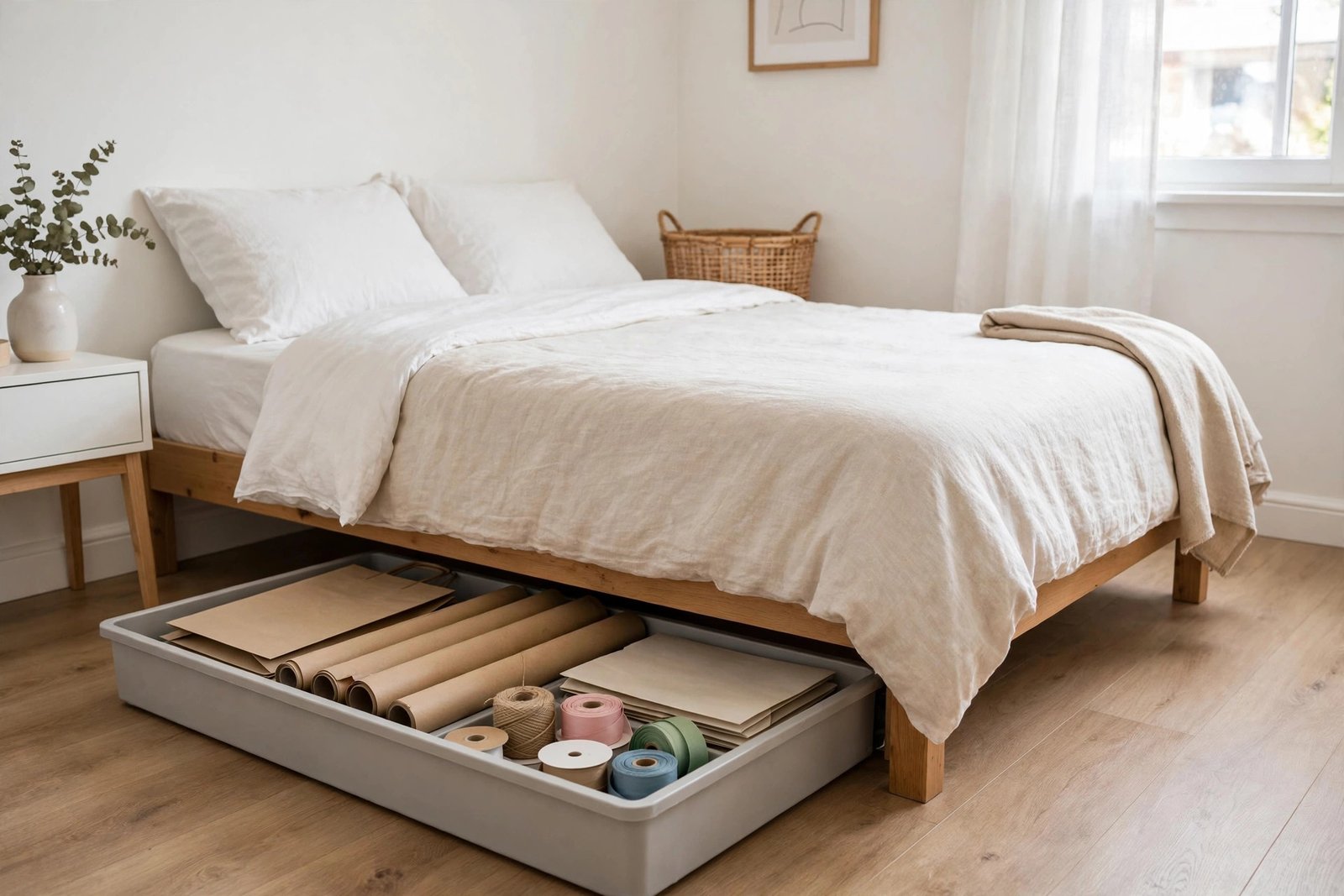
Wrapping rolls are the classic homeless object: too long for drawers, too light for cupboards. A long, low box fits rolls flat, with ribbon, tape, tags and gift bags in the end section, using space nothing else wanted.
Cost: ~$10–16 • Best for: rolls and ribbon with no cupboard • Measure first: box length against rolls, 70 to 100 cm • Watch out: loose rolls unroll and crease; keep them boxed.
12. A low book tray
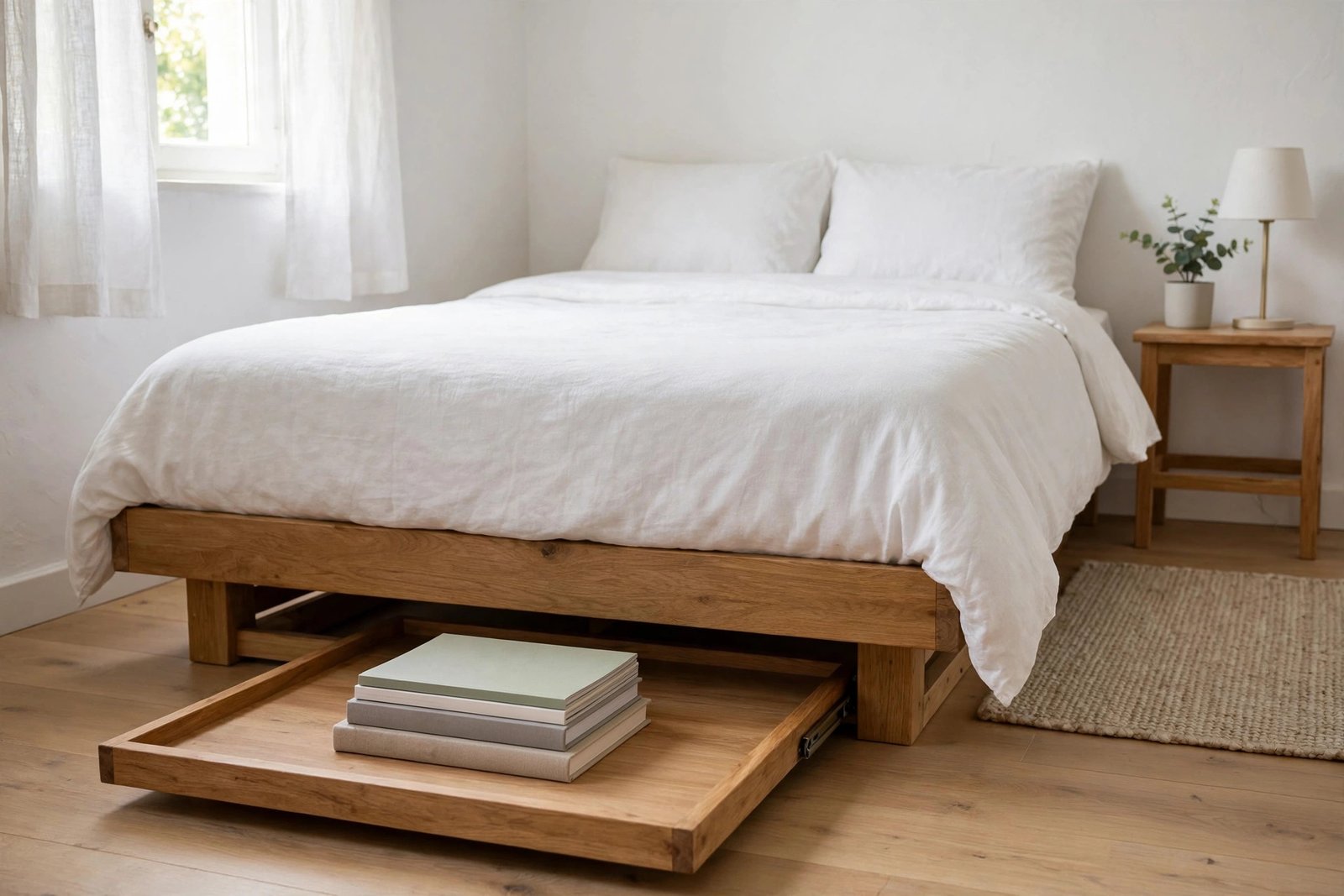
Books are heavy, flat and patient, which makes a shallow tray of them a good deep-space citizen. Keep the to-read pile in one low tray in the middle zone, in one layer or two at most. It will not slide easily, and does not need to.
Cost: ~$10–15 for a tray • Best for: book overflow, no shelf space • Measure first: tray plus two book layers, about 12 cm • Watch out: never store books directly on the floor.
13. A long tray for a yoga and exercise kit
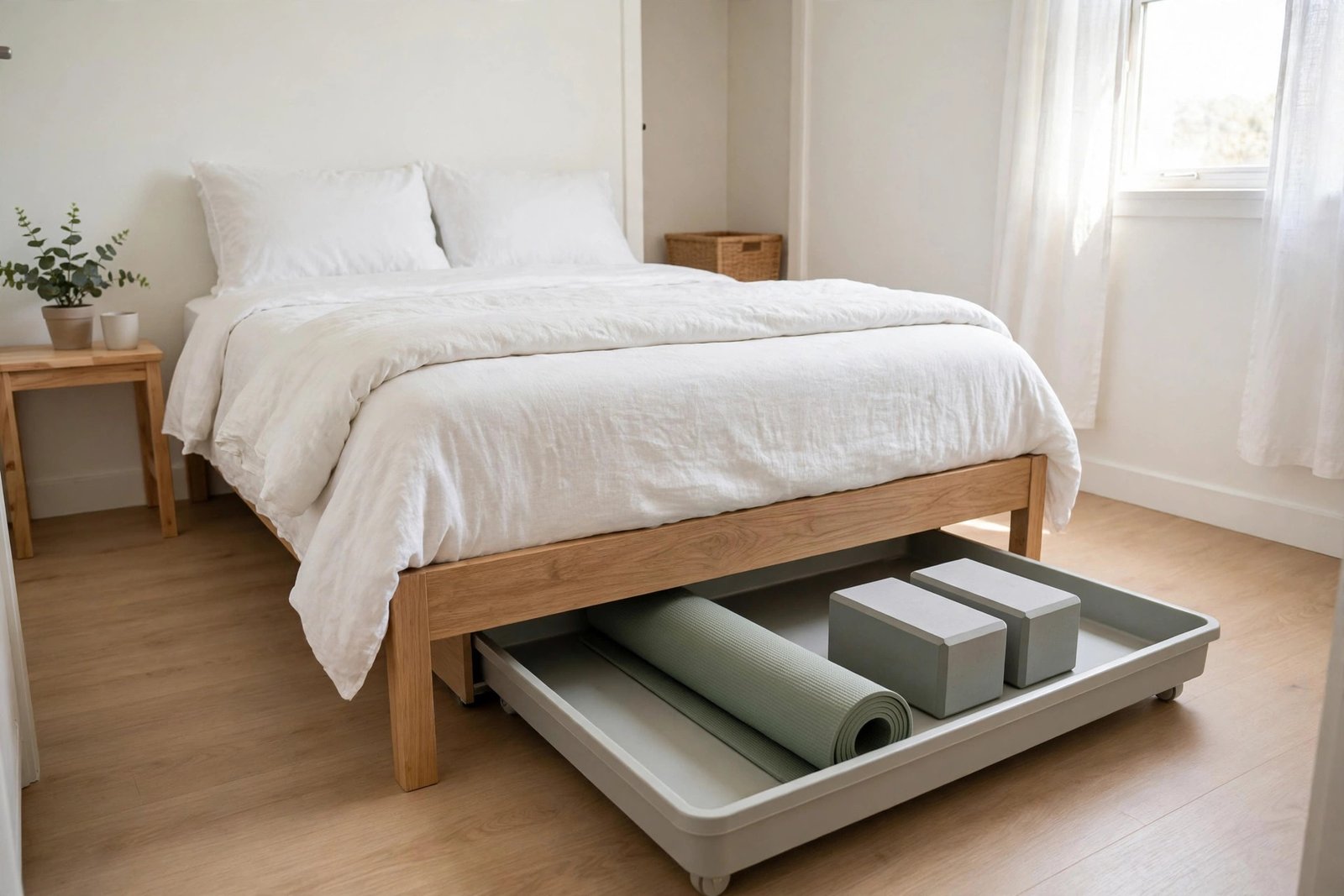
A rolled mat, two blocks and a band are long, light and awkward, and fit under a bed better than anywhere else in a small rental. One long tray keeps the kit together and pulls out in a single motion.
Cost: ~$10–18 • Best for: a mat and blocks, no hall cupboard • Measure first: mat length, 173 to 183 cm, against the bed’s length • Watch out: a damp mat smells within days; dry first.
Fit, security and keeping it clean
14. Bed risers, to buy extra height

If clearance is too low for the bins you need, risers lift the frame by 8 to 15 cm (3 to 6 in) and change what fits. They are freestanding and reversible, but the bed sits higher and cheap risers can creep. Re-check them after week one.
Cost: ~$15–25 for four • Best for: frames under 15 cm (6 in) clearance • Measure first: lift adds 8 to 15 cm; recheck door swing • Watch out: never stack beyond the maker’s rating.
15. A flat lockable document box

Passports, certificates, the tenancy folder: a flat, lockable metal box keeps important papers together, private and findable in an emergency. It is not a safe and does not pretend to be; it is a discreet home for documents in a rental with no desk drawer.
Cost: ~$20–35 • Best for: documents, no desk drawer • Measure first: box height 8 to 12 cm (3 to 5 in) • Watch out: add silica sachets in damp-prone rooms.
16. Label the ends that face out
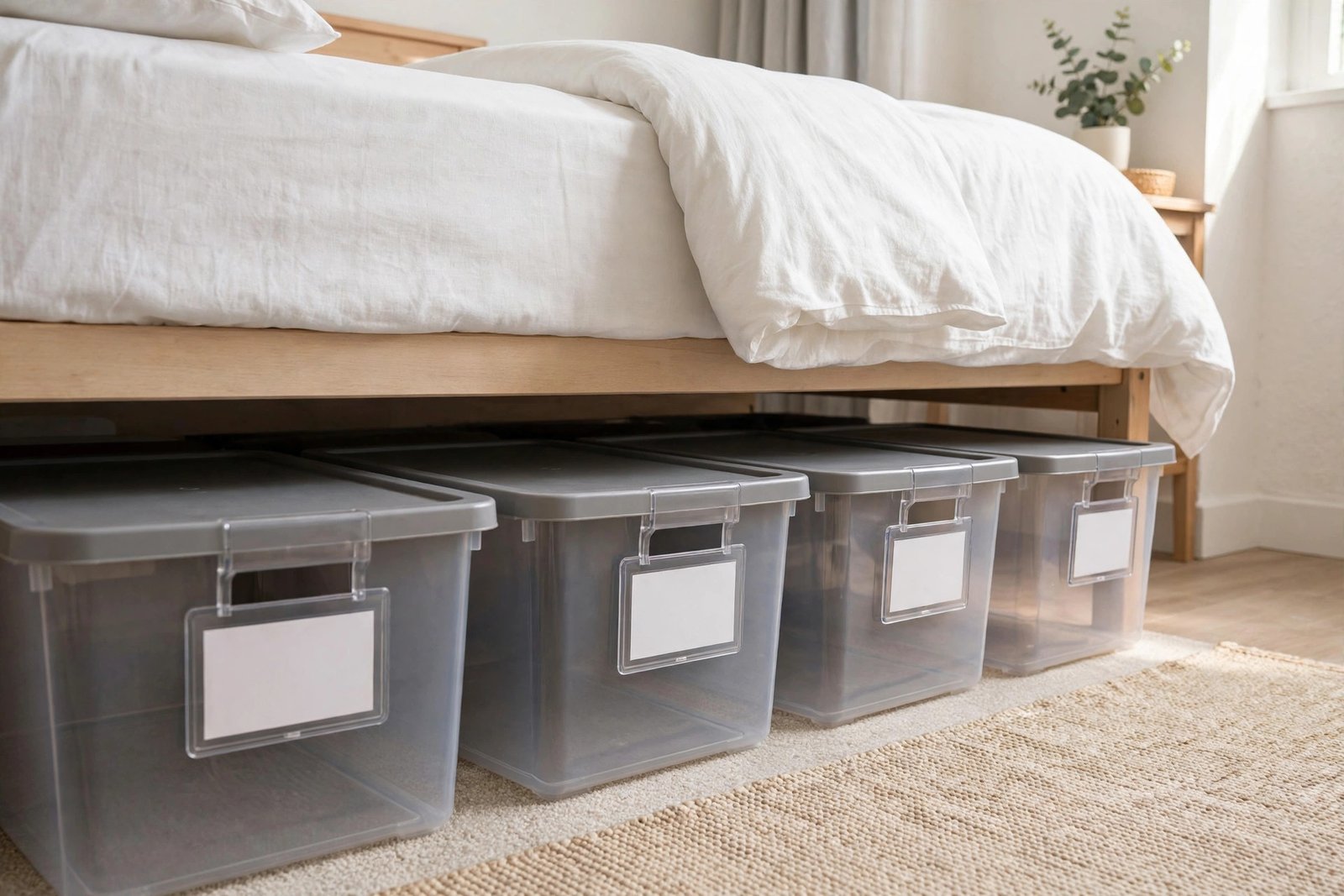
Under-bed storage fails quietly when every bin looks the same from the foot of the bed. A label card on the outward end of every container makes the system searchable without pulling anything out. Labels face the way you approach.
Cost: ~$3–6 • Best for: systems with more than three containers • Measure first: nothing; label after the final layout • Watch out: vague labels are no labels; name contents.
17. Cover the gap with a washable valance

A fabric valance reaching the floor hides the whole system, cuts the dust that reaches it, and makes a storage bed look like a plain bed. Choose a washable one; it is doing a dust filter’s job. A bed that hides its workings also makes a small room feel bigger, the same trick our weekly reset routine uses on surfaces.
Cost: ~$15–25 • Best for: open frames with bins on show • Measure first: drop to floor, commonly 35 to 40 cm • Watch out: keep daily bins where the fabric lifts easiest.
Common mistakes we’d skip
- Buying bins before measuring. Clearance at the edge is not clearance in the middle. Measure the lowest point, usually a middle rail, and subtract 2 cm for sliding.
- Storing loose items on the floor. Shoes, books and clothes slid under a bed bare come back dusty, sometimes damp-marked. Everything here sits in a bin, bag, case or tray.
- Putting daily things in the deep middle. If reaching it means moving two other containers, it is burial, not storage. Weekly at the edge, monthly in the middle, seasonal deepest.
- Filling every centimetre. A packed under-bed cannot be cleaned under, and the dust reaches bedding. Leave one section half-empty so a vacuum nozzle fits.
The short version
Measure the lowest clearance, then zone the space: rolling bins at the edge, vacuum bags and swap boxes in the middle, trays for shoes, wrap, books and a yoga kit, labels on every outward end. Add risers only if the height is not there, keep documents in one flat lockable box, and hide it all behind a washable valance. The space under a double bed quietly replaces a wardrobe and a linen closet in a bedroom that has neither.
Questions renters ask
How do I measure under-bed clearance properly?
In three places: the open edge, the middle rail, and around any legs. Use the smallest number, then subtract about 2 cm so containers slide without scraping. Most frames give 15 to 25 cm (6 to 10 in).
Will things stored under the bed get dusty or damp?
Dusty, yes, if stored loose; that is why every idea here is lidded, zipped or covered. Damp is a property question: if the floor feels cold or damp, keep paper and fabrics off the floor entirely, and never store against an outside wall.
What should I not store under a bed?
Anything needed daily but buried deep, anything heavy in a fabric box, power strips in enclosed spaces, and leather or feathers under long vacuum compression. Food, paint and chemicals do not belong here at all.
My bed is a divan with almost no gap. Can I still use these ideas?
Partly. The flat trays and document box (ideas 10 to 13 and 15) may fit a shallow gap, and divan drawers follow the same zoning: weekly at the front, seasonal at the back. For no space at all, see our no-closet bedroom storage ideas.
Pin this post for later
Save it to Pinterest for later, or tell us your smallest-space problem in the comments — the best posts here started as a reader’s awkward space.