

Restaurants call it the closing shift: the short, fixed routine that leaves the kitchen clean enough to open without thinking the next morning. A small rental needs the same thing, on a smaller scale. This nightly cleaning routine for apartments takes fifteen minutes, in eight timed steps, and it closes the home down properly: sink empty, counters clear, sofa reset, bathroom wiped, bed turned down, door locked. Nothing here is deep cleaning. It is the difference between waking up to yesterday and waking up to a fresh room.
Do it in order, kitchen first and bedroom last, and stop when the last step ends. Food and dishes come before living spaces, wet rooms before dry ones. It sits between our Sunday reset cleaning routine and our 30-minute weekly reset: those reset the week, this one resets the day.
In this post
About 9 min read · 100% renter-friendly — no drills, no nails, no paint.
The 30-second version
- Do these steps in order: kitchen shutdown first (steps 1 to 3), living room and entryway next (steps 4 to 5), bathroom and bedroom after that (steps 6 to 7), lock-up and launch pad last (step 8). Total: 15 minutes.
- 8 steps, zero deep cleaning, zero drills. If a job needs scrubbing, soaking or descaling, it belongs to the weekly or monthly list, not tonight.
- Typical cost: $0 with a basic kit you already own. Start-here order is steps 1, 4 and 8 if you only have five spare minutes: empty sink, reset sofa, set the launch pad. The printable version lives in our Free Renter Printables hub.
Kitchen shutdown
1. Empty the sink and start the dishwasher (3 minutes)

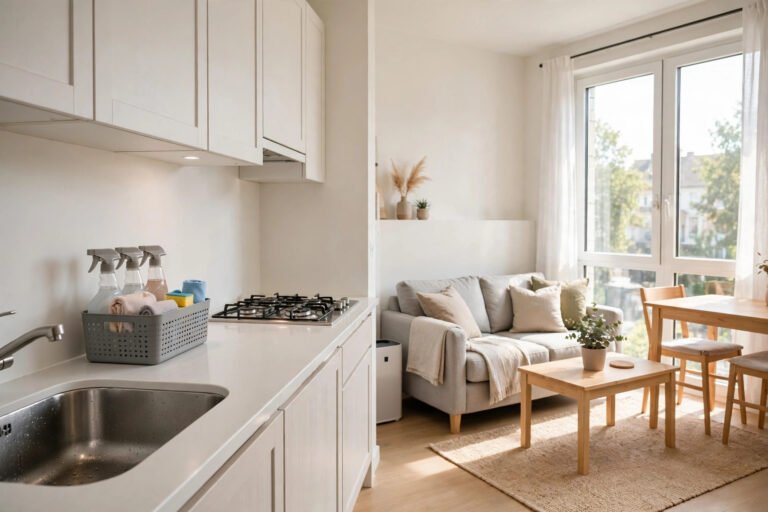
Everything in the sink gets washed, loaded or put away, and the dishwasher starts tonight, not in the morning. Rinse the sink itself, wipe the tap base, and leave the sink empty and dry. An empty sink is the single clearest signal that the kitchen is closed, and it removes the morning job nobody wants before coffee. If you wash up by hand, wash, dry and put away in the same three minutes; a draining rack left full overnight is just storage by another name, and it steals the counter space our small kitchen storage ideas for renters work hard to protect.
Cost: ~$0 to $1 in washing-up liquid or a dishwasher tablet • Best for: every rental kitchen, with or without a dishwasher • Measure first: 3 minutes total; leave the sink completely empty, not nearly empty • Watch out: do not leave sharp knives soaking hidden in soapy water; wash them separately and put them away.
2. Wipe the counters and stove, and put food away (2 minutes)
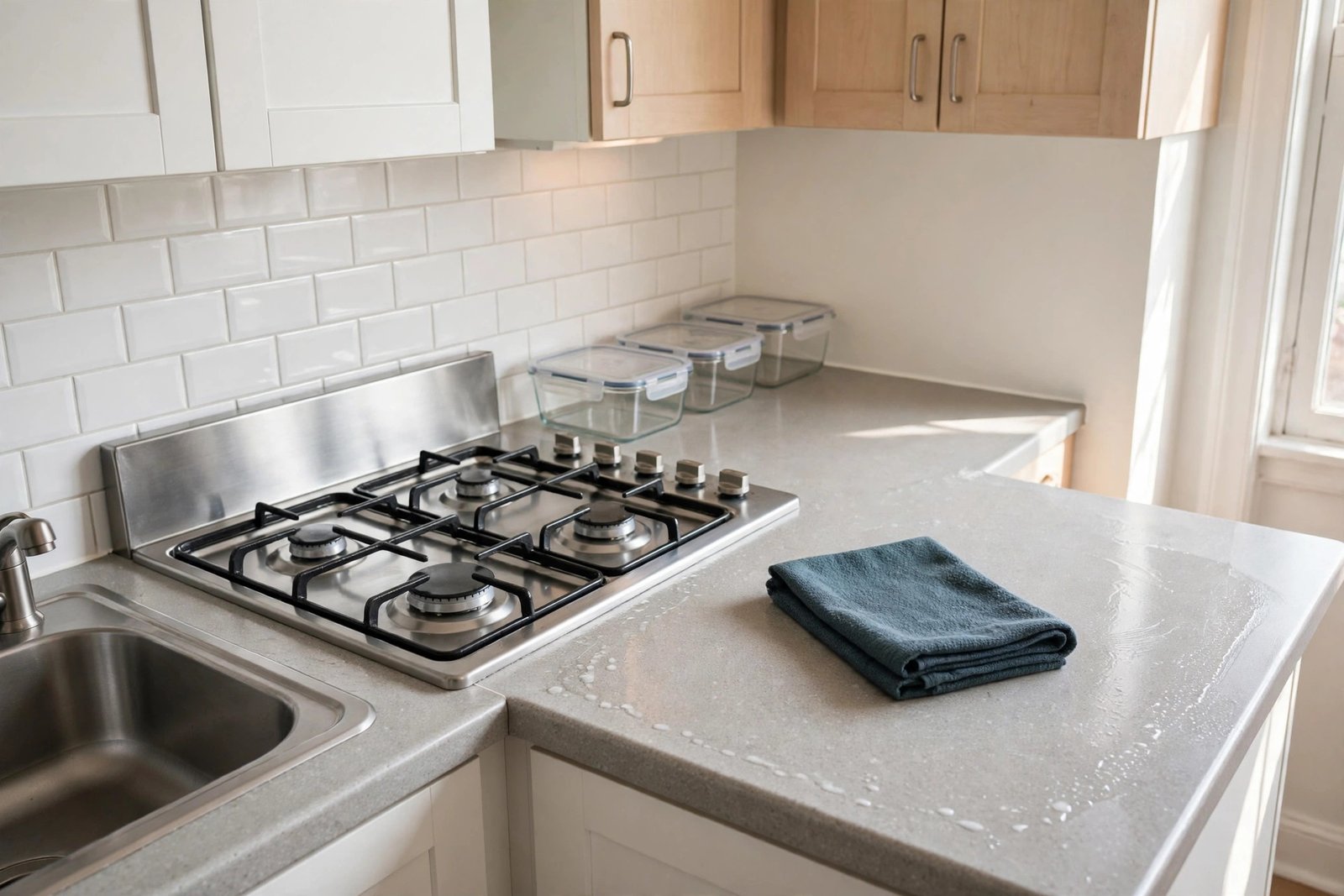
Clear the counters back to what lives there daily, wipe them and the stovetop with a damp microfibre cloth, and check the stove is off as you wipe it. Leftovers go into the fridge in sealed containers, bread and fruit go back to their places, and anything open gets closed properly. Two minutes is enough because it happens nightly: crumbs and splashes from one day wipe off, while a week of them needs scrubbing. Wring the cloth out and hang it to dry over the tap or a rail, never in a damp ball by the sink.
Cost: ~$0 to $1 • Best for: small kitchens where the counter is also the morning prep space • Measure first: leave at least 60 cm (24 in) of clear counter beside the stove for the morning • Watch out: check hob knobs and the oven are off every night, without exception; make it part of the wipe, not a separate thought.
3. Spot-sweep the kitchen floor and check the bin (2 minutes)
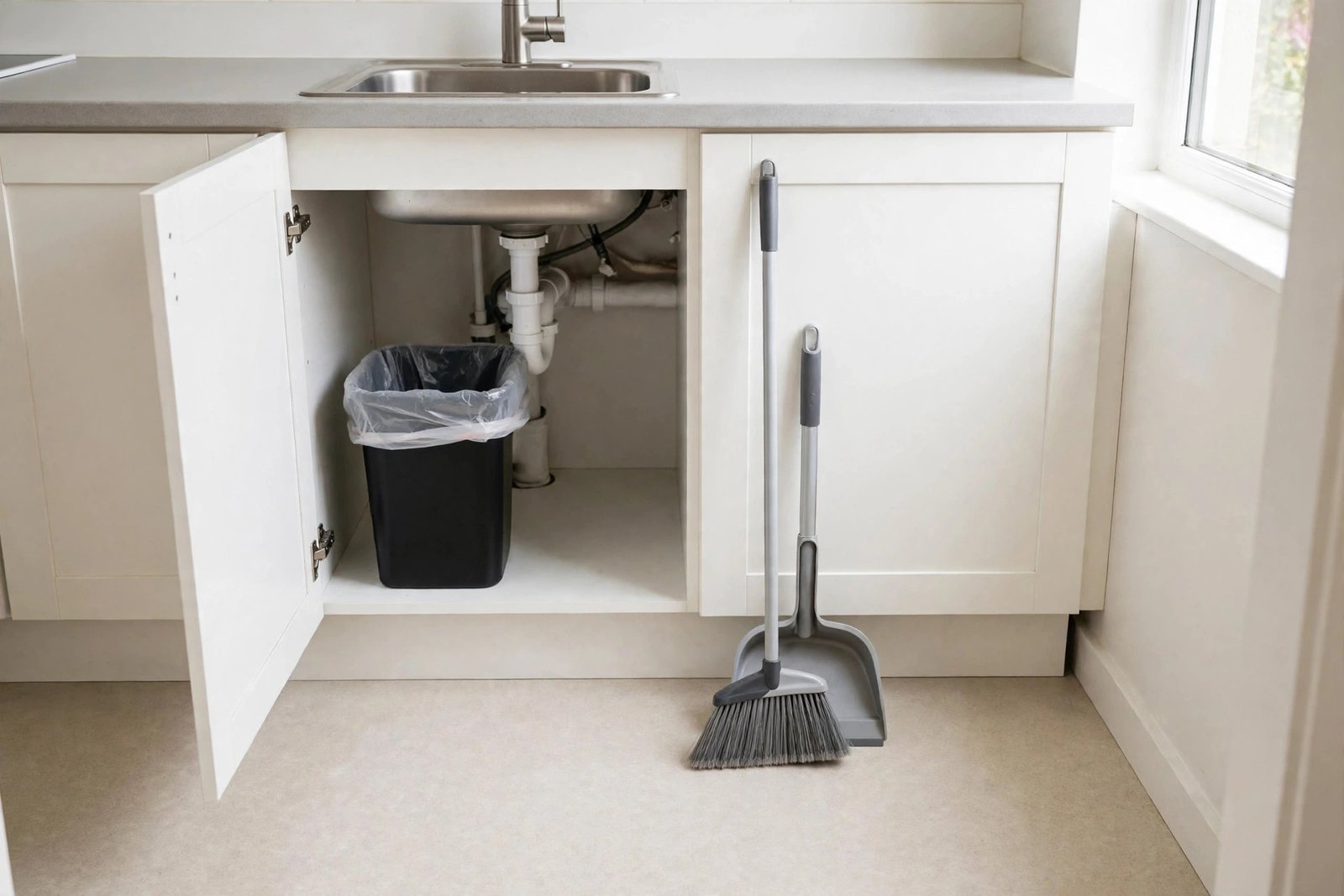
Take a slim broom or a handheld vacuum over the kitchen floor only, and only where crumbs actually fall: in front of the stove, the sink and the fridge. Thirty seconds of sweeping nightly stops grit being walked into every other room. Then look at the bin. If it is full, or if tonight’s food scraps are in it, tie the bag and put it out now, and fit a fresh liner straight away. Food waste left overnight is what makes a small kitchen smell like yesterday by morning, however clean the counters look. Most under-sink bins are sized in our under-sink storage ideas, and the liner should match yours.
Cost: ~$0 to $1 in liners • Best for: kitchens with hard floors where crumbs travel fast • Measure first: 2 minutes total, about 1 minute sweeping and 1 minute on the bin • Watch out: a liner one size too small slips into the bin under a heavy bag; match the liner to the bin, usually 20 to 30 litres.
Living room and entryway, back to calm
4. Reset the sofa, cushions and coffee table (2 minutes)

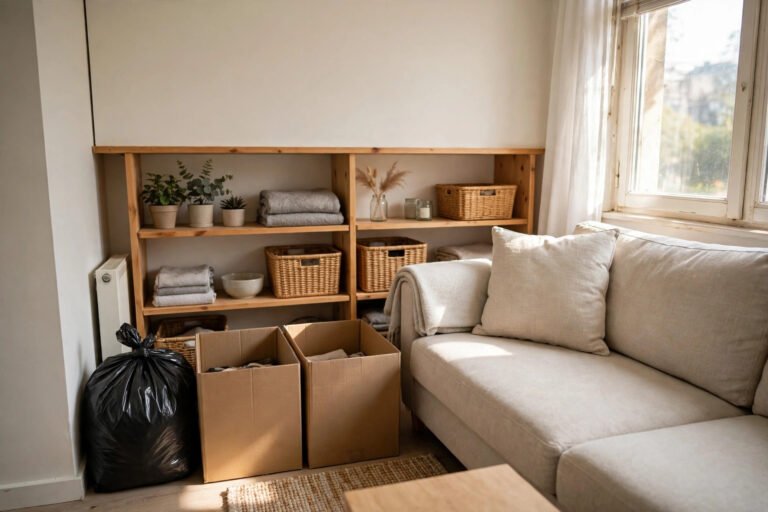
Plump the cushions, fold the throw, and clear the coffee table back to what belongs on it. Remotes go to one place, mugs go to the kitchen if you are still in time to catch the dishwasher, and post and clutter go to their homes, not to the arm of the sofa. Two minutes returns the room you will walk into first tomorrow to calm, and it feels disproportionately good in the morning.
Cost: ~$0 • Best for: open-plan rentals where the living room is visible from the front door • Measure first: coffee table clear except for one or two kept items, such as a book and a coaster stack • Watch out: do not start sorting drawers or shelves now; surfaces only, or two minutes becomes twenty.
5. Clear the entryway drop zone (1 minute)
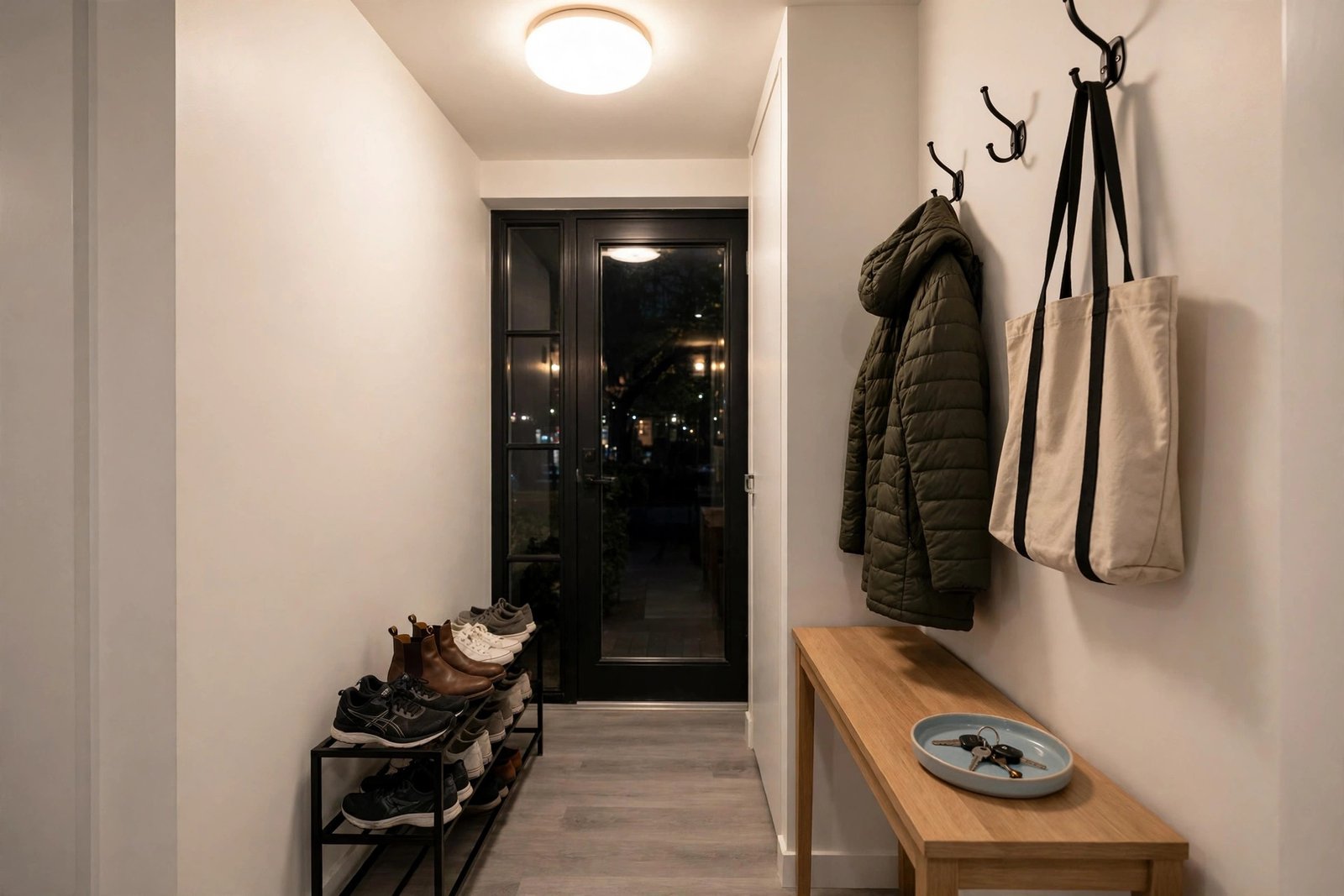
One minute, at the door you came in through. Shoes go onto the rack or into their row, bag and coat go onto their hooks, and the drop zone goes back to keys and one tray. Anything that arrived today and belongs elsewhere gets carried there now, while you pass it. This is the smallest step in the routine and the one guests and mornings feel most, because the entry is both the last thing you see tonight and the first thing you use tomorrow. If shoes keep overflowing the rack, that is a storage problem to solve once, properly, with our small entryway storage ideas, not a nightly battle to keep losing.
Cost: ~$0 • Best for: narrow entries with no hallway storage • Measure first: keep the drop zone to about 30 cm (12 in) of surface, one tray only • Watch out: do not leave tomorrow’s shoes in the walkway; line them up ready, clear of the door swing.
Doing this nightly? Print the checklist.
Eight steps, fifteen minutes, ticked off at the door before bed. The nightly, weekly and Sunday checklists are together in our Free Renter Printables hub.
Bathroom and bedroom wind-down
6. Wipe the bathroom sink and straighten the towels (2 minutes)
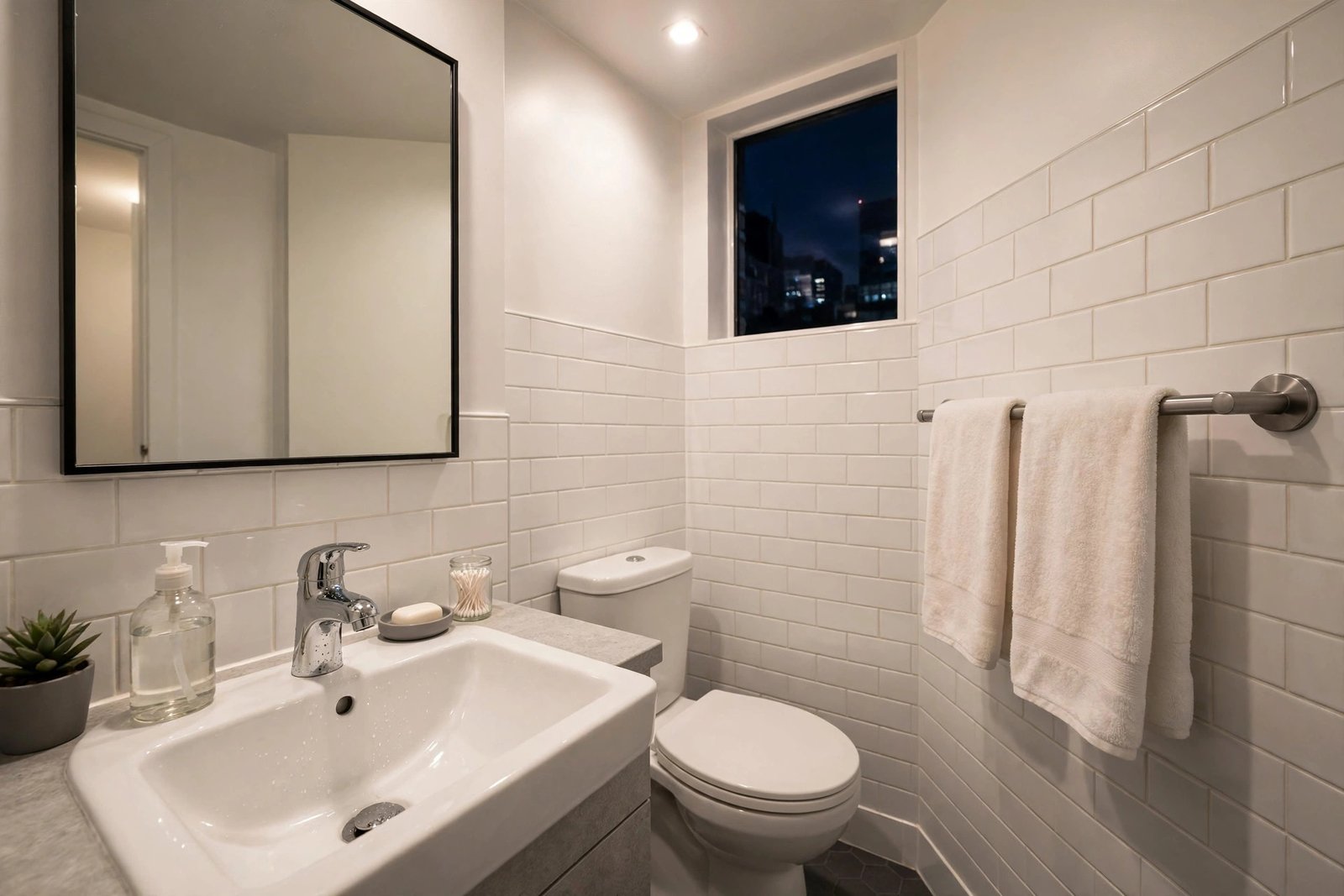
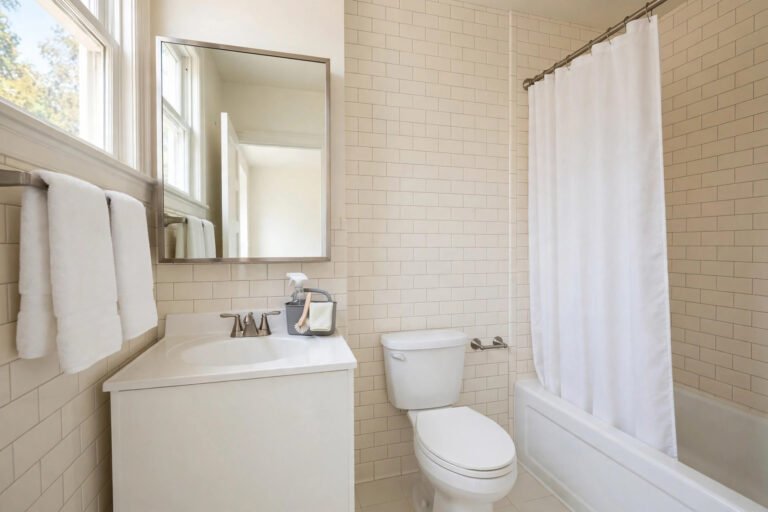
A fast pass, in dirt order: a quick wipe of the mirror spots with a dry cloth, the sink and tap with a damp one, and the toilet seat and lid down last if needed. Hang towels straight so they dry overnight, stand bottles back in their place, and leave the door or window ajar so the room dries. Two minutes nightly stops toothpaste, soap film and water marks building into the weekend scrub nobody enjoys. It also keeps a small bathroom guest-ready without warning, which matters in one-bathroom rentals. Keep products corralled as in our small bathroom storage ideas, so this step stays a wipe, not a tidy.
Cost: ~$0 to $1 in spray • Best for: one-bathroom rentals shared by two people • Measure first: towels about 70 by 130 cm (28 by 51 in) dry fastest hung straight, not bunched • Watch out: never mix cleaning products, and leave the room ventilated; a closed wet bathroom feeds mildew overnight.
7. Clear the clothes chair and turn the bed down (2 minutes)

Every small bedroom has the chair, the floordrobe corner, or the end of the bed where today lands. Clear yours completely: worn-once clothes go onto a hook or back into the wardrobe, laundry goes into the basket, and nothing stays in the in-between pile. Then turn the bed down: duvet folded back, pillows plumped, a glass of water and your book where they belong. Two minutes, and the bedroom reads as a place to sleep, not a place to store the day. A clear chair is a surprisingly strong signal; leave it piled and the whole room feels unfinished, however tidy the rest is.
Cost: ~$0 • Best for: small bedrooms where one chair does the work of a wardrobe overflow • Measure first: one basket or hook rail only for worn-once clothes; if it overflows, the pile is laundry • Watch out: the in-between pile is the trap; every item gets a home tonight, wardrobe, hook or wash basket, with no fourth option.
Lock up and set tomorrow loose
8. Lock up, charge up, and set the launch pad (1 minute)
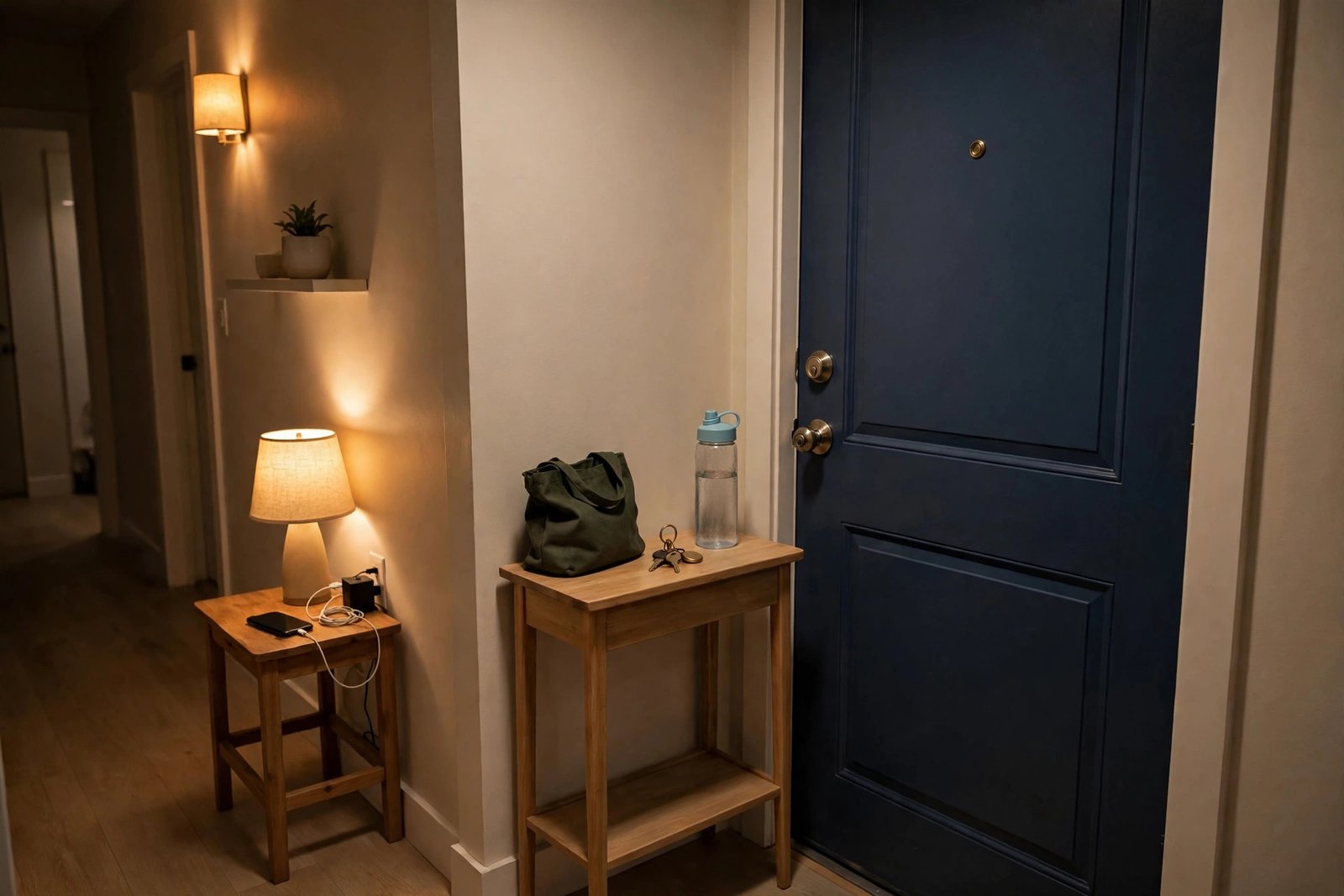
The last minute is a circuit, not a clean. Front door locked, windows you opened closed, chargers plugged in where you will find them, and tomorrow set loose by the door: bag packed, keys in the tray, shoes lined up, water bottle filled and in the fridge if you take one. Turn lamps off as you leave each room and finish in the bedroom. One minute of setting up removes five minutes of searching in the morning, and it is the step that turns a tidy night into an easy start. If you keep spices and breakfast things in one place, as in our spice storage ideas for small kitchens, the morning counter is already working for you too.
Cost: ~$0 • Best for: anyone whose mornings start with a hunt for keys, bag or charger • Measure first: one launch pad only, a tray or 30 cm of console by the door, not the whole hallway • Watch out: charge phones where you can hear the morning alarm; a phone charging in another room is a missed start.
Common mistakes we’d skip
- Turning fifteen minutes into a deep clean. The moment you descale the shower, empty a cupboard or start a load of laundry that needs folding tonight, the routine stops being nightly and starts being skipped. Deep jobs belong to the weekly reset and the monthly list.
- Starting in the bedroom. Order is the system. Kitchen first means food, dishes and smells are dealt with while you still have energy; bedroom first means the kitchen quietly gets left until morning.
- Leaving the sink nearly done. One mug and a pan left soaking undo the whole signal. The rule is empty and dry, every night, even when the nearly-done version feels close enough.
- Doing it at midnight. A closing shift done exhausted becomes a resentful one. Anchor it to dinner clearing or to the last cup of tea, not to bedtime itself, and it stays easy to keep.
The short version
Fifteen minutes, eight steps, one order: sink empty and dishwasher on, counters wiped and stove checked, kitchen floor spot-swept and bin dealt with, sofa reset, entryway cleared, bathroom wiped, clothes chair emptied and bed turned down, door locked and tomorrow set by it. Nothing here is impressive on its own. Done nightly, it is the reason the weekly reset takes thirty minutes and the Sunday reset stays at sixty, and the reason mornings in a small rental start in a room that is already calm.
Questions renters ask
Is fifteen minutes really enough every night?
For closing down, yes. This routine deals with one day of dishes, crumbs, clutter and water marks, and one day is a small amount. It is maintenance, not cleaning from scratch: skip several nights in a row and the same steps take longer, which is exactly why the nightly version is kept deliberately short and finishable.
What if I get home late and only have five minutes?
Do steps 1, 4 and 8 only: empty the sink and start the dishwasher, reset the sofa and coffee table, then lock up and set the launch pad. Five minutes covers the smells, the first room you will see, and the morning hunt. Return to all eight steps the next night.
How is this different from the weekly and Sunday resets?
Depth and direction. The nightly shift looks backwards at today: dishes, food, and the day’s clutter. The weekly reset looks at surfaces and floors across the whole home, and the Sunday reset adds dusting, a full vacuum and a bed change. The nightly routine is what stops the other two growing.
What kit should I keep ready for the closing shift?
Very little: a microfibre cloth, a non-scratch sponge, washing-up liquid or dishwasher tablets, a slim broom or handheld vacuum, and bin liners that fit your bin. Kept under the sink or in one caddy, the kit means the routine starts on time instead of starting with a search.
Pin this post for later
Save it to Pinterest for later, or tell us your smallest-space problem in the comments — the best posts here started as a reader’s awkward cabinet.
📌 PIN THIS FOR LATER