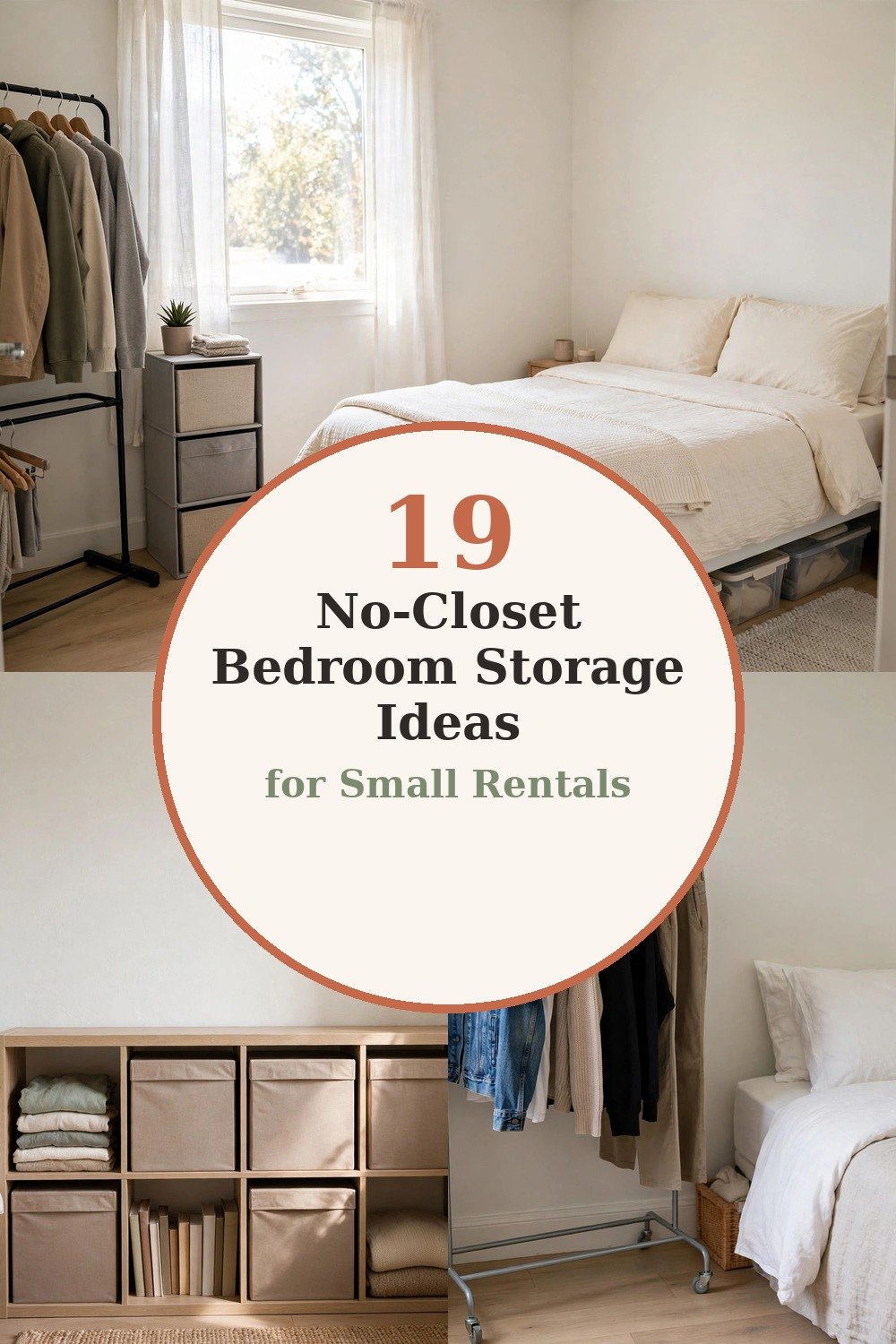


Some rental bedrooms come with no closet at all. You cannot fit a wardrobe system or screw rails into the wall. These no closet storage ideas build a closet out of freestanding, rolling, over-door and under-bed pieces instead. Nothing drills, nothing damages, and everything leaves with you.
This is the companion to our tiny closet post: that one fixes a small closet, this one replaces a missing one. Door tricks also appear in our tiny entryway post, and the Free Renter Printables hub has the worksheets.
In this post
About 15 min read · 100% renter-friendly — no drills, no nails, no paint.
The 30-second version
- Do these 3 first, in order: a rolling garment rack (idea 1), under-bed rolling drawers (idea 5), and a cube unit with fabric boxes (idea 8). About $70 to $120 together.
- 19 ideas, zero drills, zero damage. Everything stands, rolls, hooks over a door, slides under the bed or hangs from a rail you own.
- Typical cost: most renters need 6 to 8 ideas, about $130 to $220 total. Measure rack wall, under-bed clearance and door thickness first.
A place to hang
1. A rolling garment rack for everyday clothes

A slim rolling rack is the instant closet rail: hang weekly clothes in order and roll it aside to clean. Choose a braced metal frame, not the cheapest pole rack.
Cost: ~$25-45 • Best for: the main hanging rail in a bedroom with no closet • Measure first: the wall run you can spare, usually 90 to 120 cm (35 to 47 in), and rack height, about 150 to 170 cm (59 to 67 in) • Watch out: single-pole racks lean under uneven loads; balance both sides.
2. A covered portable fabric wardrobe

A fabric-covered portable wardrobe gives a closed closet look — rail, shelves and dust protection — with no fixings. It flat-packs on moving day.
Cost: ~$35-60 • Best for: a tidy, closed wardrobe look without buying furniture • Measure first: floor footprint, commonly about 110 by 45 by 175 cm (43 by 18 by 69 in) • Watch out: fabric frames wobble if overloaded; keep heavy boxes off the top.
3. A tension rod in an alcove, with a curtain front

Many no-closet bedrooms have an alcove or deep corner. A tension rod wedged across it, with a plain curtain in front, makes a hanging nook that looks built-in and leaves no mark.
Cost: ~$20-38 for rod and curtain • Best for: alcoves and recesses doing nothing • Measure first: exact width at rod height, usually 80 to 150 cm (31 to 59 in); rods fit only their stated range, so measure twice • Watch out: tension rods hold clothes, not boxes; keep the load light and centred.
4. An over-door hook rack for tomorrow’s outfit
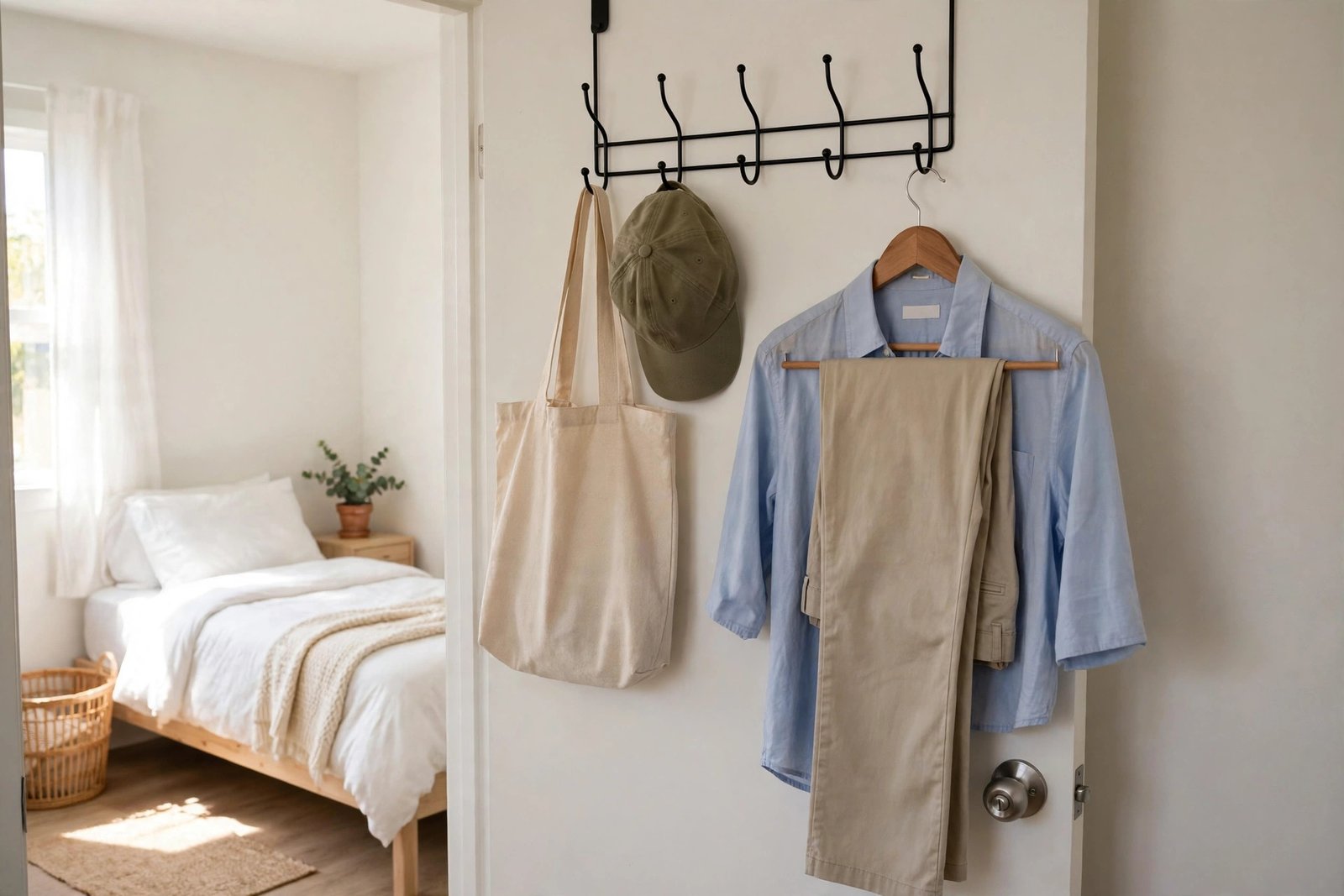
A hook rack over the bedroom door takes tomorrow’s outfit, a gown and the daily bag off the rack and the floor chair.
Cost: ~$10-18 • Best for: next-day outfits, gowns and daily bags • Measure first: door thickness, usually about 4 cm (1.6 in), and the swing space behind the door • Watch out: pad the hooks; unpadded metal can mark paint at the door top.
Folded clothes and drawers
5. Rolling drawers under the bed
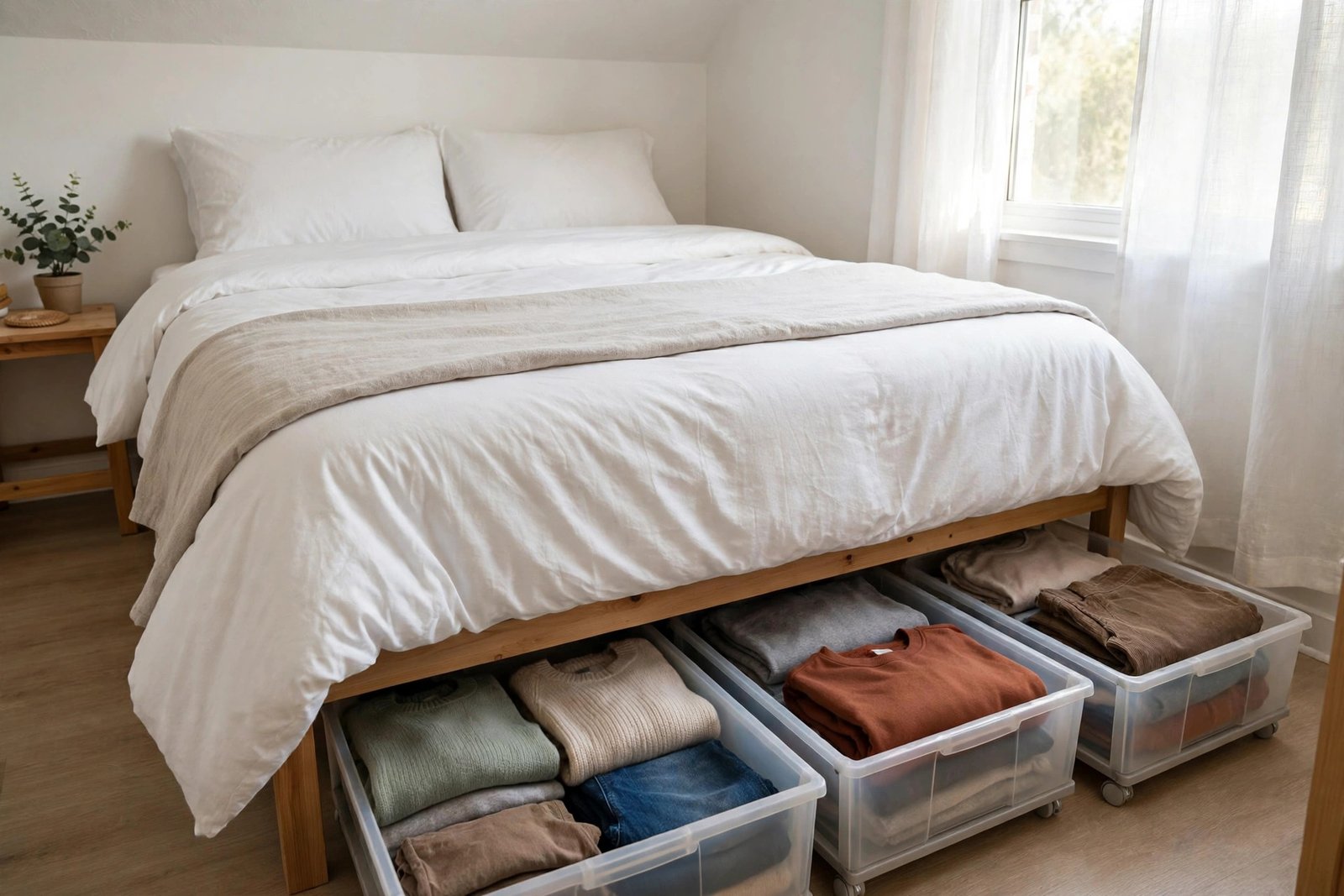
Under the bed is the biggest free storage in a no-closet room. Low rolling drawers turn it into a chest of drawers for folded clothes you use weekly.
Cost: ~$20-35 for two • Best for: folded everyday clothes with no dresser • Measure first: under-bed clearance, commonly 15 to 25 cm (6 to 10 in) from floor to frame • Watch out: measure the lowest point of the frame, not the highest; centre supports sit lower.
6. Vacuum bags for the off-season layer

Vacuum bags shrink winter jumpers and the spare duvet to a flat slab beside the under-bed drawers. The off-season layer cannot take rail space from this season.
Cost: ~$12-20 for a pack • Best for: duvets and off-season bulky clothes • Measure first: the flat footprint you have left under the bed; large bags are about 80 by 60 cm (31 by 24 in) before shrinking • Watch out: re-fluff wool and feathers mid-season, and never store leather this way.
7. A slim drawer tower in the corner
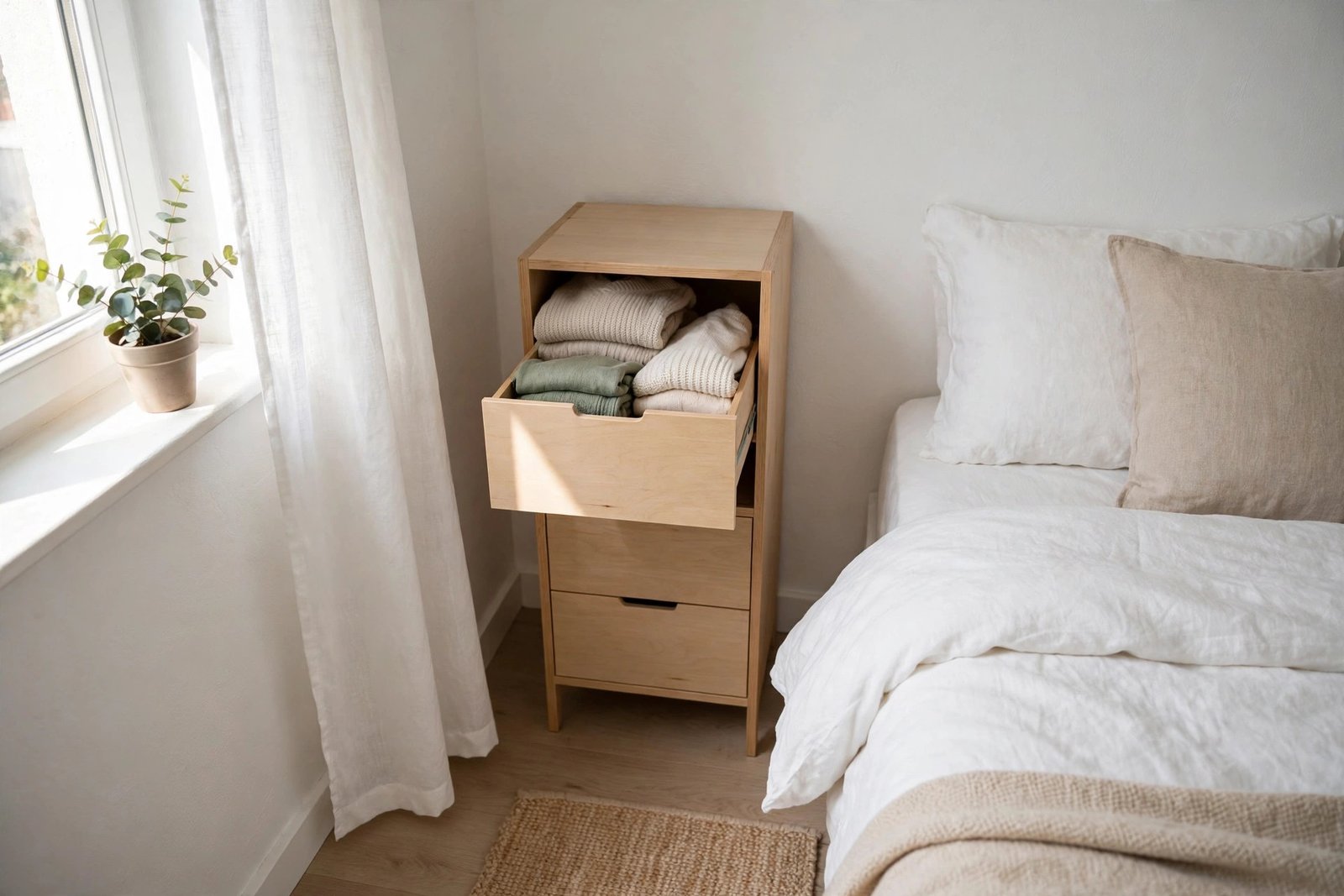
A narrow three-drawer tower fits the dead corner beside the bed and holds underwear, sleepwear and small clothes, in about a laundry basket’s footprint.
Cost: ~$25-40 • Best for: small clothes in a corner nothing else fits • Measure first: the corner patch, usually 30 to 40 cm (12 to 16 in) wide, and drawer opening clearance • Watch out: light plastic towers tip when the top drawer is loaded; heaviest items go in the bottom drawer.
8. A cube unit with fabric boxes

A low cube unit with matching fabric boxes works as dresser and shelf in one. One cube per category — gym kit, t-shirts, chargers — keeps it honest.
Cost: ~$30-55 for unit and boxes • Best for: folded clothes plus everyday clutter, in boxes • Measure first: unit size, a six cube is commonly about 90 by 30 by 60 cm (35 by 12 by 24 in) • Watch out: boxes hide mess too well; label the inside flap, not the front.
9. A storage ottoman at the foot of the bed
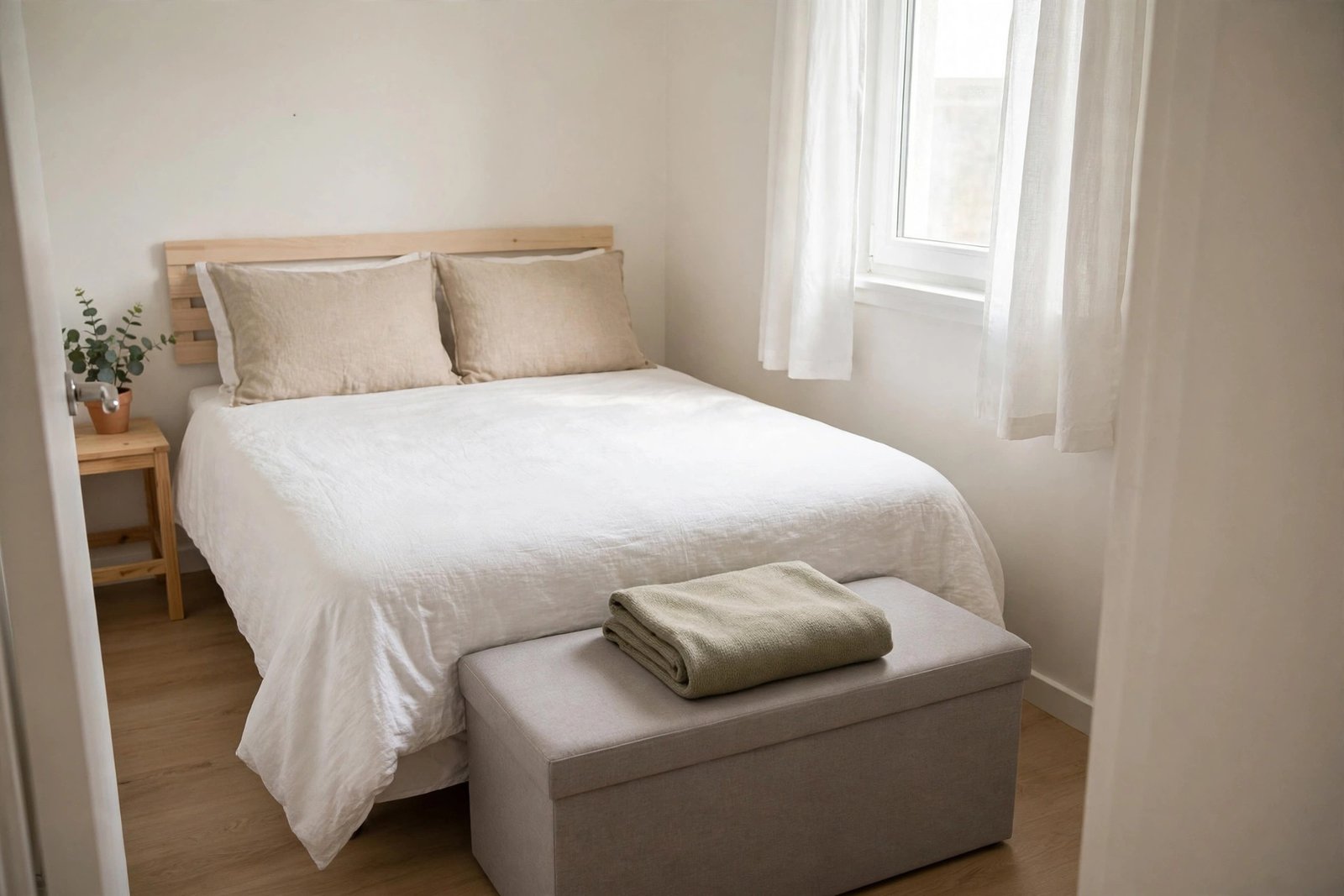
A lidded ottoman stores spare throws or gym clothes and doubles as a seat for putting shoes on. Every piece should do two jobs; this one earns its floor space.
Cost: ~$30-50 • Best for: spare textiles and a seat in one footprint • Measure first: the foot-of-bed gap; leave at least 30 cm (12 in) of walkway between ottoman and wall or unit • Watch out: check the lid’s seat rating if adults will sit on it daily.
Shopping for these? Measure first.
The free worksheets in our Free Renter Printables hub prevent most returns.
Shoes and accessories
10. A slim shoe rack along the wall
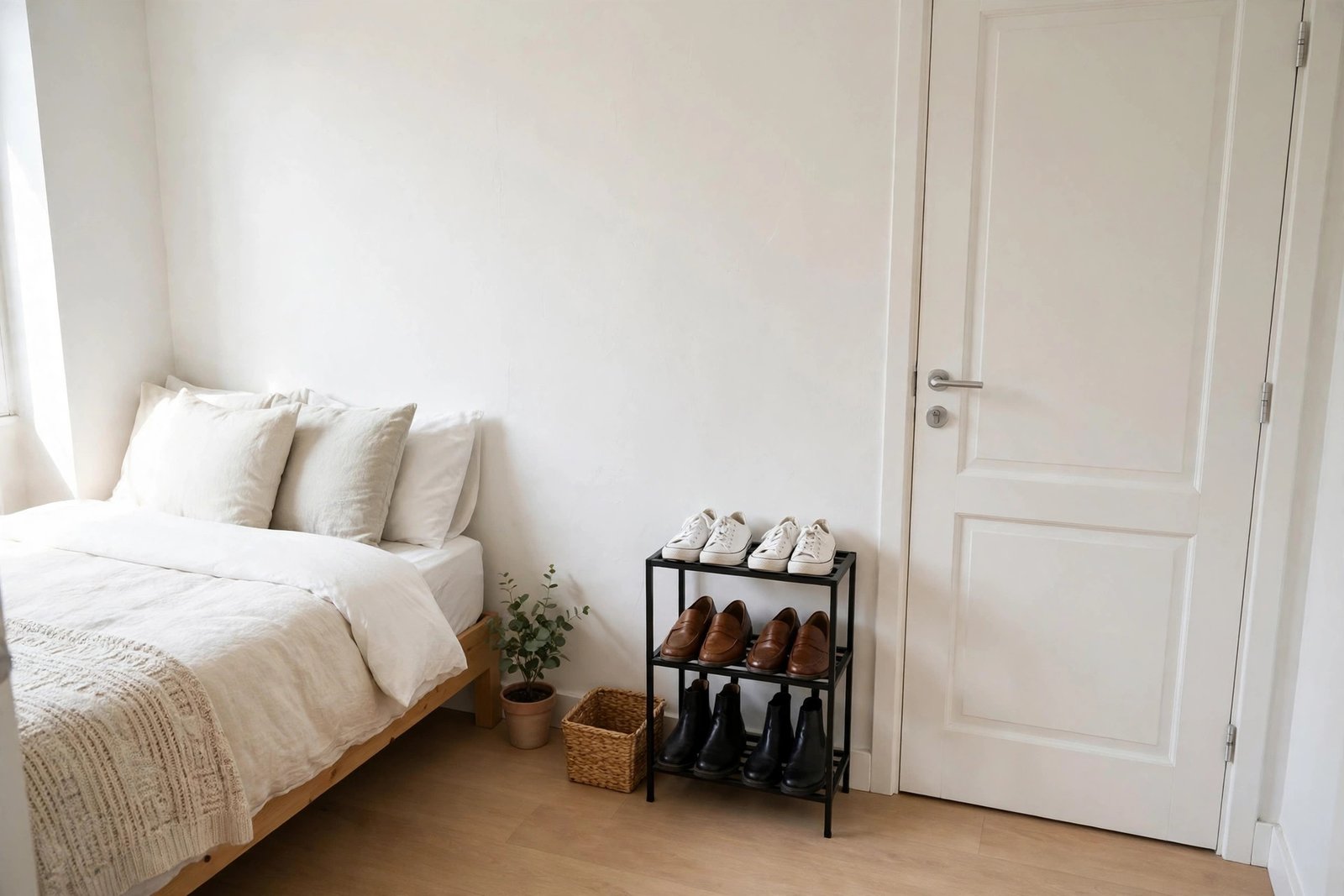
A narrow three tier rack by the door lines up about nine pairs instead of a kicked heap that migrates across the room.
Cost: ~$15-25 • Best for: everyday shoes in a room with no hallway storage • Measure first: rack depth, usually 25 to 30 cm (10 to 12 in); most tiers allow about 15 cm (6 in) of height, too low for boots • Watch out: boots need the tall space beside the rack, or they crush.
11. A clear pocket organiser over the door

A clear pocket organiser turns the back of the door into shelving for shoes, gloves and small things, all visible at once.
Cost: ~$12-20 • Best for: shoes and small accessories off the floor • Measure first: door thickness, about 4 cm (1.6 in), plus about 1 cm (0.4 in) clearance at the top so the door still closes • Watch out: spread heavy shoes across the middle rows; a top-heavy organiser bows.
12. Hanging cubbies from the rack rail

A hanging cubby column hooks over the rack or alcove rod and turns 30 cm (12 in) of rail into shelves for jumpers and t-shirts, with no floor used.
Cost: ~$15-25 • Best for: jumpers and t-shirts beside the hanging clothes • Measure first: rail width you can spare, 25 to 30 cm (10 to 12 in), and cubby depth against your rack depth • Watch out: cubbies sag under denim; save them for lighter folds.
13. A scarf, belt and tie loop hanger
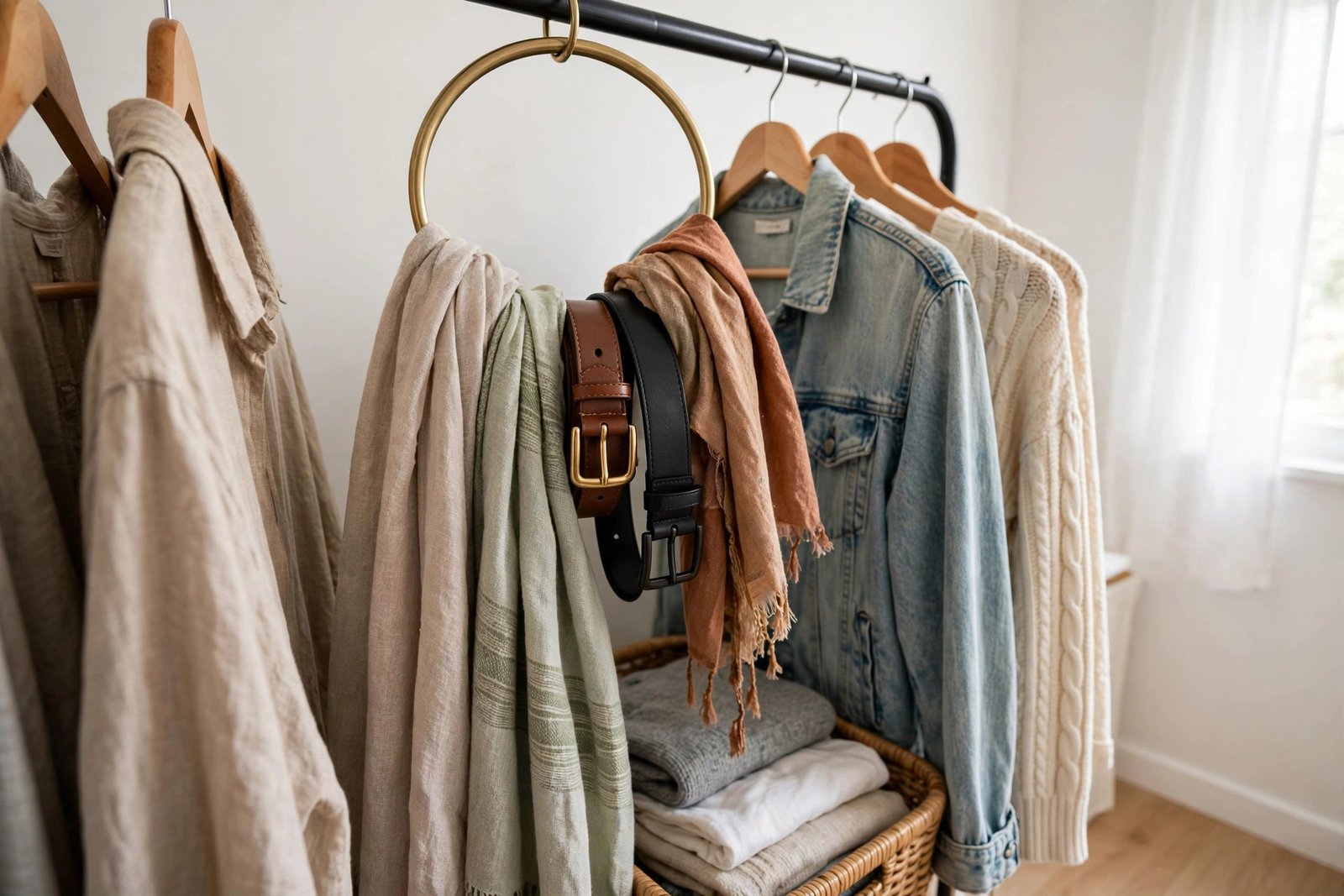
A loop hanger threads scarves, belts and ties through rings on one hanger. The whole collection takes about 5 cm (2 in) of rail.
Cost: ~$7-12 • Best for: scarves, belts and ties in almost no space • Measure first: almost nothing; it uses one hanger’s width on the rack or rod • Watch out: metal rings snag silk; choose smooth, coated loops.
Vertical space and hidden corners
14. A leaning ladder shelf, no fixings
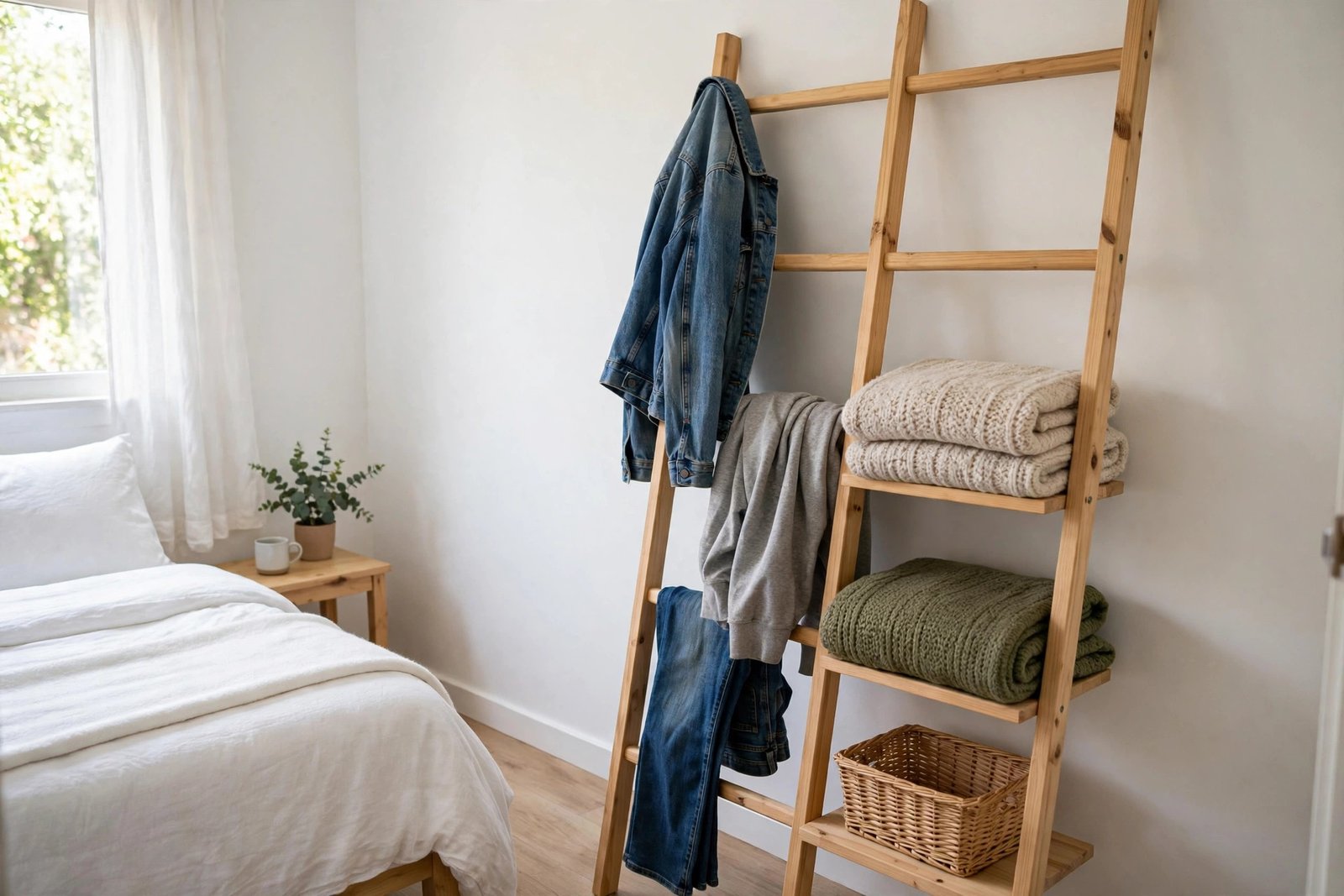
A ladder shelf leans against the wall — no screws — and holds folded blankets, a basket and tomorrow’s outfit over a rung. Add non-slip pads at the feet.
Cost: ~$30-50 • Best for: blankets and display storage on a blank wall • Measure first: the lean footprint; the base usually sits 35 to 45 cm (14 to 18 in) out from the wall • Watch out: top shelves are for light items only; a leaning shelf is not a bookcase for heavy stacks.
15. Adhesive hooks inside the door

Removable hooks inside the door, or on the portable wardrobe’s side, hold a cap, gown or daily bag at grab height. Like our no-drill decor post ideas, they remove with the pull tab.
Cost: ~$8-14 • Best for: daily cap, gown and grab-and-go bag • Measure first: a flat, sound patch of door or panel, and clearance so hooks do not press into hanging clothes • Watch out: strips fail on flaking paint; test first. Rating usually 1 to 2 kg (2 to 4 lb) per hook.
16. Woven baskets on top of the wardrobe
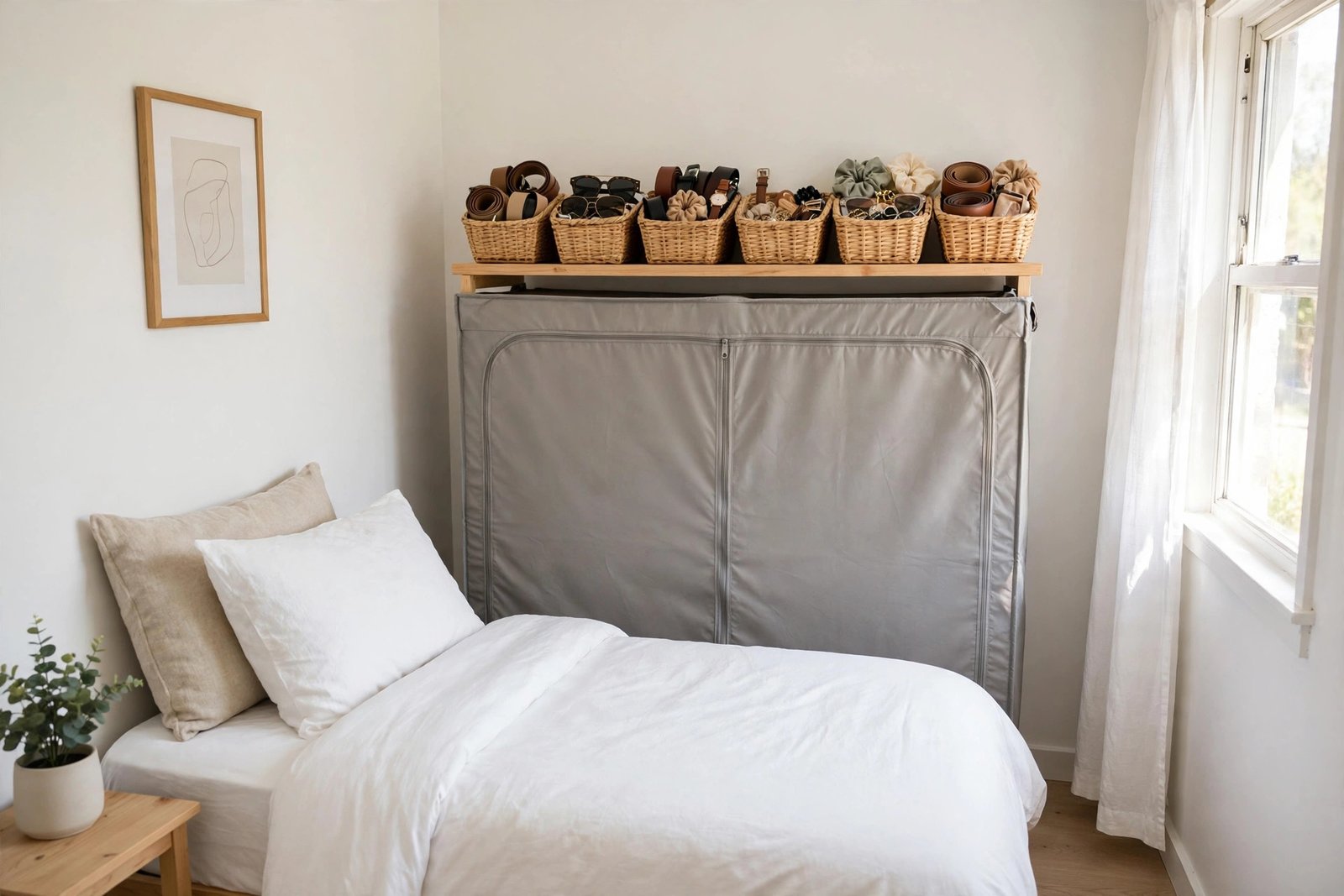
The top of a portable wardrobe is a wasted shelf. Small woven baskets up there corral rolled belts, sunglasses and pocket clutter.
Cost: ~$10-18 for a set • Best for: small accessories, kept light and high • Measure first: top surface depth, usually 30 to 45 cm (12 to 18 in); baskets about 25 cm (10 in) deep • Watch out: heavy items do not belong overhead; if you cannot lift it down one-handed, store it lower.
17. A hanging caddy beside the bed
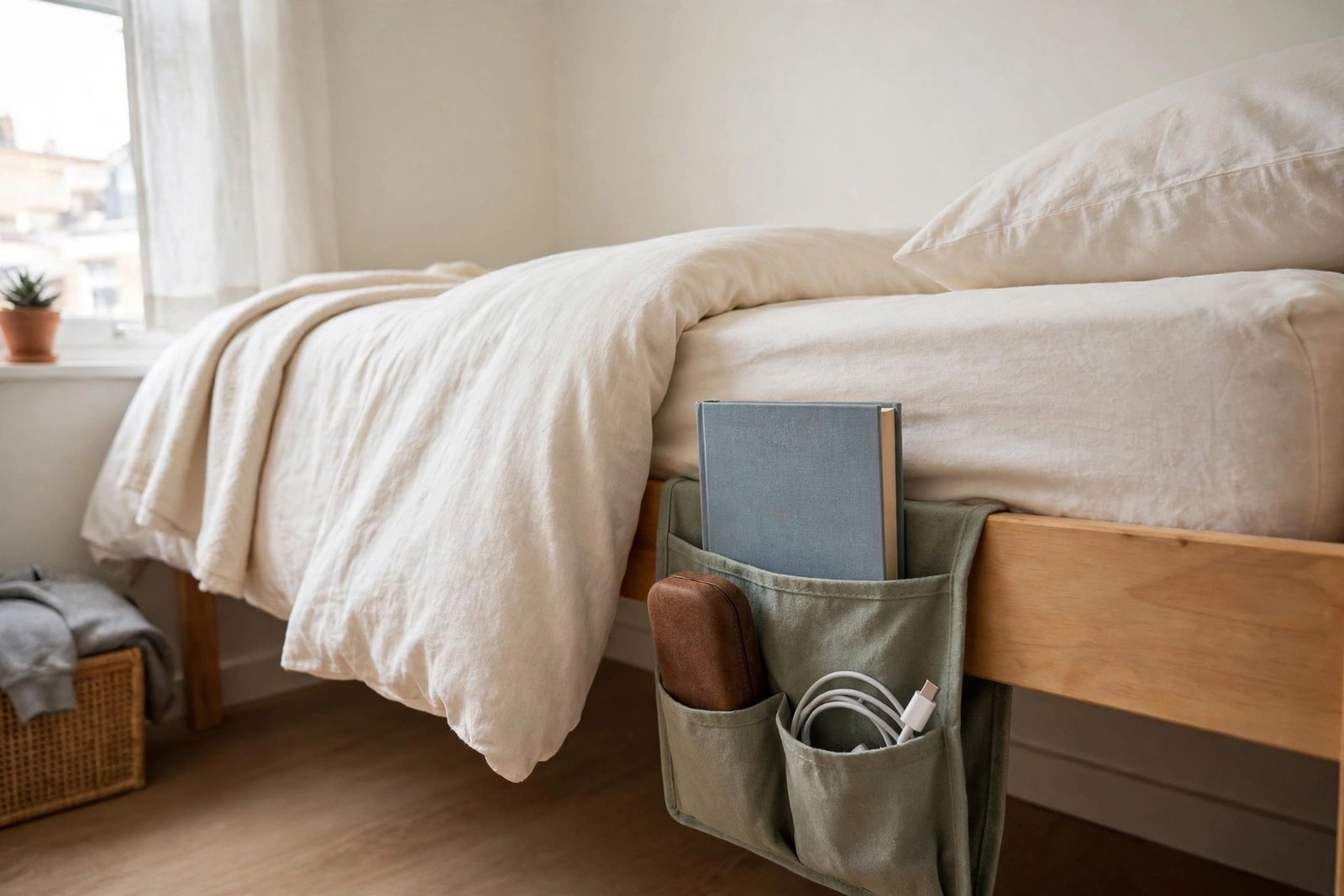
A fabric caddy tucked between mattress and frame holds a book, glasses case, charger and tissues at arm’s reach, with no nightstand needed.
Cost: ~$9-15 • Best for: bedside essentials in a room with no drawers • Measure first: the tuck flap, usually about 25 to 30 cm (10 to 12 in) of fabric under the mattress • Watch out: heavy books pull a caddy out; keep it to light essentials and shake it out on your Sunday Reset.
Laundry and spare bedding
18. A hanging laundry bag on the door
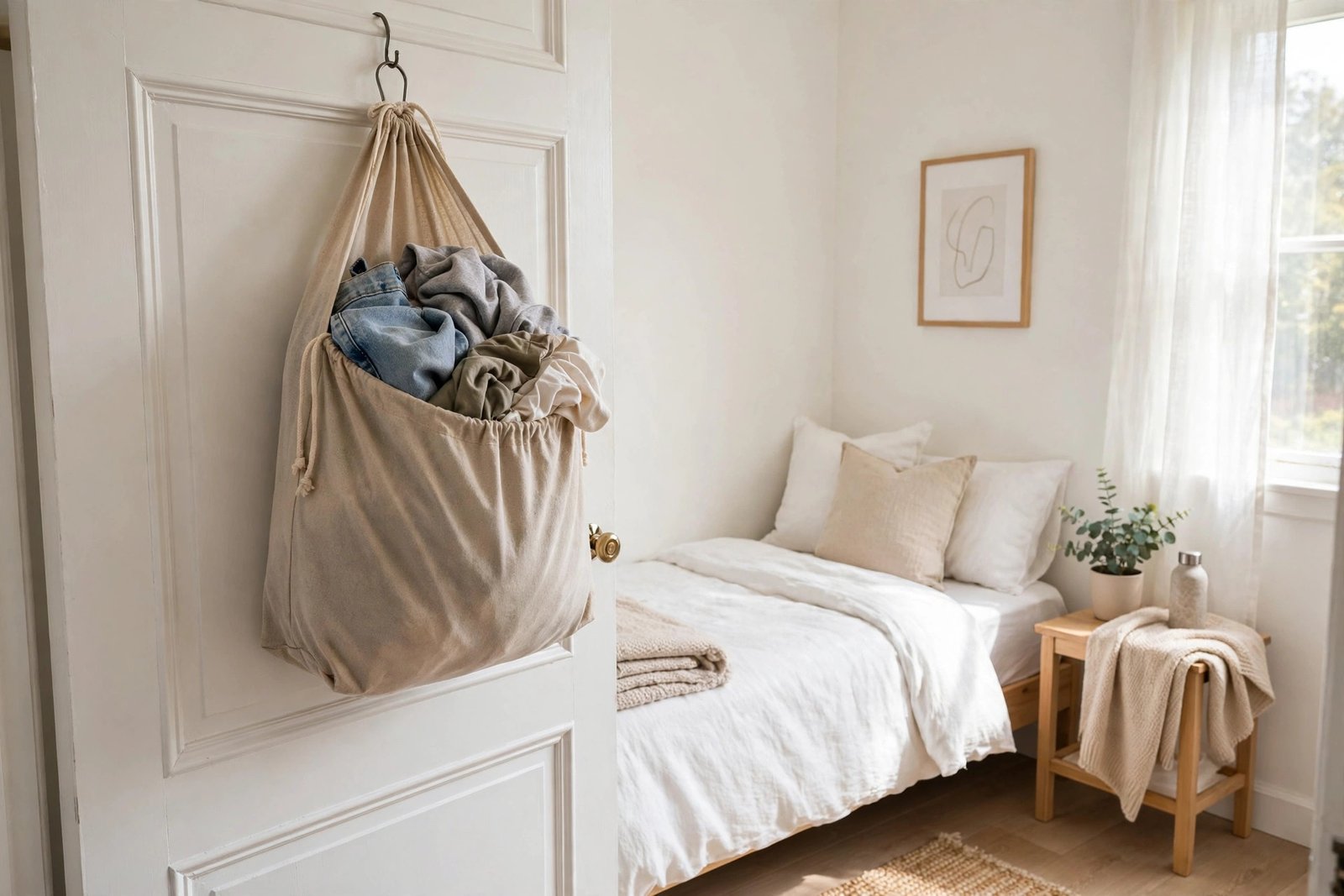
A laundry bag over the door keeps worn clothes off the floor chair. When full, unhook it and carry it straight to the machine.
Cost: ~$9-15 • Best for: laundry with no floor space for a basket • Measure first: door thickness, about 4 cm (1.6 in), and clearance behind the door so a full bag does not block the rack or unit • Watch out: a full bag is heavy; empty it weekly and pad the hooks.
19. A storage trunk for spare bedding

Spare bedding is bulky, light and rarely used — perfect for a lidded trunk. Keep the guest duvet and spare sheets in it, and let drawers serve this week’s clothes.
Cost: ~$25-45 • Best for: spare bedding and bulky, rarely used textiles • Measure first: trunk size, commonly about 80 by 40 by 40 cm (31 by 16 by 16 in); if the ottoman is there too, choose one, not both • Watch out: air bedding before boxing it; a sealed trunk keeps damp smells in.
Common mistakes we’d skip
- Buying a big wardrobe first. Start with the rack, under-bed drawers and cube boxes. Most no-closet bedrooms are solved before a wardrobe is needed.
- Wasting under the bed. It is the largest storage volume in the room; measured drawers and flat vacuum bags use almost all of it.
- Letting the door do nothing. Hooks, a pocket organiser and a laundry bag turn one door into three storage zones.
- Storing this season under the bed. Daily clothes belong on the rack, where mornings are fast.
The short version
Build the closet in layers: a rack to hang from, drawers under the bed, cubes for folded clothes, and the door working three jobs.
Questions renters ask
Will a garment rack look messy in a bedroom?
Only if everything you own is on it. Hang the weekly rotation, keep the rest in boxes, and use matching hangers. A covered wardrobe (idea 2) hides the rail completely.
How much can I really fit under a bed?
On a standard double, usually two to three rolling drawers of about 80 by 40 cm (31 by 16 in), plus flat vacuum bags beside them — roughly a small dresser’s worth.
Are over-door hooks and adhesive hooks really deposit-safe?
Padded over-door hooks sized to the door, about 4 cm (1.6 in), lift off without a mark. Adhesive hooks are safe at the right rating, set for 24 hours and removed with the pull tab — never twisted off.
My room is too small for a rack and a cube unit. Which one wins?
The rack. Hanging space is hardest to replace, and cubbies (idea 12) plus under-bed drawers cover folded clothes.
Found this useful?
Save it to Pinterest for later, or tell us your smallest-space problem in the comments — the best posts here started as a reader’s awkward cabinet.
📌 Pin this post🖨 Print this post
Tell us your smallest-space problem in the comments.
📌 PIN THIS FOR LATER