
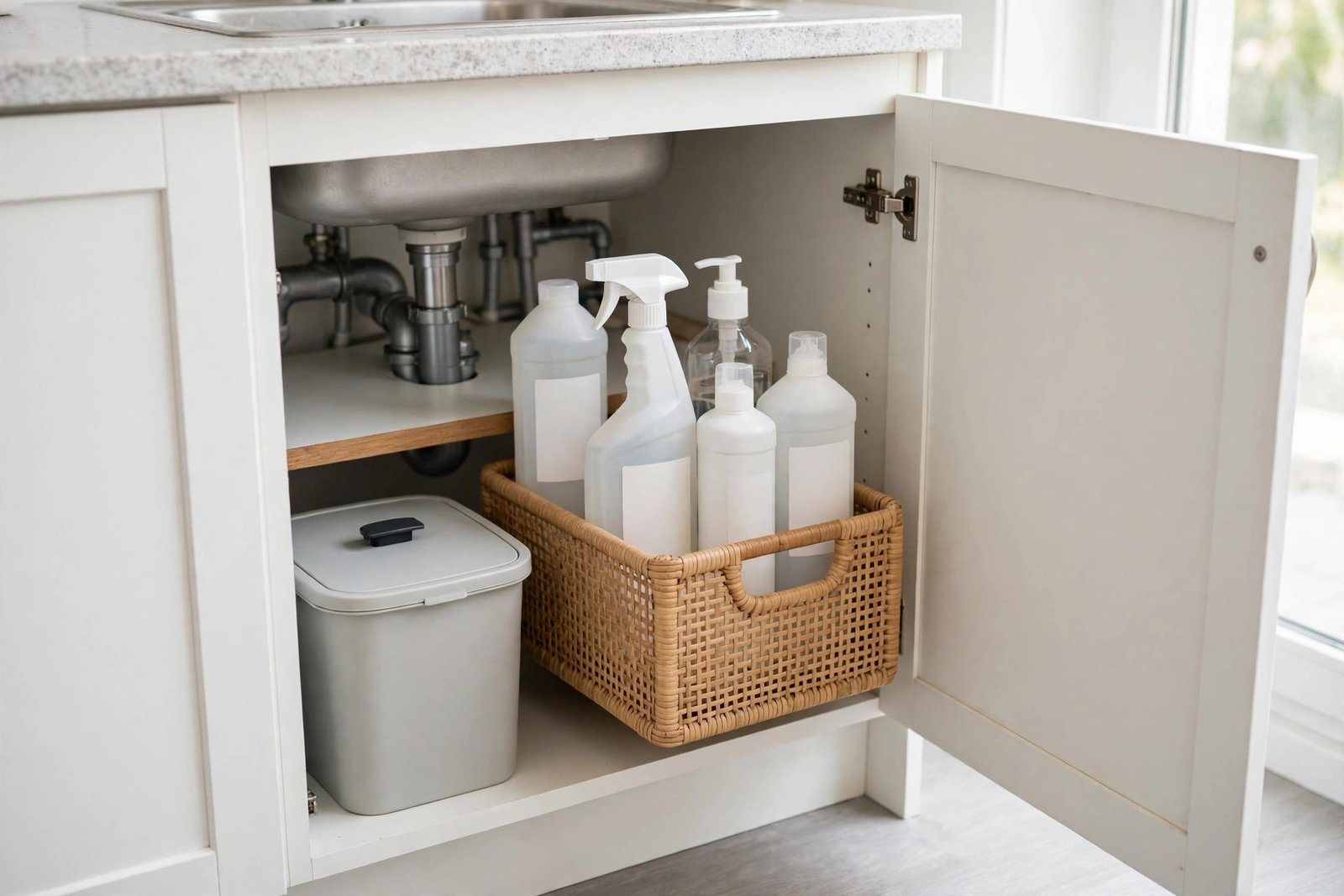
Cleaning supplies are the worst-shaped things in a small rental: tall sprays that fall over, a mop with nowhere to stand, and a vacuum that eats a whole closet corner. These cleaning supply storage ideas give every one of them a home that fits a rental, with nothing drilled and nothing that cannot be packed up on moving day.
The system is simple: one caddy for the bottles you use, one home for the tall tools, and one shelf for the spares. If you are starting from a pile rather than a system, our 7-day declutter plan clears the pile first, and this post keeps it from coming back.
One safety rule runs through all thirteen ideas: products stay in original labelled bottles, upright, out of reach of children and pets. Decanting into a pretty unlabelled bottle is the one shortcut this post will not teach. The blank labels in our photos stand for the labels you already have.
In this post
- The 30-second version
- The carry and the cabinet
- Walls, bathroom and closet
- Daily use, tools and the system
- Common mistakes we’d skip
- The short version
- Questions renters ask
The 30-second version
- Do these 3 first, in order: the portable cleaning caddy (idea 1), the under-sink sliding bin (idea 2), and the daily sink tray (idea 9). Combined: about $35 to $75 for the set.
- 13 ideas, zero drills, zero damage. Most renters need the caddy, one under-sink home and one tall-tool home, about $40 to $90.
- The cleaning checklist and measuring worksheet are in our Free Renter Printables hub.
The carry and the cabinet
1. The portable cleaning caddy
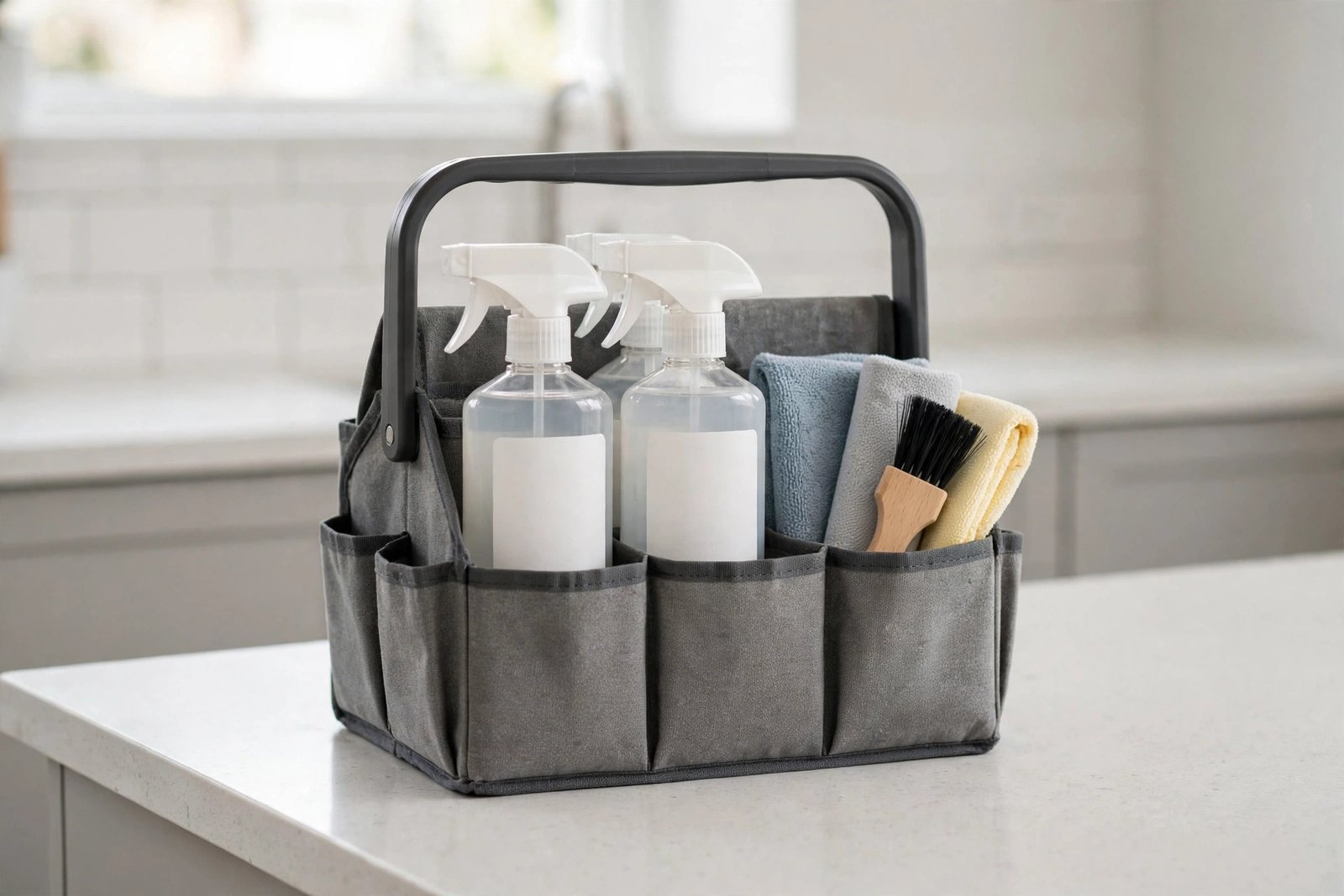
One caddy, carried room to room, beats five half-empty stashes. Put your three or four most-used sprays, two cloths and a small brush in a handled caddy, and carry the whole clean with you. A caddy about 30 cm (12 in) long holds four standard sprays without tipping, and it must be easy to carry one-handed.
Cost: ~$10-20; Best for: every renter, this is the first buy; Measure first: your tallest spray, plus the shelf or cupboard the caddy lives on; Watch out: a caddy wider than its home shelf becomes a countertop resident, which defeats it.
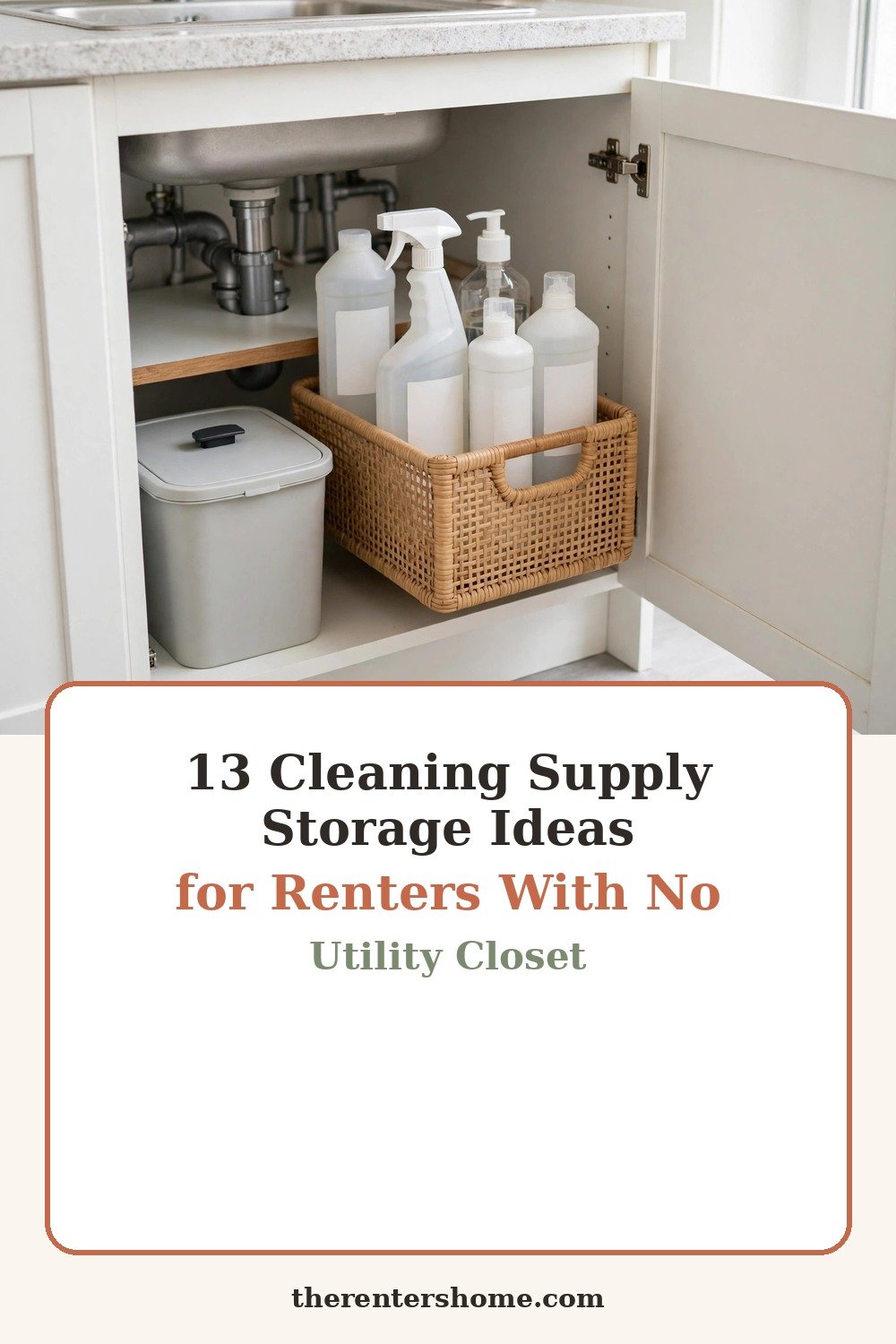
2. The under-sink sliding bin
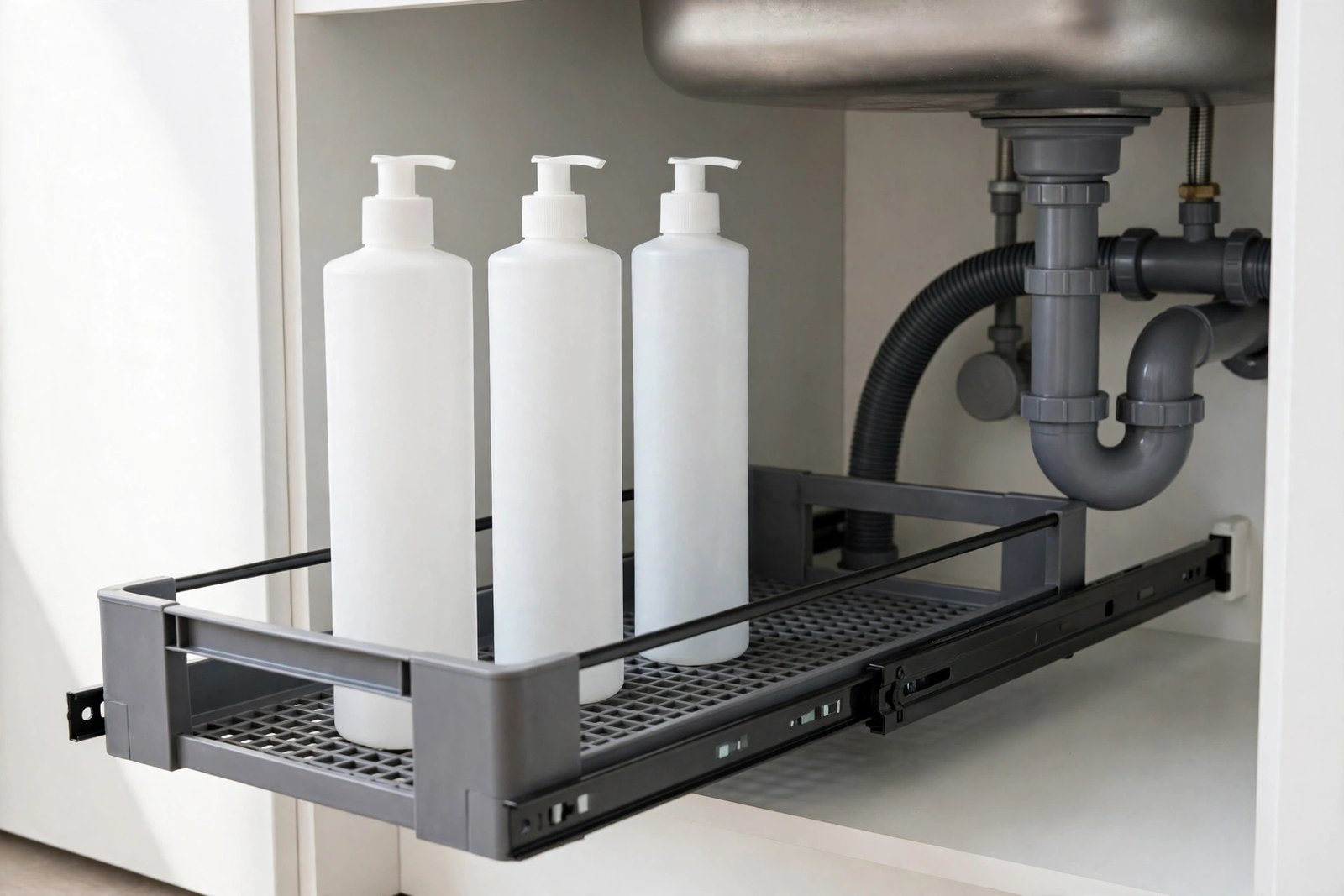
Under the sink is where cleaning bottles belong, but only if you can reach the back ones. A sliding tray on runners pulls the whole row out to you, instead of forcing you to kneel past the trap. Keep bottles upright, tallest at the back, clear of the pipes. See also our under-sink storage ideas.
Cost: ~$15-30; Best for: kitchens with a usable under-sink cabinet; Measure first: the clear width beside the pipes and the cabinet depth, then the tallest bottle; Watch out: a tray that fouls the trap will not slide, and a bottle stored on its side will leak eventually.
3. The door-mounted spray rack
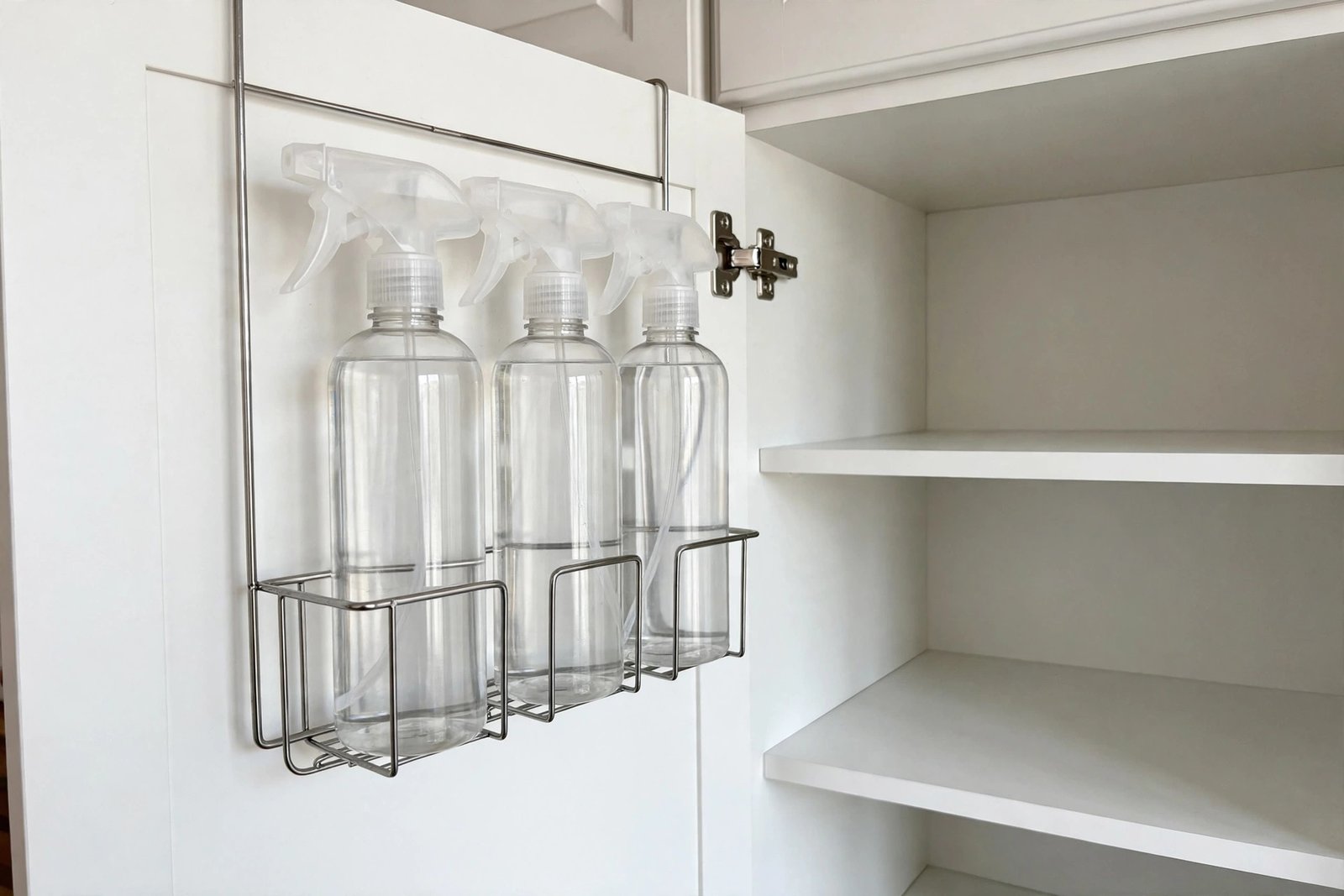
The inside of a cabinet door is free storage, and a rack hooking over the door top uses it without a screw. Three sprays sit upright and visible, so you stop buying a second bottle because you forgot the first. The rack hangs on the door, not the wall, so it is landlord-safe and moving-day easy. Check the door still closes once loaded, heaviest bottle lowest.
Cost: ~$8-18; Best for: renters whose under-sink floor is already full; Measure first: door thickness at the top, plus bottle height against the shelf inside; Watch out: a rack on a thin or warped door swings and bangs, so test the close twice.
4. The slim rolling cart in the gap
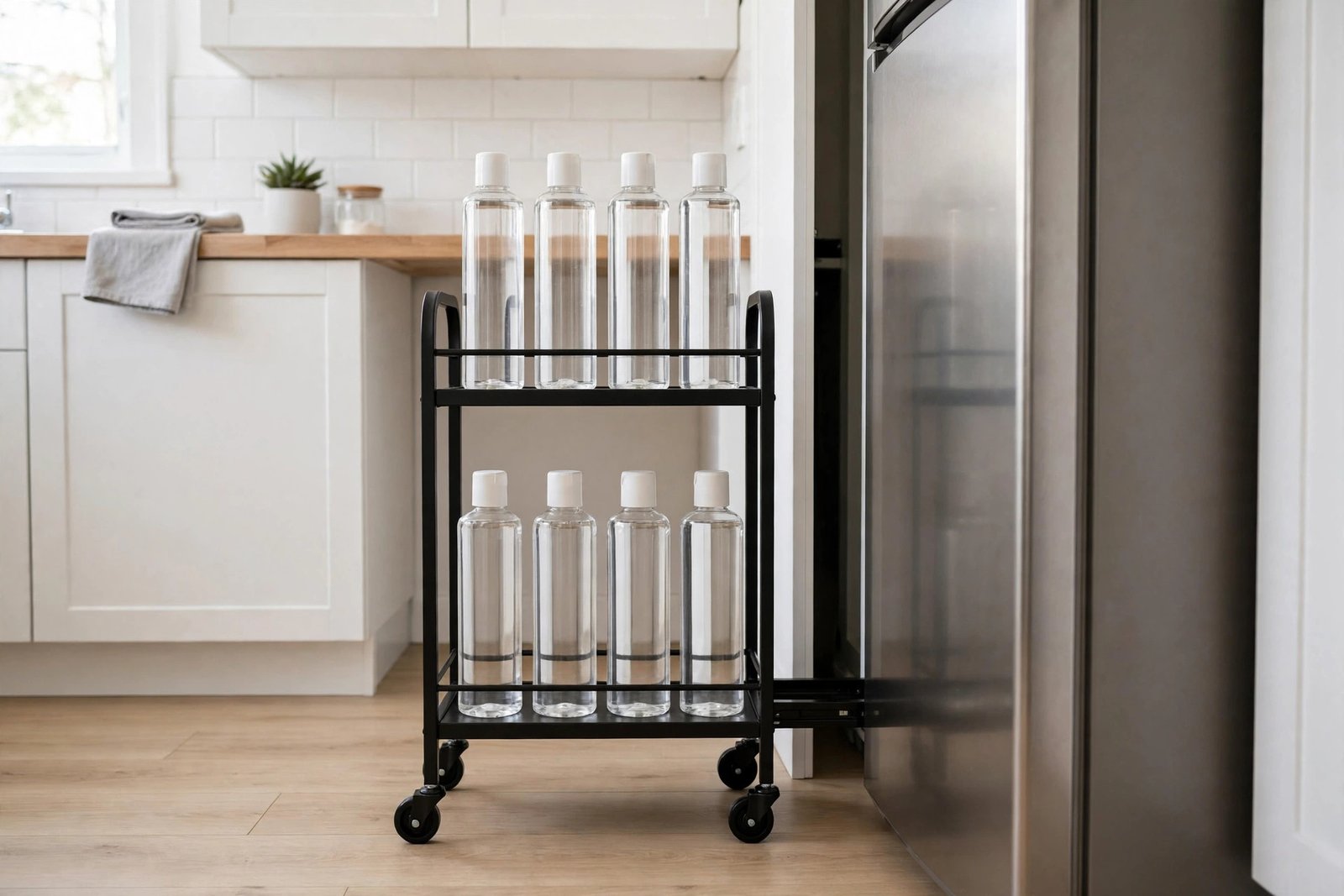
Every rental kitchen has a dead gap: beside the fridge, or at the end of a run of units. A slim rolling cart, about 15 cm (6 in) wide, turns that gap into tall-bottle storage that pulls out like a drawer. Two shelves hold eight to ten bottles, all reachable on wheels. Push it fully home after use, or it becomes a shin hazard.
Cost: ~$20-35; Best for: kitchens with a gap of 15 cm or more; Measure first: the gap width, the gap depth, and the height under any overhang; Watch out: a cart 1 cm too wide will not roll in, so measure the gap in two places, walls are rarely straight.
Walls, bathroom and closet
5. Adhesive holders for the broom and mop

A broom leaning in a corner falls over and blocks a door. Adhesive grip holders, stuck to a smooth wall or the inside of a closet door, hold the broom and mop upright, heads up, off the floor, with no drilling. Hang them so the heads clear the floor, dustpan on a third hook beside them. Use removable rental adhesive on a clean, dry wall, or it will peel within a week.
Cost: ~$8-15 for a set; Best for: utility nooks, closet doors and laundry corners; Measure first: handle diameters, since grips are sized, and the wall height to the head clearance; Watch out: adhesive on textured or damp walls fails, and a mop stored head-down stays damp and smells.
6. A separate bathroom cleaning caddy
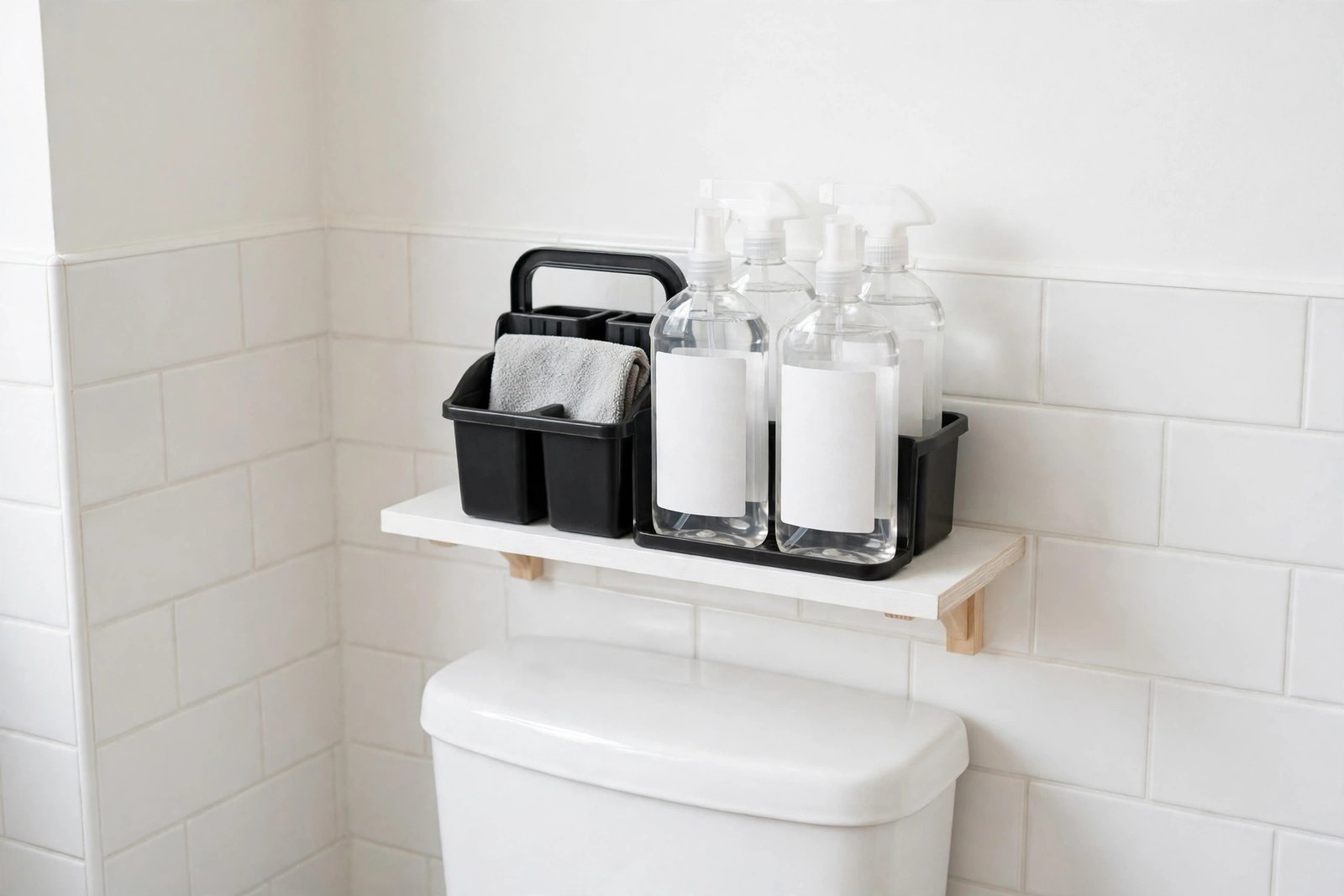
Bathroom cleaners should not live with the kitchen cleaners: the trip to fetch them is why the bathroom gets skipped. A small second caddy, on a shelf above the toilet or in the bathroom cabinet, holds the bathroom spray, a cloth and a brush, nothing else. It pairs with our bathroom weekly clean, which takes twenty minutes when the tools are already in the room. Keep bathroom and kitchen cloths different colours, so they never mix.
Cost: ~$10-18; Best for: renters with a bathroom shelf or cabinet to spare; Measure first: the shelf depth and the tallest bathroom spray; Watch out: a bathroom caddy that lives on the floor gets splashed, so it needs a shelf, not a corner.
7. Closet shelf bins, one per room

If you have a closet shelf to spare, give each room a lidded bin: kitchen, bathroom, and general. Everything for that room lives in its bin, lid on. Lids keep dust off and stop a tipped bottle leaking across the shelf. Label the bins by room on the front, so you find the right one without opening all three.
Cost: ~$15-25 for three bins; Best for: renters with a spare closet or wardrobe shelf; Measure first: shelf width, shelf height with the lid on, and the tallest bottle inside; Watch out: bins without lids collect dust and topple, and an unlabelled bin gets opened three times for every one use.
8. The high shelf basket, out of reach
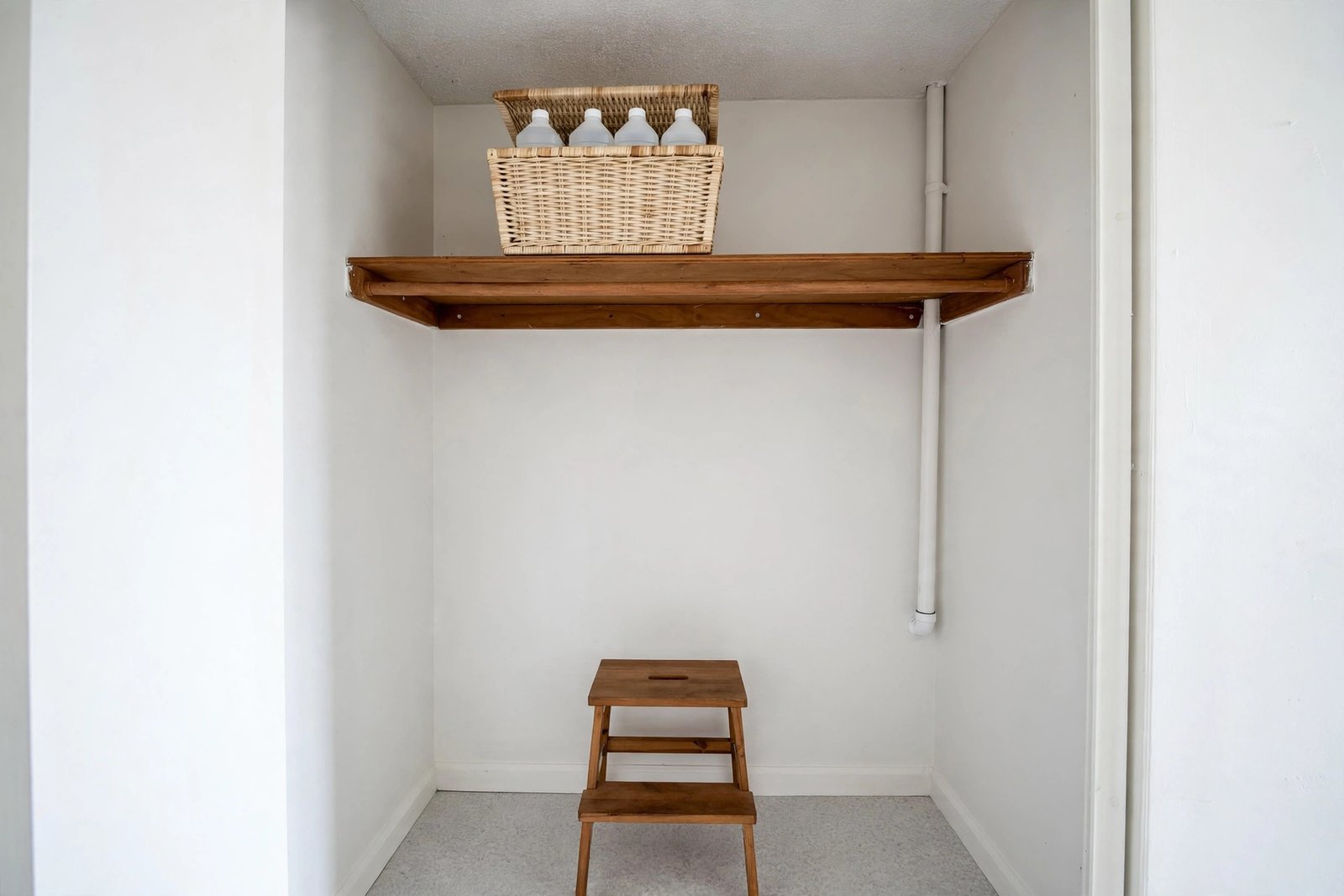
Strong cleaners, used once a month or less, do not belong at hand height, especially where children or pets visit. A lidded basket on a high shelf keeps them up, out of the way, and together, with a step stool nearby for the adult who needs them. This is storage by frequency: daily bottles low, monthly bottles high. The basket needs a lid and a handle, since a high open basket tips when pulled down, and the step stool must live in the same room.
Cost: ~$10-20; Best for: homes with children, pets, or visiting little ones; Measure first: the shelf height against your safe reach with the step stool, and the basket with its lid on; Watch out: never store anything heavy above head height, and never climb on a chair to reach it.
Daily use, tools and the system
9. The daily tray by the sink

Two sprays and a cloth, on a small tray by the sink, handle ninety percent of daily wiping. The tray is the boundary: if a third bottle joins it, one leaves. Wipe the tray itself once a week. This is the daily-use companion to our weekly reset routine.
Cost: ~$8-15; Best for: anyone who wipes surfaces daily; Measure first: the counter space beside the sink, keeping the tap and drying area clear; Watch out: a tray without a lip lets bottles slide off when the counter gets wet.
10. The lidded box and bucket station
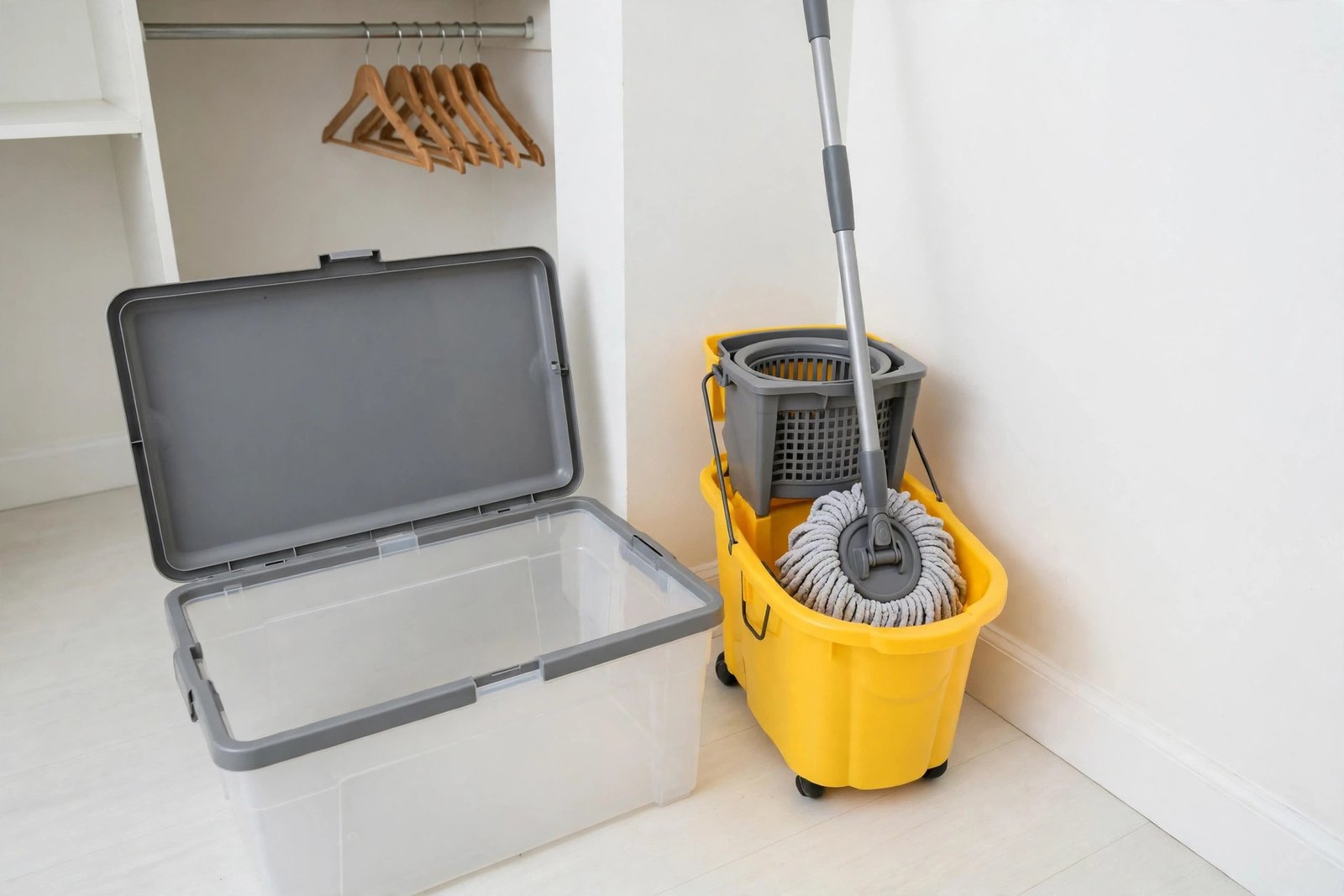
Mops and buckets are the bulkiest tools, and they need one station, not three corners. A lidded box holds spare heads and small tools, the bucket beside it with the mop head inside, one footprint in a closet corner. Store the mop head up and dry, never sealed wet in the box. Measure the corner first, because a box that blocks the door makes the station unusable.
Cost: ~$15-25; Best for: renters with a closet corner or utility nook; Measure first: the corner footprint and the bucket diameter with the mop head inside; Watch out: a damp mop head sealed in a box is a smell factory, dry it first, every time.
Shopping for these? Measure first. Every home here is sized to a bottle, a gap, or a shelf, and the tape measure is cheaper than the return trip. The cleaning checklist and measuring worksheet are in our Free Renter Printables hub.
11. The cloth and refill bin
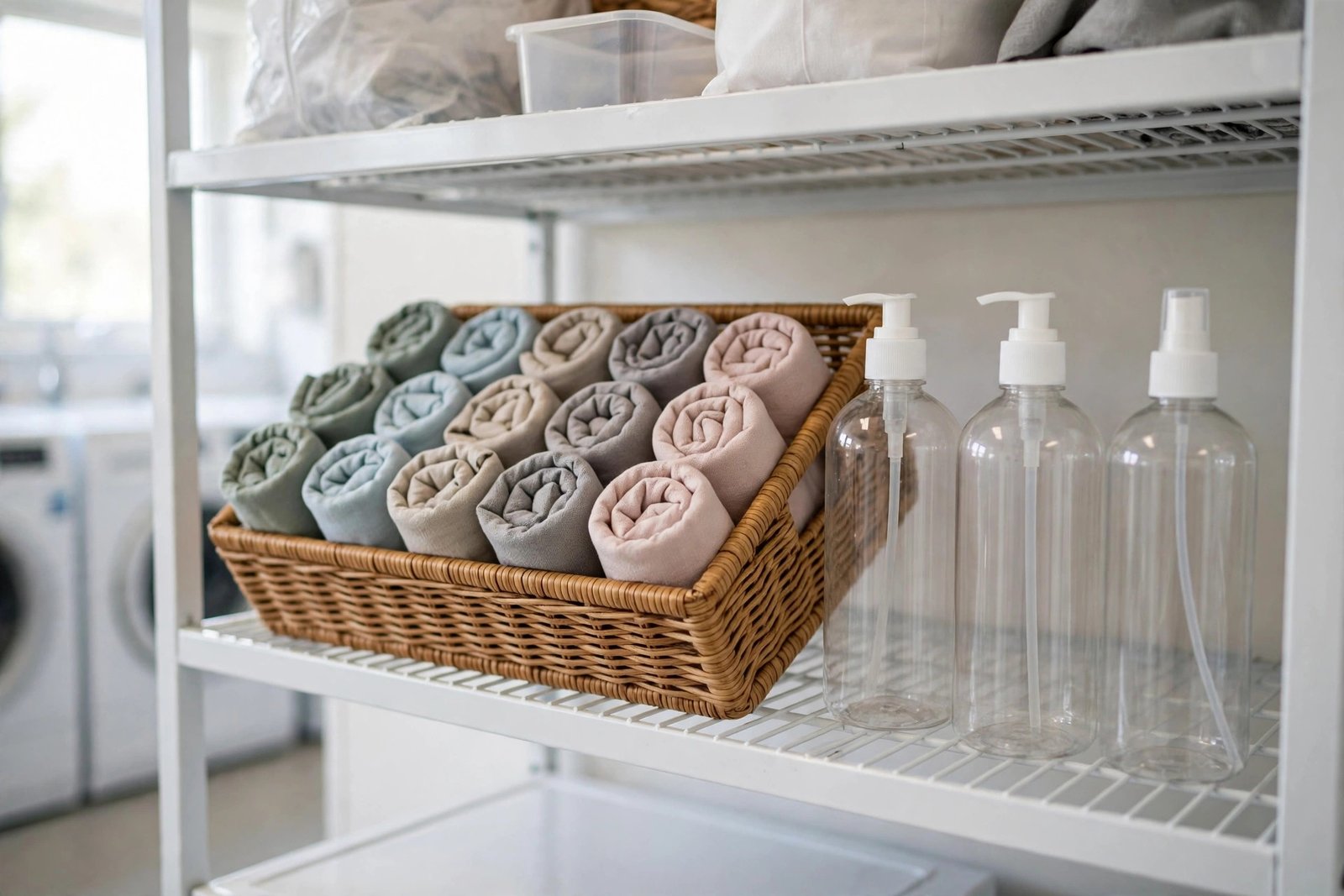
Cloths rolled, not heaped, in an open bin, refill bottles beside it: that is the whole system. Rolled cloths show how many clean ones are left, and refills beside them mean you never run dry mid-clean. Keep cloths for different jobs different colours, and wash them hot, without fabric softener, which coats the fibres. Wash the bin itself once a month.
Cost: ~$10-20; Best for: renters who clean with cloths rather than paper; Measure first: the shelf or bin width against the rolled cloth length; Watch out: softener ruins microfibre, and a damp cloth left rolled in a closed bin smells fast.
12. The vacuum attachments pouch
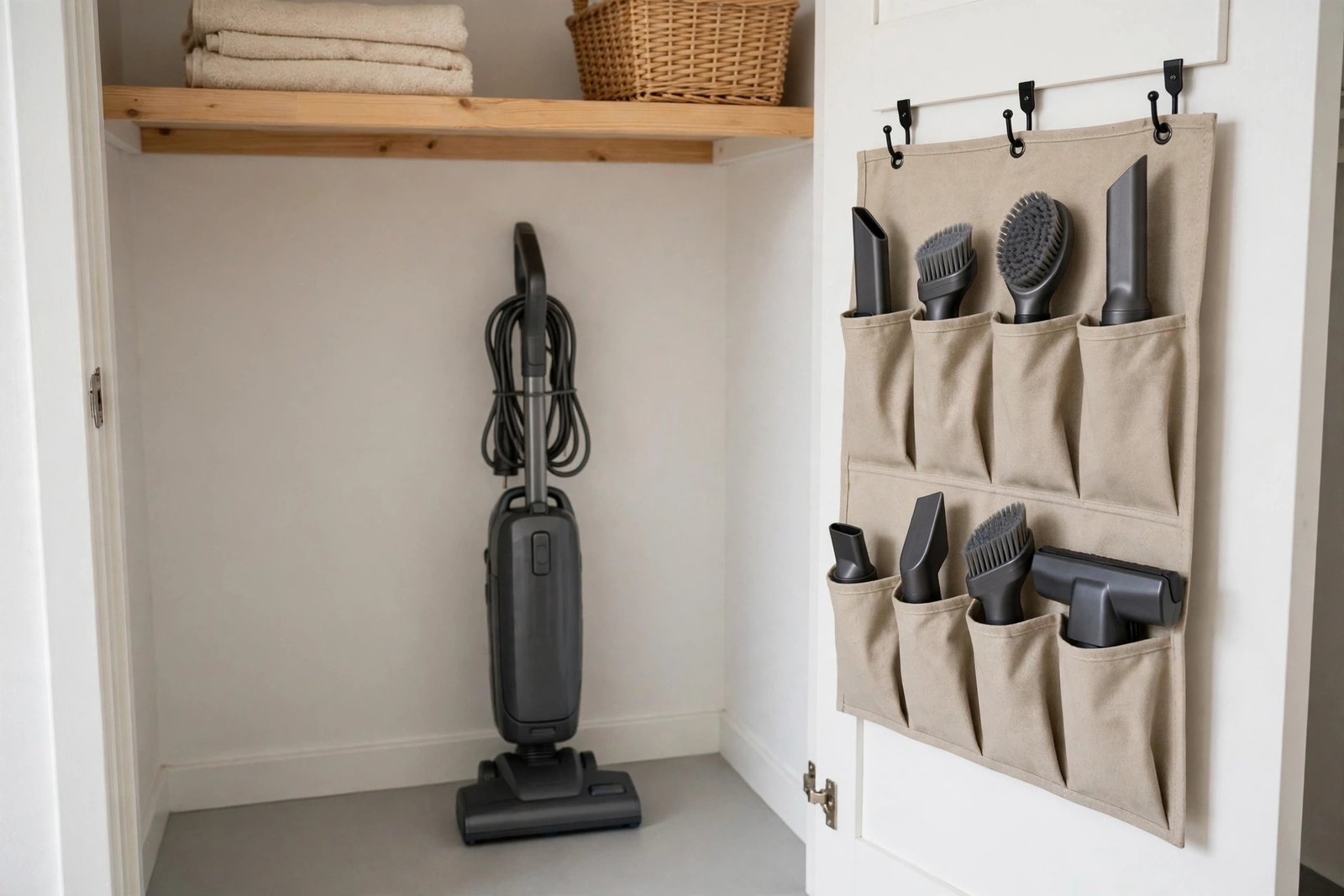
Vacuum attachments vanish: crevice tool in a drawer, brush under the bed, upholstery head nowhere. A hanging pouch on the closet door, one pocket per attachment, keeps them with the vacuum, its cord wrapped in one loop, not a tangle. When you finish, attachments go straight back in the pouch. If the vacuum lives elsewhere, move the pouch, not the attachments.
Cost: ~$10-18; Best for: any renter with a stick or upright vacuum; Measure first: the longest attachment against the pocket depth, and the door the pouch hangs on; Watch out: a pouch on a door that swings into the vacuum blocks the vacuum, so hang it where the door opens clear.
13. The one-spare restock shelf
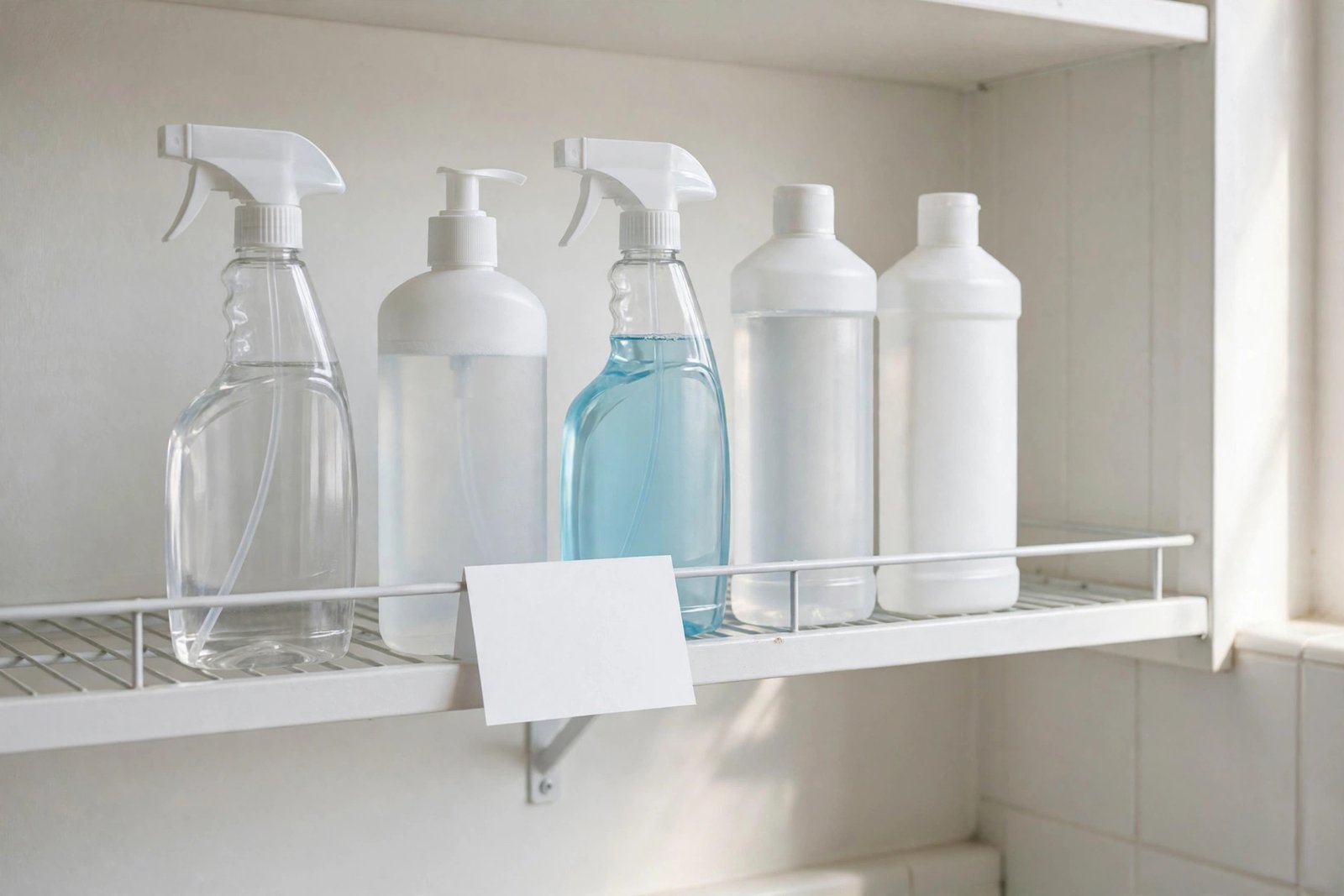
One spare of each regular product on a single shelf, with a small blank card in front: that card is the shopping list. Open a spare, write it on the card, and the card goes shopping with you. One spare, not three: three spares are a stockpile that eats the shelf. Once a month, audit it, and anything unopened for a year leaves the flat, following the product label.
Cost: ~$0, the shelf already exists; Best for: renters who keep running out mid-clean; Measure first: the shelf length against one row of spares, no stacking; Watch out: a restock shelf without the card becomes a second stash, so the card is not optional, it is the system.
Common mistakes we’d skip
- Decanting into unlabelled bottles. A bottle with no label is a risk, especially under a sink. Keep original bottles and labels, always.
- Storing everything under the sink. The cabinet is one home, not the only home. Spread the load, or it becomes a landslide.
- Buying the organiser before measuring. A cart 1 cm too wide, a tray fouling the pipes, a bin taller than its shelf: all returns waiting to happen. Measure first, buy second.
- Keeping the mop head wet and sealed. A damp mop in a closed box smells. Dry first, store second.
- No lid on the high basket. A high open basket tips when pulled down. Up high, lids are the safety feature.
The short version
Thirteen ideas, one system: a caddy for the bottles you use, a home for the tall tools, and a shelf for the spares. Keep products in original bottles, upright and labelled, measure every gap before you buy, and let the daily tray hold only the two sprays you reach for.
Questions renters ask
Where should cleaning supplies be stored in a small rental with no utility closet?
Split them: a caddy for daily bottles, a sliding bin or door rack under the sink, a slim cart in a kitchen gap, and a closet shelf for the rest.
Is it safe to store cleaning products under the kitchen sink?
Yes, if bottles stay upright in original labelled containers, the tray sits clear of the pipes, and strong products go on a high lidded shelf, out of reach of children and pets.
How do I store a mop and bucket in a small apartment?
One station: a lidded box for spare heads beside a bucket with the mop head inside it, in a closet corner, mop head fully dry first.
What size rolling cart fits beside a fridge in a rental kitchen?
Measure the gap in two places, walls are rarely straight, and buy a cart at least 1 cm narrower than the tightest measurement. A cart about 15 cm (6 in) wide fits most gaps, but your gap measurement decides.
📌 Pin this post for later
🖨 Print this post
Tell us your smallest-space problem in the comments below.