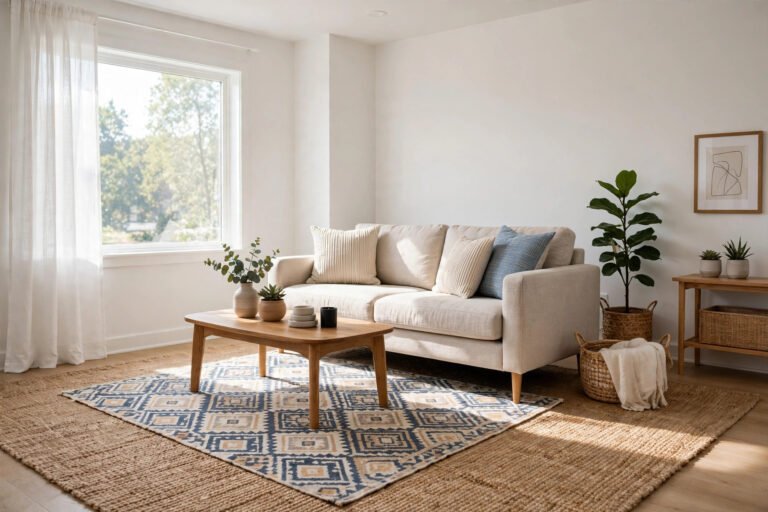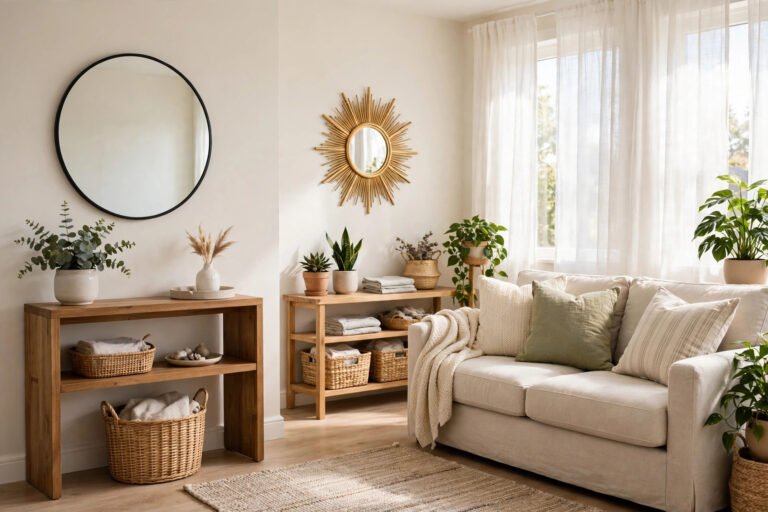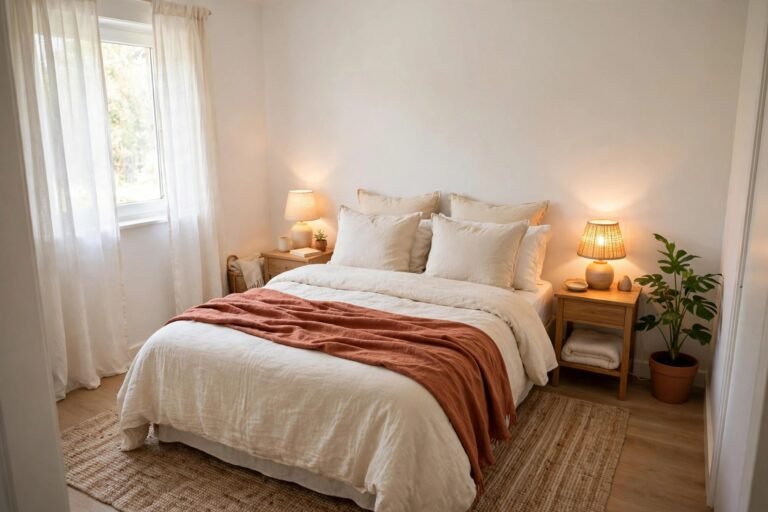


A rental living room usually fails for three reasons: a floor you would never choose, walls you cannot touch, and one harsh ceiling bulb. None needs paint, nails or permission to fix. These rental-friendly living room ideas work in layers: cover the floor, lean or stick the art, plug in the lighting, then hide the storage and cords. Every idea reverses on moving day, and most take under an hour.
Start with 17 No-Drill Decor Ideas, sort storage with 21 No-Pantry Storage Ideas, and keep the room finished with The Sunday Reset.
In this post
About 11 min read · 100% renter-friendly — no drills, no nails, no paint.
The 30-second version
- Do these 3 first, in order: a large washable rug (idea 1), a leaning art piece (idea 2), and plug-in sconces (idea 7). About $110 to $190 together; they fix floor, main wall and lighting in one afternoon.
- 19 ideas, zero paint, zero nails, zero drills. Everything leans, sticks, tensions into a frame, plugs in or stands on its own feet.
- Typical cost: most renters need 5 to 8 ideas, about $150 to $300 total. Measure first; free worksheets are in the Free Renter Printables hub.
Floors, walls and windows
1. Cover the floor with one large washable rug
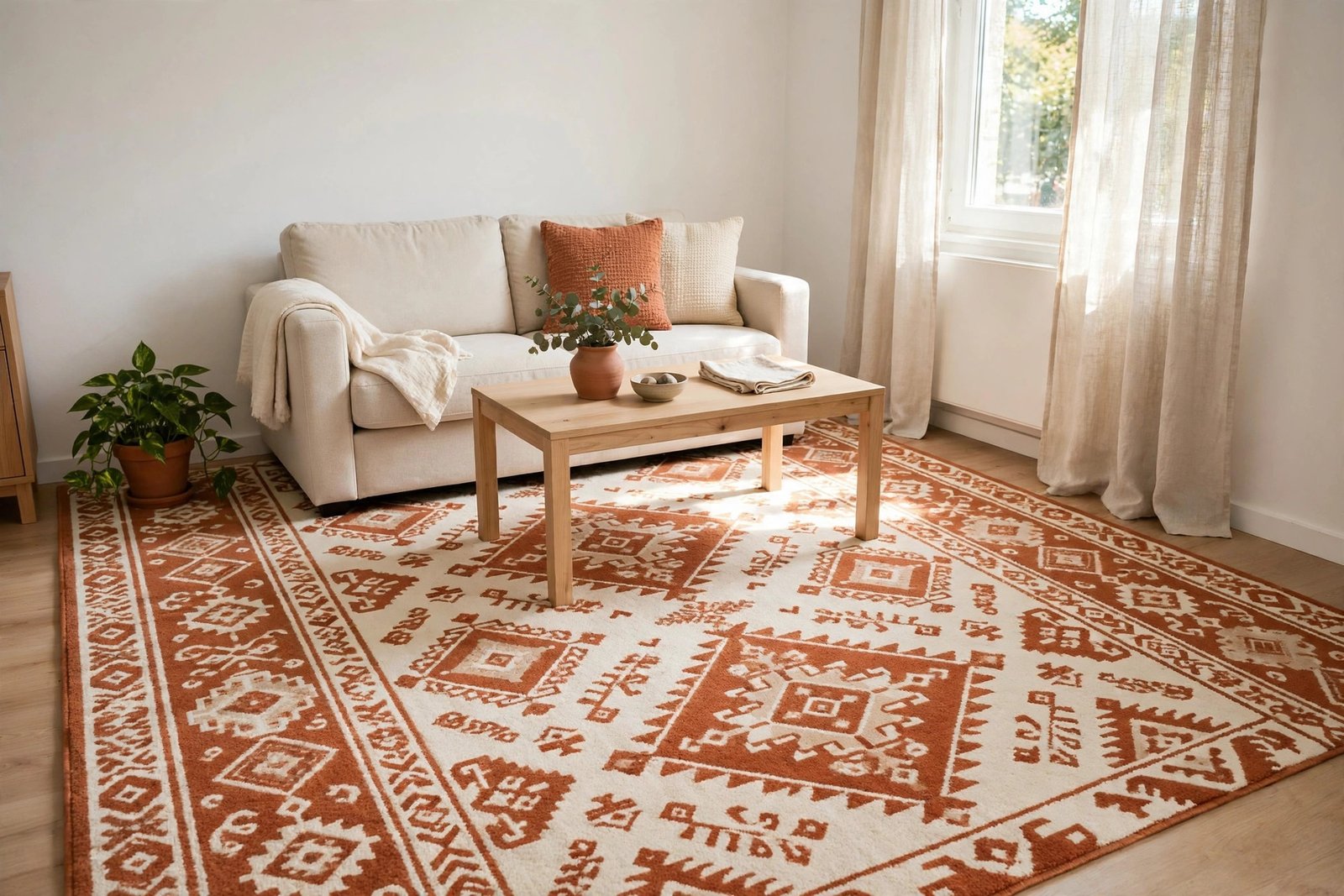
One big rug changes more than any other buy. It covers worn laminate or tired carpet, sets the palette, and tells the furniture where it belongs. Go washable.
Cost: ~$60–120 • Best for: ugly, cold or echoey rental floors • Measure first: the seating zone; the front legs of the sofa and chairs should all sit on it, usually 160 by 230 cm (5 by 8 ft) minimum • Watch out: check door clearance; a thick pile under a swinging door will drag and curl.
2. Lean one large artwork or mirror instead of hanging it
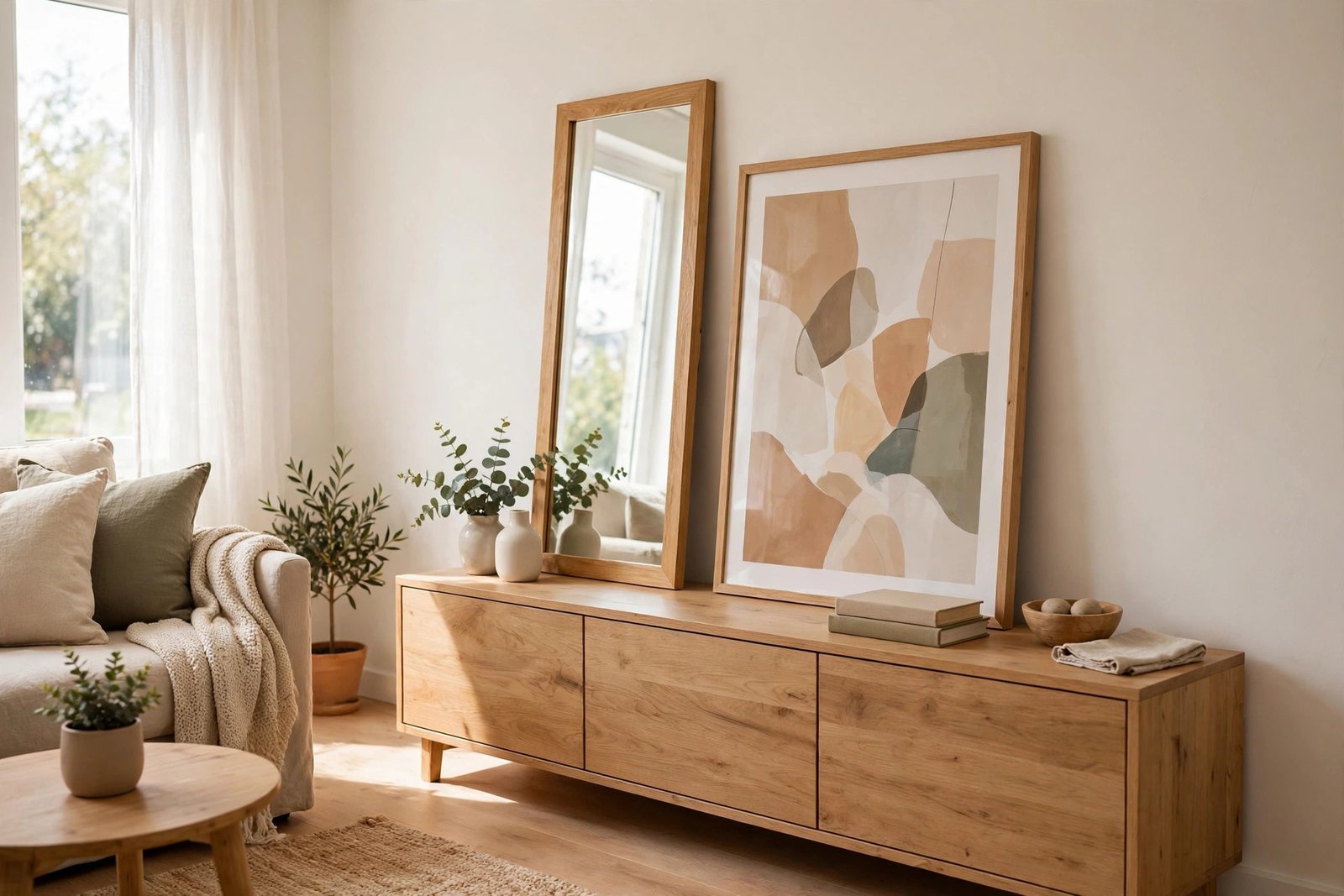
A big framed print or mirror, leant on a sideboard or the floor, gives a hung piece’s impact with no hole. Leaning reads deliberate when the piece is large; a mirror bounces light into dark corners.
Cost: ~$30–80 • Best for: the blank main wall behind the sofa or sideboard • Measure first: the sideboard width; the frame should be about two thirds as wide • Watch out: add a non-slip pad underneath; keep out of toddler and pet routes.
3. Hang a light gallery wall with adhesive strips

Six small frames on rated adhesive strips make a gallery wall that peels off clean. Plan it on the floor, photograph it, then work from the centre out. Keep frames light; that is what protects the paint.
Cost: ~$25–50 for frames and strips • Best for: renters who want art at eye level, not leant • Measure first: the wall width; leave 5 to 8 cm (2 to 3 in) between frames • Watch out: strips fail on dusty walls; wipe, dry, respect the rating per pair.
4. Stand a leaning ladder shelf against the wall

A ladder shelf gives display and book storage on its own feet: books low, plant and baskets higher. It fills a tall, narrow gap a bookcase would overwhelm.
Cost: ~$45–90 • Best for: a narrow gap beside the sofa or TV unit • Measure first: floor to ceiling height and the skirting board depth at the base • Watch out: load bottom shelves heaviest; top-heavy shelves walk forward on carpet.
5. Hang curtains high on a tension rod inside the frame

Curtains inside the frame on a tension rod add softness, privacy and insulation, no brackets needed. Full length matters: floor-length curtains make a rental window look chosen.
Cost: ~$30–60 for rod and curtains • Best for: overlooked rooms and thin, draughty windows • Measure first: the inside frame width at three points; rods grip the narrowest • Watch out: wide windows sag; over 150 cm (59 in), choose sheers only or a supported rod.
6. Add static-cling window film for privacy

Frosted film sticks with water, not glue, and peels off clean. Use it on a street-facing window’s lower half: privacy at seated height, light above.
Cost: ~$12–25 per window • Best for: ground-floor and overlooked living rooms • Measure first: the glass pane only, then cut 1 cm (0.5 in) oversize and trim in place • Watch out: bubbles mean too little water; soak, squeegee slowly, redo rather than poking holes.
Lighting and layout
7. Plug in wall sconces either side of the sofa

Plug-in sconces give layered light a ceiling bulb never will. Run cords down inside a cord cover so the wall stays clean. Warm bulbs, always.
Cost: ~$35–70 for a pair • Best for: rooms lit by one harsh overhead light • Measure first: socket distance; most cords run 1.5 to 2 m (5 to 6.5 ft) • Watch out: some plug-in sconces still expect screws; choose adhesive or clamp models.
8. Drape a plug-in swag pendant over the reading corner

A swag pendant plugs in like a lamp but hangs like a fitting: cord up the wall, across on a removable hook, down over an armchair. A dead corner becomes everyone’s favourite seat.
Cost: ~$30–60 • Best for: a dark corner that needs a job • Measure first: the cord route from socket to seat; most swag cords are 4 to 5 m (13 to 16 ft) • Watch out: keep the shade 30 cm (12 in) above seated head height.
9. Stick battery puck lights into the bookcase

Battery puck lights under bookcase shelves light books and objects like a display, no wiring needed. Choose warm, remote or tap models so batteries last.
Cost: ~$12–22 for a pack of six • Best for: dark bookcases, media units and glass cabinets • Measure first: shelf underside depth; pucks are about 7 cm (3 in) across • Watch out: cool-white pucks look like a fridge; choose warm white, 2700 to 3000K, every time.
10. Float the sofa and put a slim console behind it

Pulling the sofa 20 to 30 cm off the wall, with a slim console behind it, makes a small room feel larger. The console holds a lamp, drinks and a plant.
Cost: ~$40–80 • Best for: rooms where everything is pushed against the walls • Measure first: the gap you can afford; consoles run 20 to 30 cm (8 to 12 in) deep • Watch out: keep the walkway in front at least 75 cm (30 in) clear.
11. Zone the room with a freestanding bookshelf divider

In a studio or long room, one open bookshelf at right angles makes two rooms of one: living one side, desk or dining the other. Style both sides.
Cost: ~$50–100 • Best for: studios and long, corridor-like living rooms • Measure first: the ceiling height and the swing of any door the shelf edge might block • Watch out: keep heavy books low; never let children climb it.
Shopping for these? Measure first.
Note the seating zone, sofa wall, sockets and window frames before ordering. The free worksheet in our Free Renter Printables hub was built for this.
Storage and hiding the rental bits
12. Use a storage ottoman as seat, table and blanket box
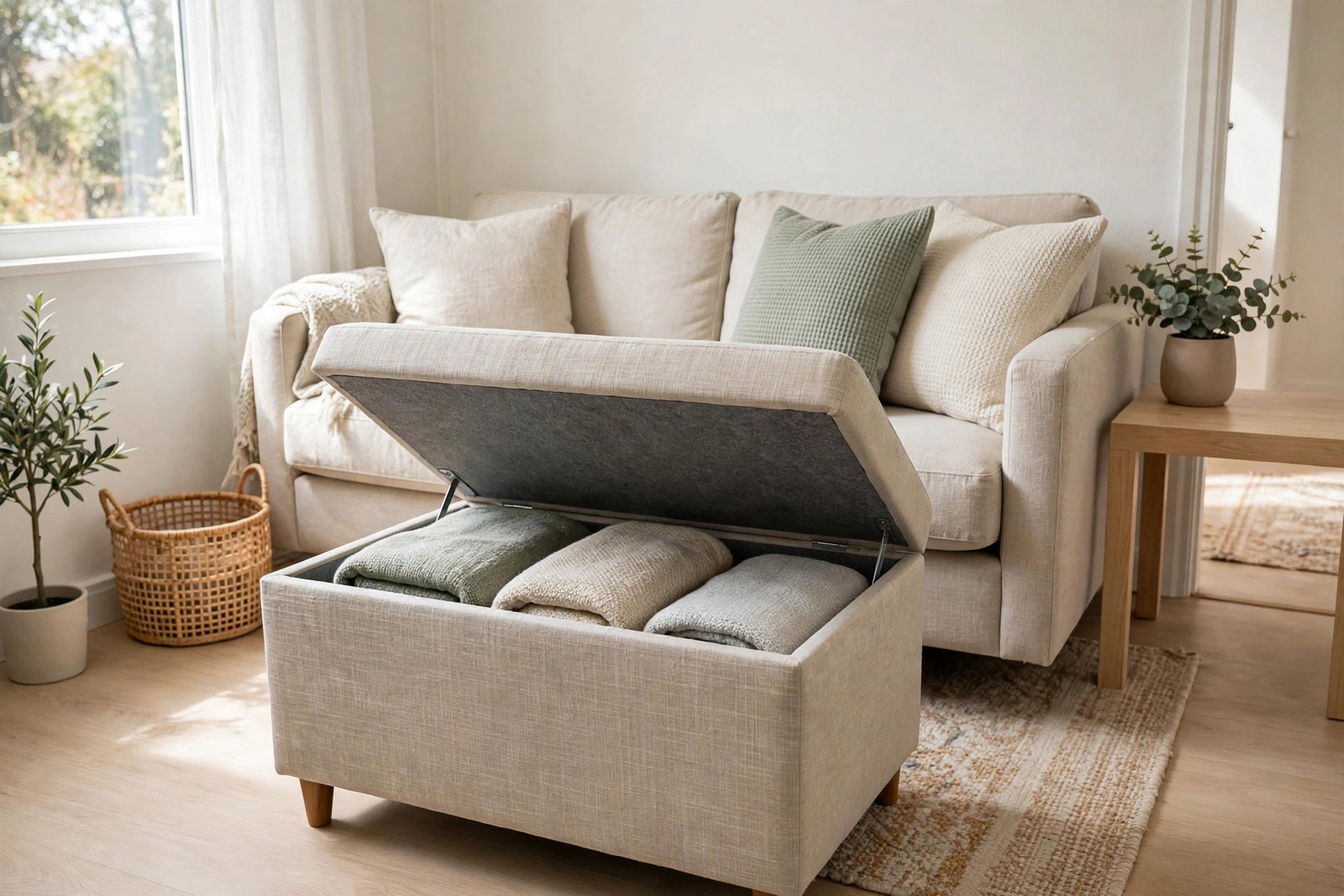
A storage ottoman earns its space three ways: spare seat, footrest, and home for throws and games. With a tray on top it covers for a coffee table too.
Cost: ~$35–70 • Best for: blanket and game clutter with nowhere to go • Measure first: the space in front of the sofa; leave about 45 cm (18 in) between sofa edge and ottoman • Watch out: check the lid’s weight rating before using it as a table.
13. Line up lidded baskets for the small clutter

Remotes, chargers, coasters: small clutter makes a tidy room look untidy. Matching lidded baskets on one low shelf give it a closed home. Lids matter.
Cost: ~$20–35 for three • Best for: media units and low shelves near the sofa • Measure first: shelf height and depth; most baskets run 25 to 35 cm (10 to 14 in) wide • Watch out: one basket per category; mixed baskets become junk drawers.
14. Hide the cords and router in a cable box
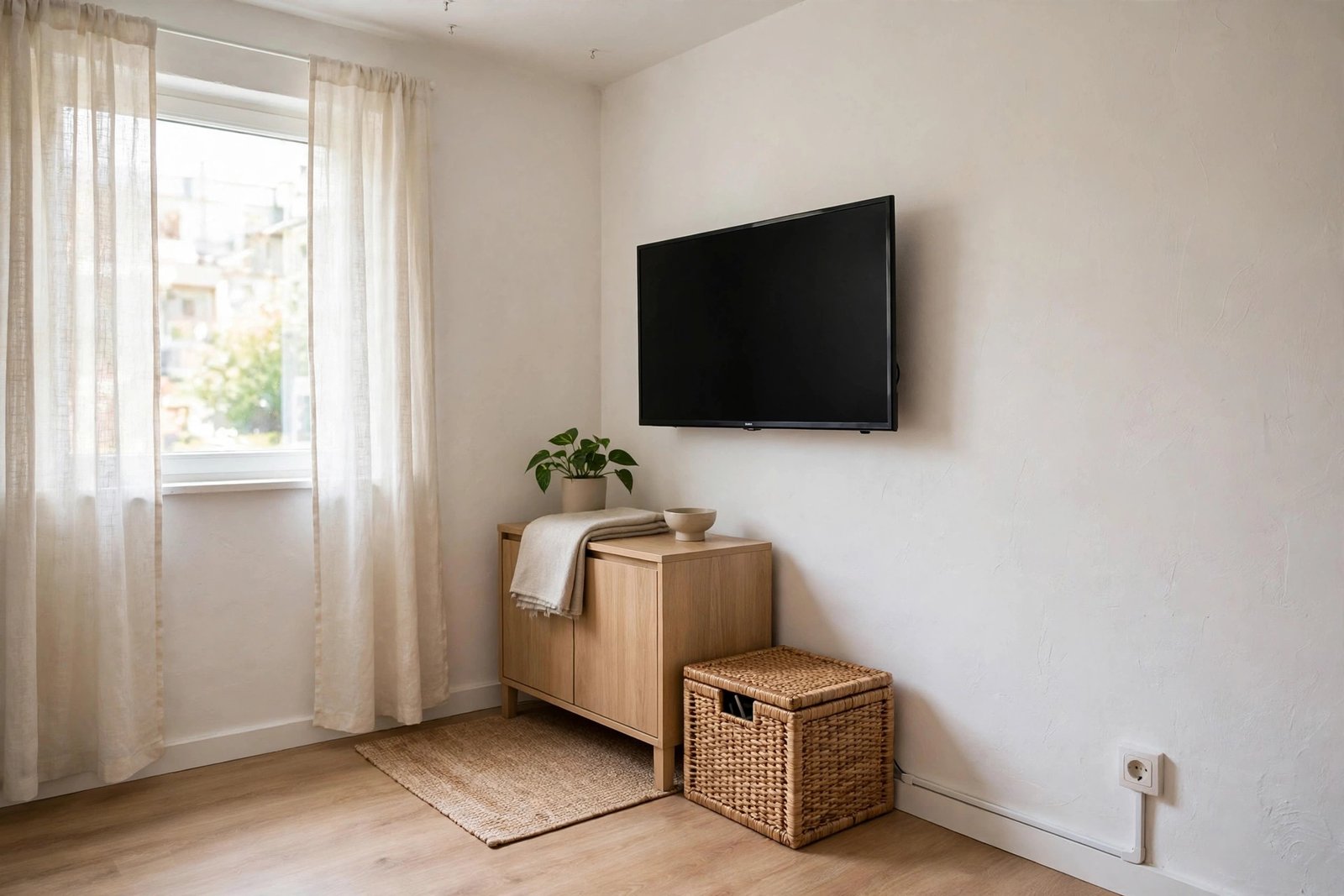
The nest behind the TV is most rentals’ cheapest-looking corner. A lidded cable box hides the power strip, a ventilated cover disguises the router, and a flat cord cover reaches the socket safely.
Cost: ~$15–30 • Best for: TV corners and router shelves on open display • Measure first: the power strip length; boxes run 30 to 40 cm (12 to 16 in) • Watch out: routers need air; never bury a hot power strip in fabric.
15. Screen the ugly corner with a folding screen

Every rental has one undecoratable corner: a meter box, a stained wall, the laundry rack’s spot. A folding screen simply stands in front of it.
Cost: ~$40–75 • Best for: utility corners, spare-room overflow, work-from-home backdrops • Measure first: the corner width; most screens span 120 to 160 cm (47 to 63 in) across three panels • Watch out: keep clear of radiators that are on; hide a cold radiator, never a hot one.
Textiles and finishing touches
16. Refresh a tired sofa with a fitted cover
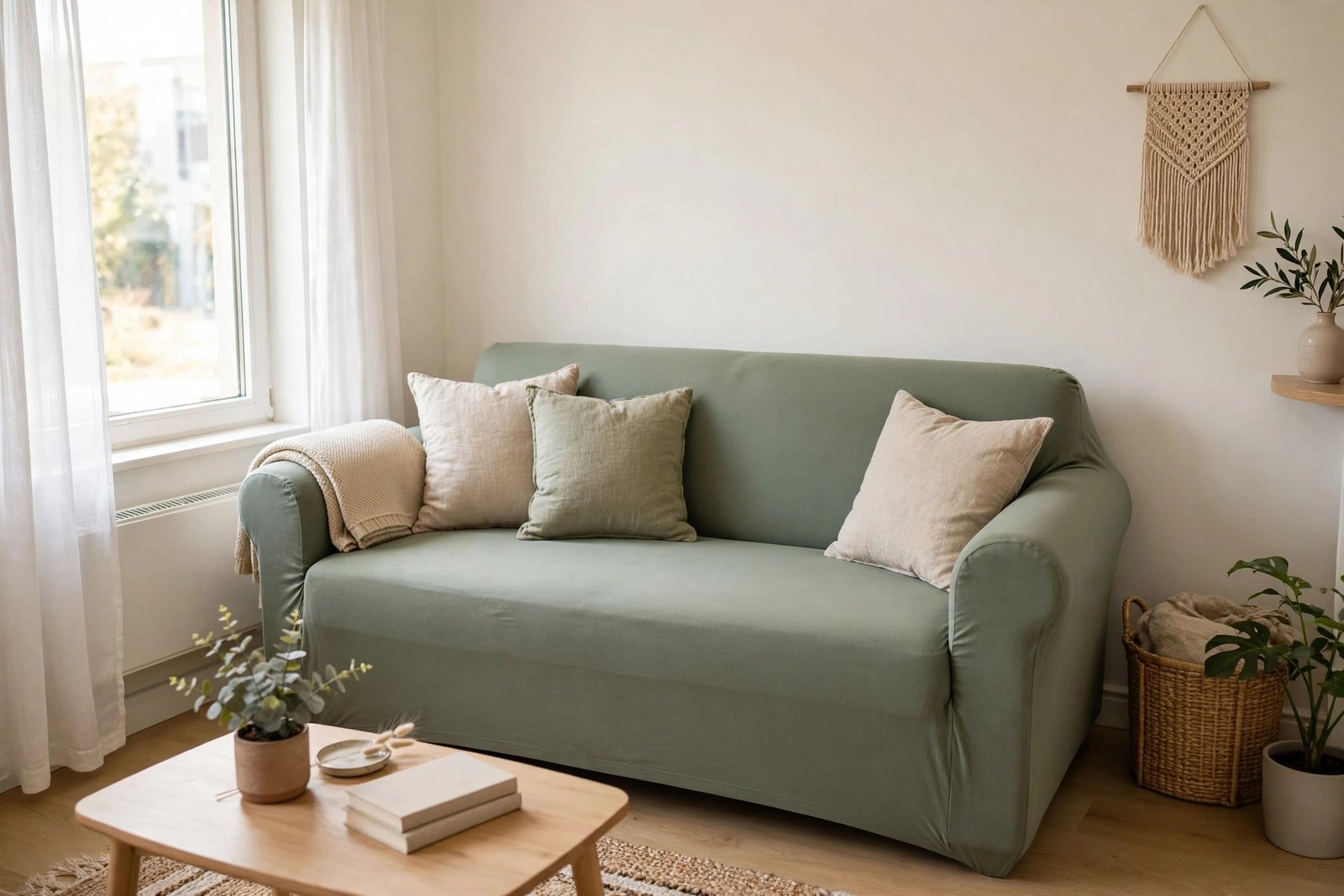
If the sofa came with the flat, its fabric is rarely your colour. A stretch fitted cover in one calm colour changes the room’s largest object cheaply, and protects the landlord’s upholstery too.
Cost: ~$25–45 • Best for: furnished rentals with a dated or clashing sofa • Measure first: the sofa back width, arm to arm; covers size by that, not by seat count alone • Watch out: shiny thin covers slip; choose matte textured fabric and tuck excess with the foam sticks.
17. Layer throws and cushion covers, not new cushions
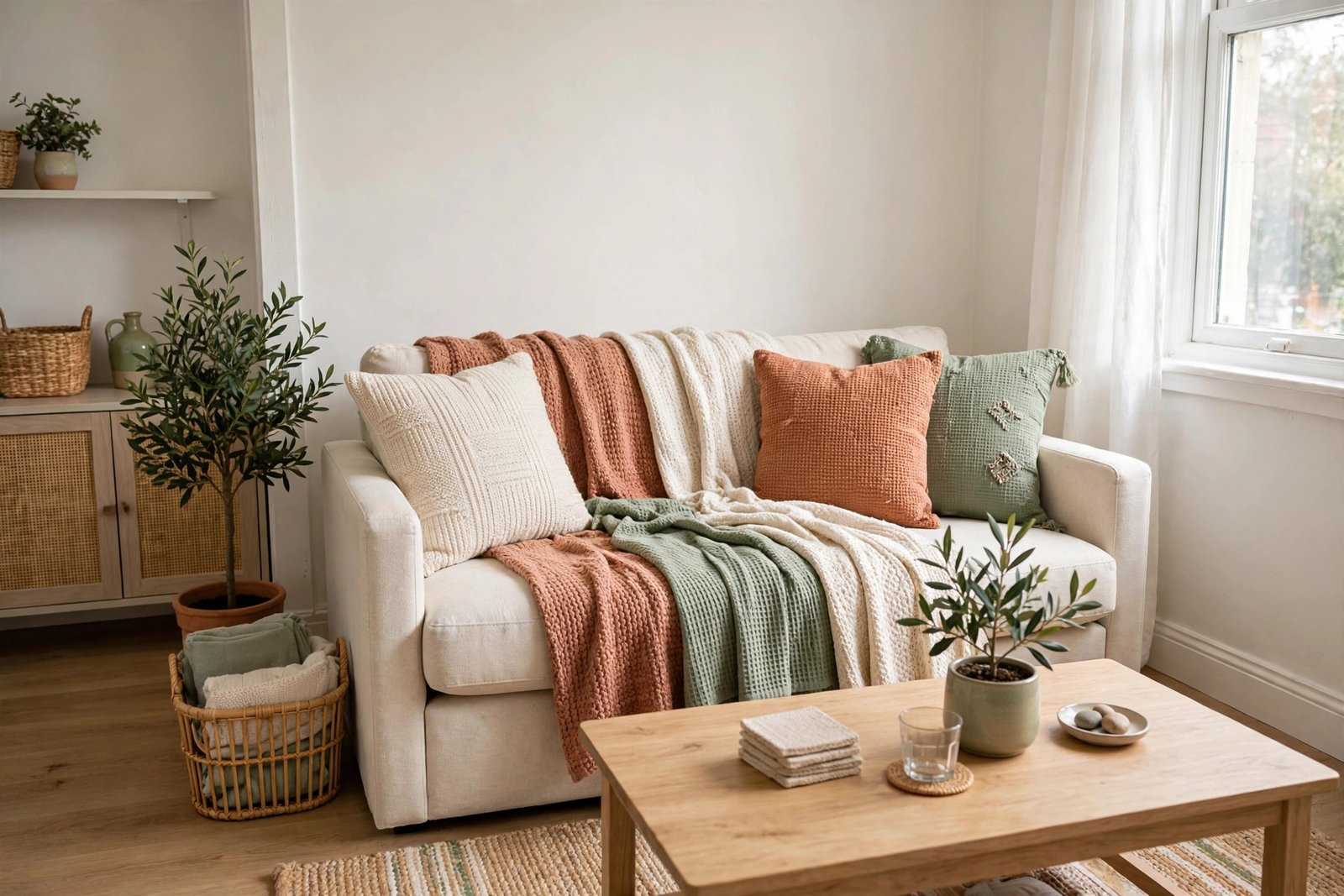
Texture makes a plain room feel finished. Two throws and three cushion covers in your palette, over cushions you own, deliver it cheaply. Mix knit, woven and smooth fabrics.
Cost: ~$20–40 • Best for: plain sofas and rooms that feel flat despite being tidy • Measure first: your cushion pads; covers should match the pad size exactly, usually 45 by 45 cm (18 by 18 in) • Watch out: stop at two throws; more reads as a blanket collection.
18. Fill the empty corner with one tall plant

One tall plant in a woven basket does art, screen and softness at once in the corner nothing else fits. Choose by your light. Height is the point.
Cost: ~$25–50 including the basket pot • Best for: the empty corner beside the sofa or TV • Measure first: the corner footprint; allow 50 to 60 cm (20 to 24 in) of spread for a mature plant • Watch out: check pet toxicity; use a saucer inside the basket.
19. Swap the coffee table for nesting tables

A fixed coffee table eats a small room’s centre all day. Nesting tables slide out for drinks and guests, then tuck back, freeing the floor.
Cost: ~$35–65 for a pair • Best for: small rooms that double as play, work or workout space • Measure first: the tucked footprint; most pairs nest into about 50 by 40 cm (20 by 16 in) • Watch out: light tables wobble; choose solid tops, about 45 cm (18 in) tall.
Common mistakes we’d skip
- Pushing all furniture against the walls. It looks like a waiting room. Floating the sofa on a rug (ideas 1 and 10) is the change visitors notice most.
- Trusting adhesive strips beyond their rating. Weigh the frame, read the pack, pull the tab straight down on moving day.
- One bright ceiling light and nothing else. Layered plug-in light (ideas 7 to 9) makes the same furniture look expensive by evening.
- Buying decor before storage. With cords and blankets still homeless (ideas 12 to 14), no room looks finished. Storage first, then decor: Post 1.
The short version
Cover the floor, lean or stick the art, plug in warm light, float the furniture, hide storage and cords, finish with textiles and one tall plant. Nothing touches paint or a drill. Start with ideas 1, 2 and 7.
Questions renters ask
What makes the biggest difference in a rental living room for the least money?
The rug and the lighting. A large washable rug (idea 1) plus plug-in sconces or a swag pendant (ideas 7 and 8) change floor, walls and evenings for about $95 to $180.
Will adhesive strips really hold a gallery wall?
Yes, for light frames within the rated weight, on clean, sound paint. Weigh each frame, follow the pack’s pairing guide, and never hang heavy glass frames over a sofa or bed.
How do I add curtains if I’m not allowed brackets?
A tension rod inside the frame (idea 5), or adhesive hook brackets rated for the rod’s weight. Measure the frame at three points first.
Can I make a studio feel like separate rooms without building anything?
Yes. A rug, a floated sofa and one open bookshelf divider (ideas 1, 10 and 11) create clear zones light still passes through.
Found this useful?
Save it to Pinterest for later, or tell us your smallest-space problem in the comments — the best posts here started as a reader’s awkward room.
📌 Pin this post · 🖨 Print this post
📌 PIN THIS FOR LATER

🖨️ PRINT THIS POST
💬 Tell us your smallest-space problem in the comments below.