

Christmas is the hardest season in a rental: shops sell six-foot trees to people with garages. These small-space Christmas decor ideas work backwards from storage. Every piece folds flat, coils, nests or stacks, and the whole set fits one clear box of about 64 litres. No paint, no nails, no drilling.
This is the Christmas version of our fall decor post — same box, same rule. For the room underneath, see 19 Rental-Friendly Living Room Ideas and 17 No-Drill Decor Ideas.
In this post
About 12 min read · 100% renter-friendly — no drills, no nails, no paint.
- The 30-second version
- The tree, scaled down (ideas 1 to 3)
- Soft swaps that fold flat (ideas 4 to 6)
- Doors, walls and glass, no nails (ideas 7 to 10)
- Small pieces that nest, line up or hang flat (ideas 11 to 13)
- The table and the box that holds it all (ideas 14 to 15)
- Common mistakes we’d skip
- The short version
- Questions renters ask
The 30-second version
- Do these 3 first, in order: the tabletop tree (idea 1), the cushion covers (idea 4), and the storage box itself (idea 15), bought first. About $60 to $100 together.
- 15 ideas, zero drills, zero paint, zero nails. Everything folds flat, coils, nests, stacks, or hangs from a removable hook.
- Typical cost: most renters need 8 to 10 ideas, about $120 to $210 total. The box is about 60 by 40 by 32 cm (24 by 16 by 13 in); if a piece would not fit, skip it. Planning help: Free Renter Printables.
The tree, scaled down
1. Choose a tabletop tree, not a floor tree
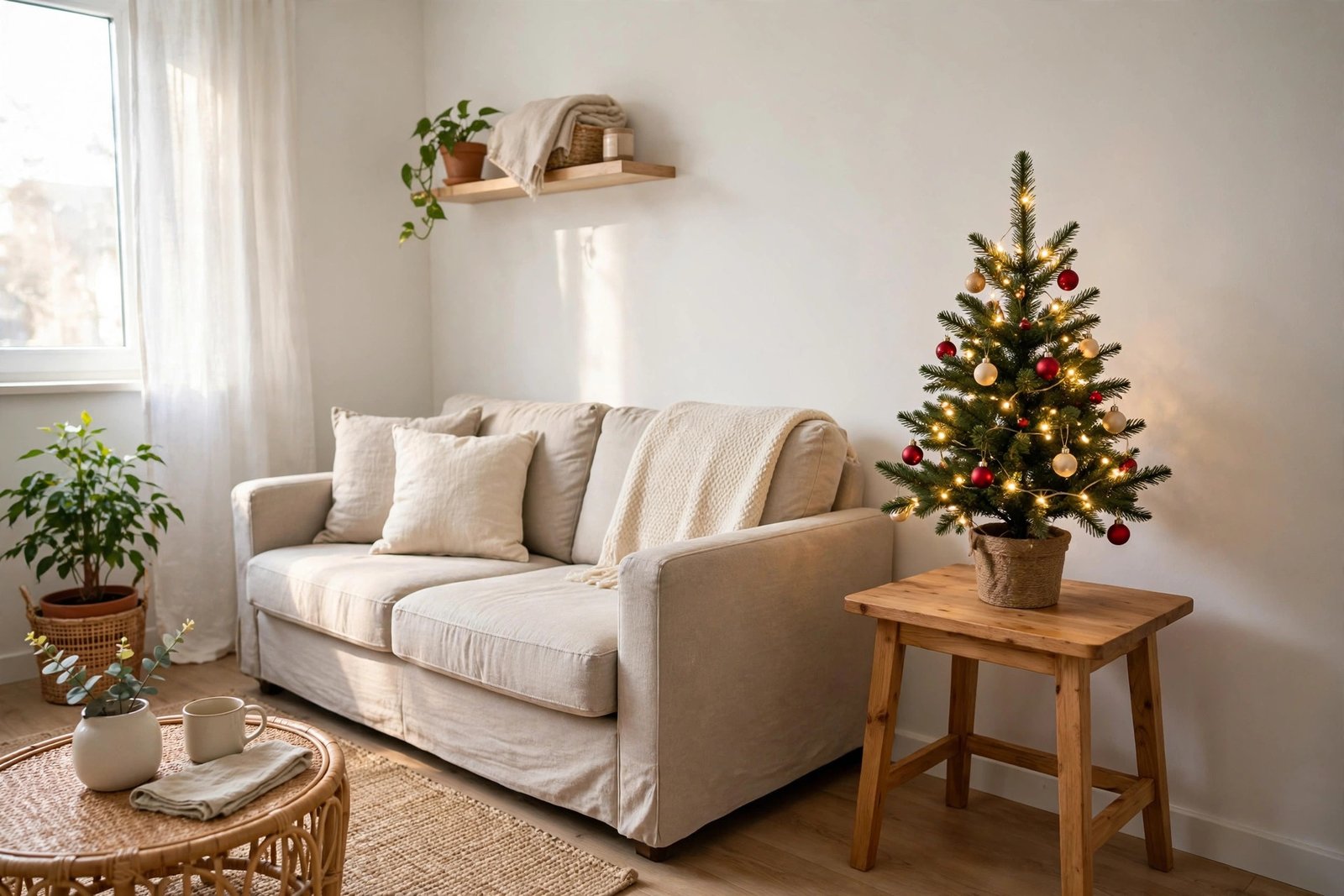
A 90 cm (3 ft) tree on a side table reads as a proper tree at eye level, without eating floor. Hinged branches fold against the stem, the base unscrews, and it lies diagonally across the box. Dress it lightly and well.
Cost: ~$25-45 • Best for: a real tree focal point in a room with no spare floor • Measure first: tabletop height plus tree height against the ceiling, and the box diagonal, about 68 cm (27 in) usable once the stem is folded • Watch out: check the folded length; some 90 cm trees fold to over 70 cm and will not fit.
2. Keep baubles shatterproof, in one divided tray
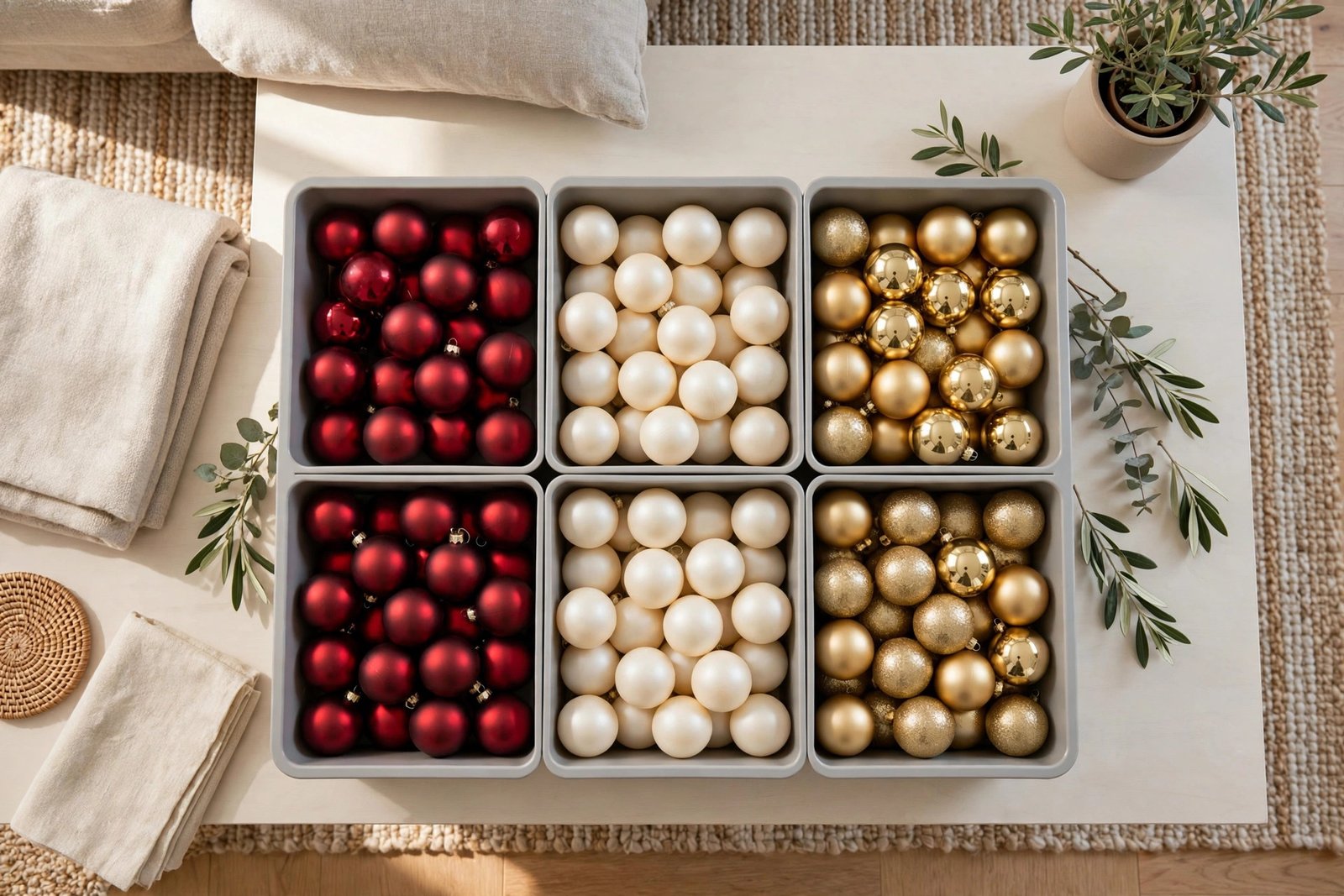
Glass baubles are a deposit risk. Shatterproof baubles in one flat divided tray survive the season and the box. Stick to three colours — deep red, cream and one metallic reads deliberate; a rainbow set reads cluttered.
Cost: ~$12-20 for 24-30 • Best for: a small tree that needs dressing without breakage risk • Measure first: bauble diameter, mostly 4 to 6 cm (1.5 to 2.5 in) for a 90 cm tree; one oversized bauble looks wrong at this scale • Watch out: glitter sheds in the tray; choose matte, shiny and clear finishes.
3. Wind battery string lights on a flat card
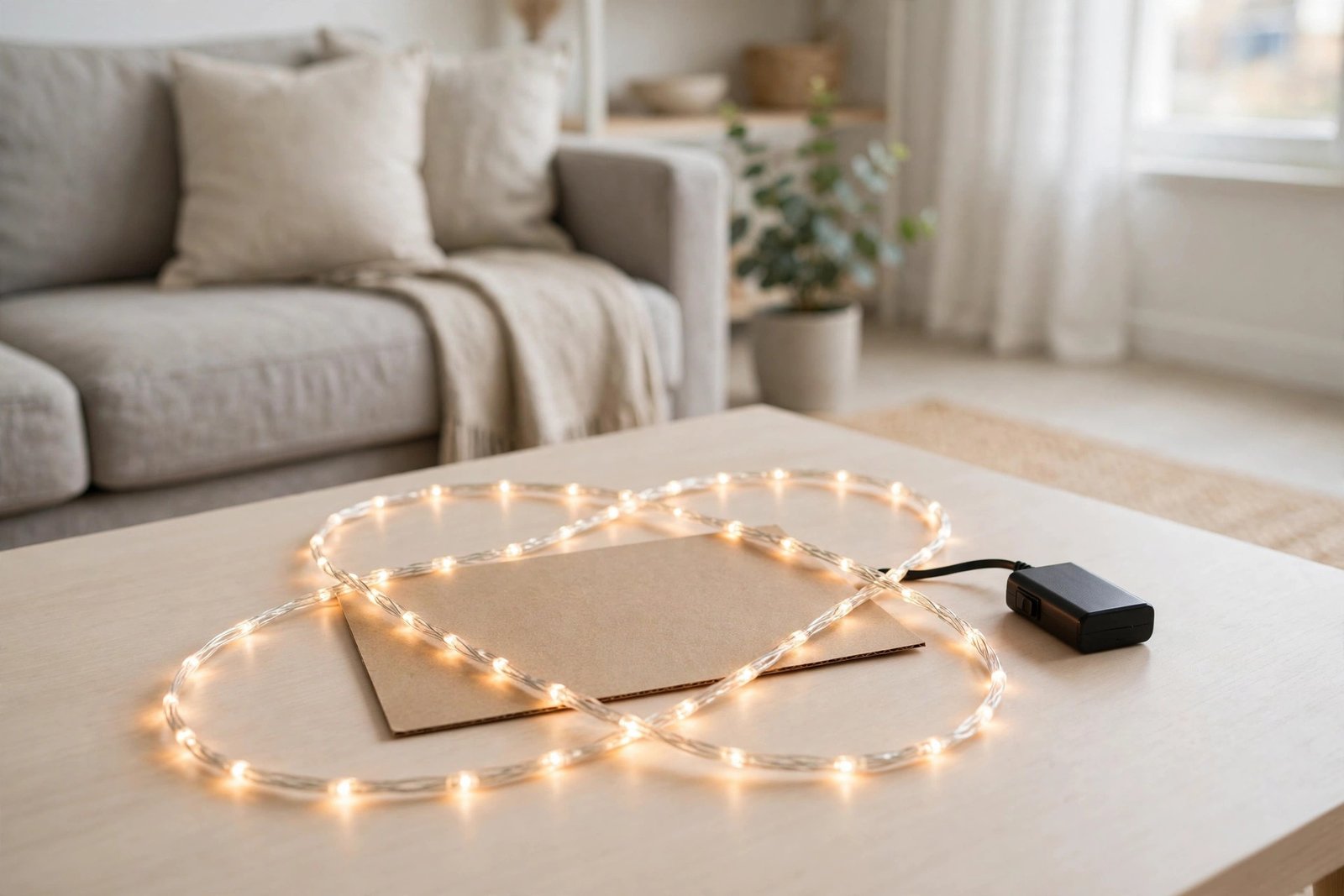
Battery lights need no socket and no cable across rented flooring. A warm-white string of about 5 m (16 ft) covers a tabletop tree and a shelf. Wind it figure-of-eight around a flat card before boxing — no January tangle.
Cost: ~$8-14 • Best for: tree and shelf light where sockets are in the wrong place • Measure first: string length, about 5 m (16 ft) for a 90 cm tree plus one shelf run • Watch out: remove batteries before storage; leaks corrode the whole string.
Soft swaps that fold flat
4. Swap in Christmas cushion covers

Covers beat whole cushions: zip deep red, forest or a check over your existing cushions and the sofa turns festive in five minutes. In January they fold to tea-towel size. Two are enough on a two-seat sofa.
Cost: ~$16-28 for a set of 4 • Best for: an instant living-room change with near-zero storage • Measure first: your existing inserts, usually 45 by 45 cm (18 by 18 in) or 50 by 50 cm (20 by 20 in); buy covers the same size • Watch out: sequin covers scratch and shed; choose woven or printed fabric.
5. Add one festive throw, used daily

One throw in deep red or cream does colour, warmth and box padding in one piece. Drape it over the sofa arm, use it nightly, then fold it flat as the box’s bottom layer.
Cost: ~$20-35 • Best for: colour and warmth on the sofa you already own • Measure first: throw size, usually about 130 by 170 cm (51 by 67 in); smaller looks lost on a two-seat sofa • Watch out: acrylic pills; a cotton or wool blend lasts more seasons.
6. Fold out a Christmas table runner
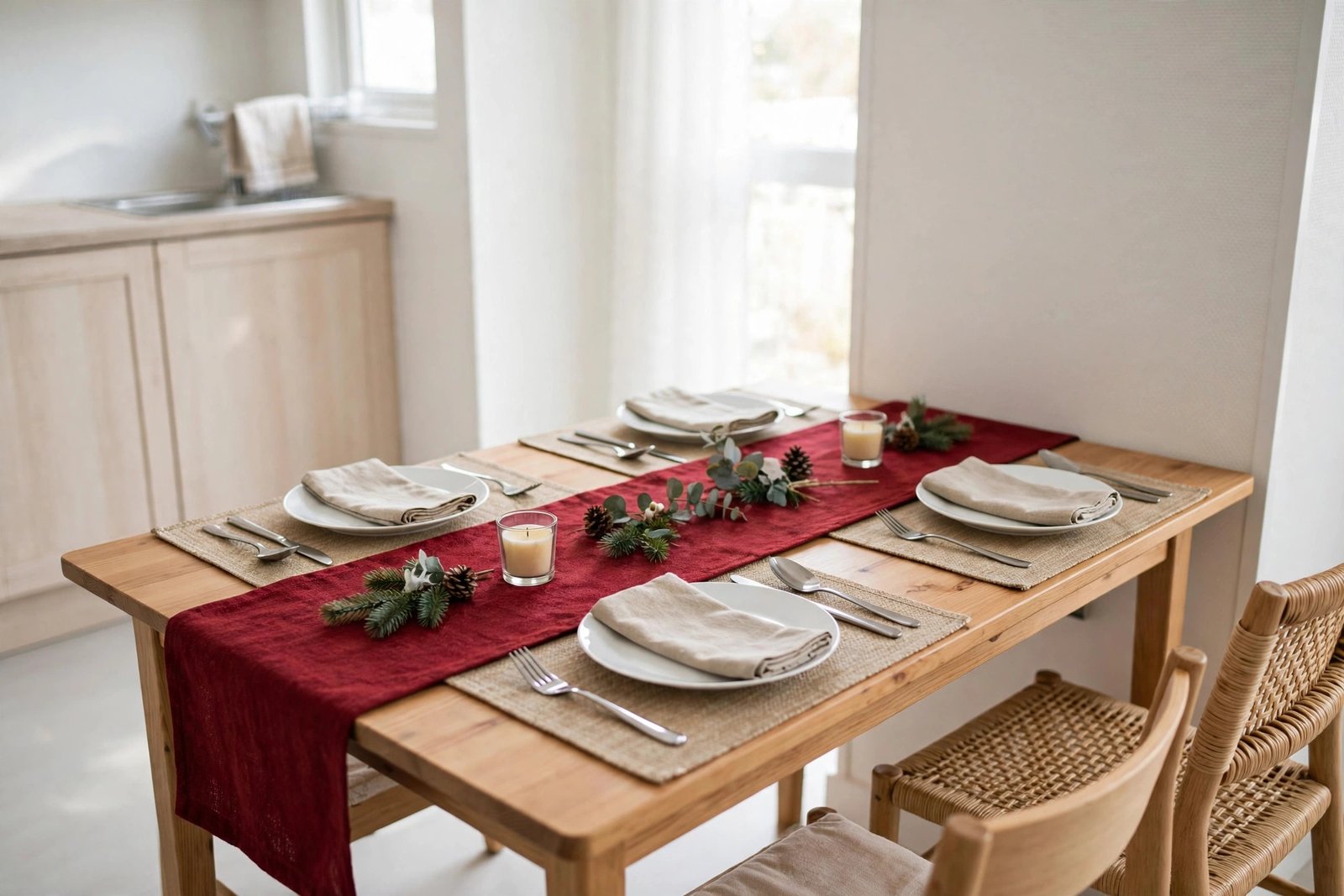
A runner turns your hosting table — often also your desk — into a Christmas table in seconds, then folds flat. Same small table as our Thanksgiving hosting post, different season. Add plain placemats, not a themed set.
Cost: ~$12-22 for runner and 4 placemats • Best for: small dining tables and desk-tables at Christmas • Measure first: table length; a runner should overhang each end by 15 to 20 cm (6 to 8 in), so most small tables need 180 to 220 cm (71 to 87 in) • Watch out: pale runners show gravy permanently; mid-tone red hides a season.
Doors, walls and glass, no nails
7. Hang one flat wreath on a removable hook
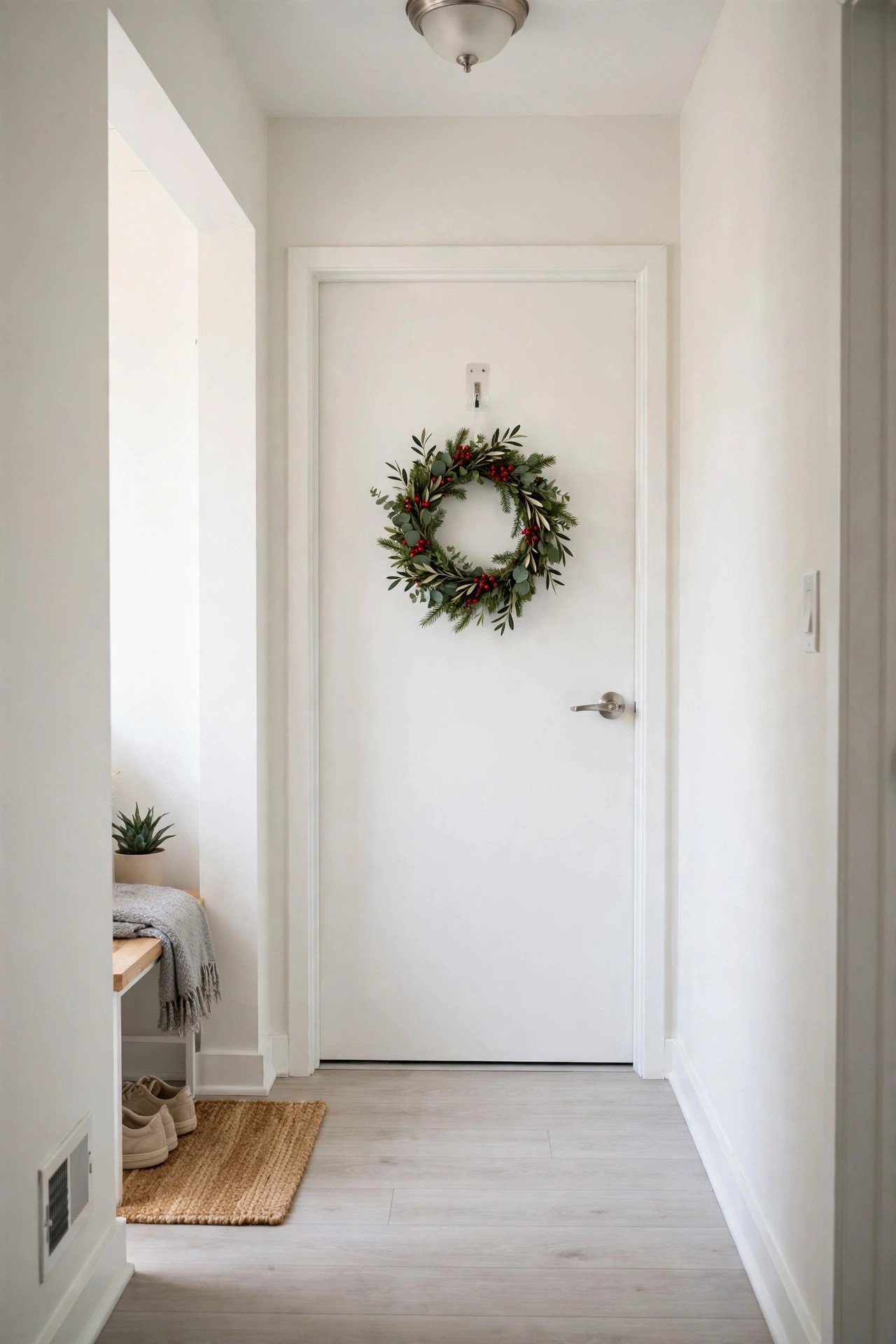
A slim wreath under about 8 cm (3 in) deep hangs from a removable or over-door hook and stores upright along the box’s side. A fat foam wreath eats a quarter of the box — flat is the point. Hang it inside if corridor rules are strict.
Cost: ~$18-30 • Best for: the front door or the wall above a sideboard, one hook • Measure first: wreath diameter, usually 35 to 45 cm (14 to 18 in) at rental scale, and depth under 8 cm (3 in) • Watch out: give the hook 24 hours to set; check its weight rating first.
8. Open paper honeycomb trees and stars

Paper honeycombs open into trees, stars and baubles, then fold completely flat and store in an envelope. Three on a shelf give height and colour for almost no weight or money. Keep them dry and away from heat.
Cost: ~$10-18 for a mixed set • Best for: shelf and mantel colour that stores in an envelope • Measure first: opened height, usually 15 to 30 cm (6 to 12 in) per piece; group odd numbers, tallest at the back • Watch out: paper tears if forced; open slowly and re-fold on the same creases.
9. Coil one faux pine garland along a shelf
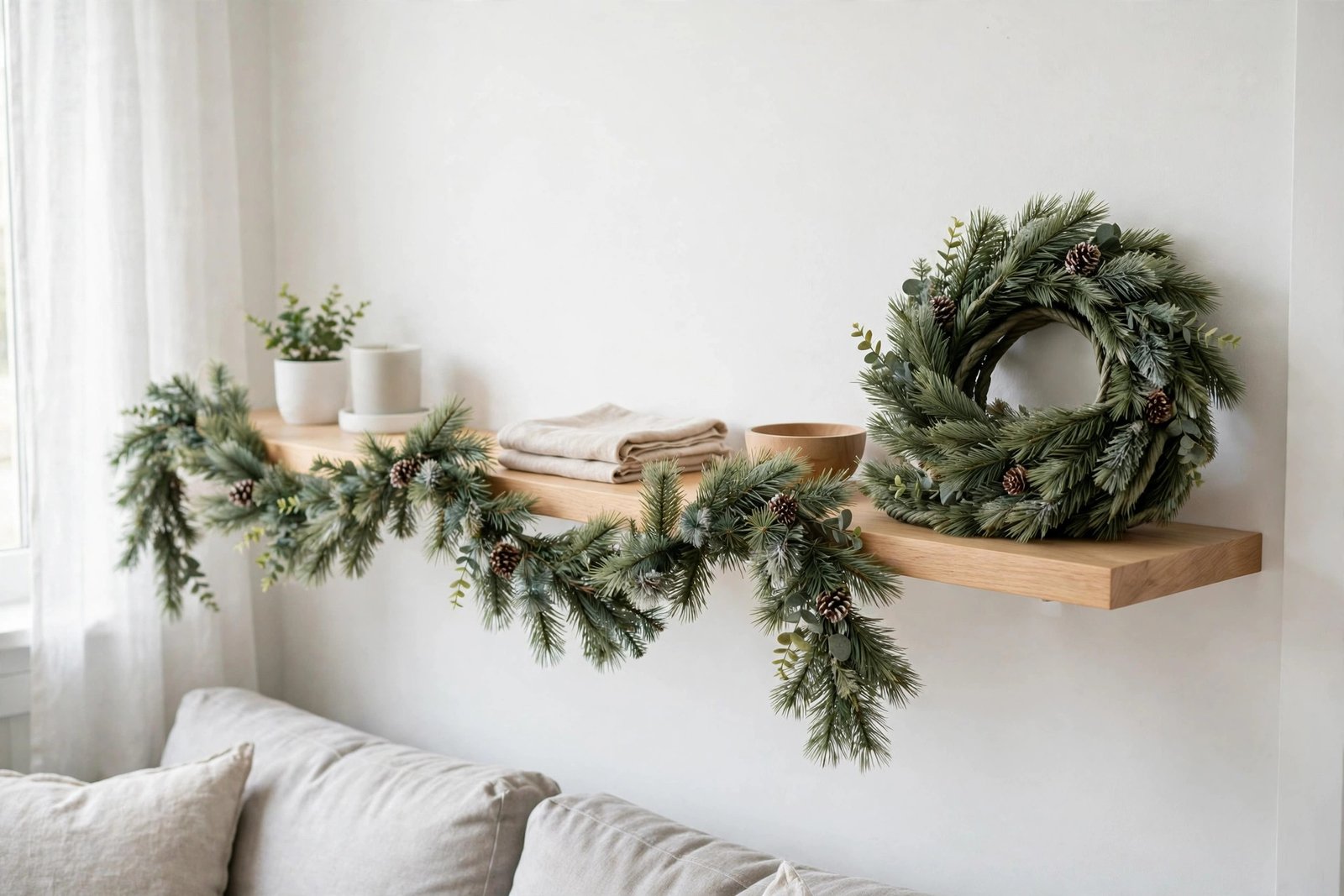
One good garland does the long jobs — shelf, doorway, window ledge — draped or held with removable clips, never pinned into woodwork. At pack-away it coils flat on the textiles. One full garland beats two thin ones.
Cost: ~$14-26 • Best for: shelves, doorways and ledges with no fixings at all • Measure first: garland length, usually 180 to 270 cm (71 to 106 in); measure your shelf run before ordering • Watch out: wire-core holds a drape best; all-plastic springs off and tangles.
10. Stick snowflake clings on the window

Snowflake clings stick with static, peel off in January, and store flat in their envelope between the covers. Use them on a window, glass door or mirror, especially where wall space is full, as in our tiny entryway post.
Cost: ~$7-12 for a multi-sheet set • Best for: windows, glass doors and mirrors in rooms with no spare wall • Measure first: your glass area; one set usually covers about 60 by 90 cm (24 by 35 in) in a loose scatter • Watch out: clean the glass first; clings stored in a ball will not lie flat next year.
Shopping for these? Measure first.
Check any piece against the box: 60 by 40 by 32 cm (24 by 16 by 13 in), tree diagonally, wreath upright at the side. Worksheets: Free Renter Printables.
Small pieces that nest, line up or hang flat
11. Group battery tea lights in jars you own

Battery tea lights in plain glass jars give candle glow without flame near garlands, paper or a no-candle clause. The jars return to everyday use in January; only the lights go in the box, in one bag. Warm flicker looks real.
Cost: ~$9-15 for 12 tea lights • Best for: evening glow on shelves and tables, no flame • Measure first: tea light diameter, about 3.8 cm (1.5 in), against your jar openings; jars about 8 to 10 cm (3 to 4 in) tall diffuse best • Watch out: remove batteries before boxing; keep spares, as lights dim gradually.
12. Line up a small row of mini houses

Three to five small houses on a windowsill make a village at rental scale. Choose ceramic or thick card houses that line up in one row and nest in the box corner. A row reads charming; a sprawl reads clutter.
Cost: ~$15-28 for a set of 3-5 • Best for: windowsills and shelves with a narrow ledge • Measure first: house height, usually 10 to 15 cm (4 to 6 in), and ledge depth — most sills give only 10 to 12 cm (4 to 5 in) • Watch out: wrap ceramic houses in the covers; card houses crush under the tree.
13. Hang stockings from removable hooks, not a mantel
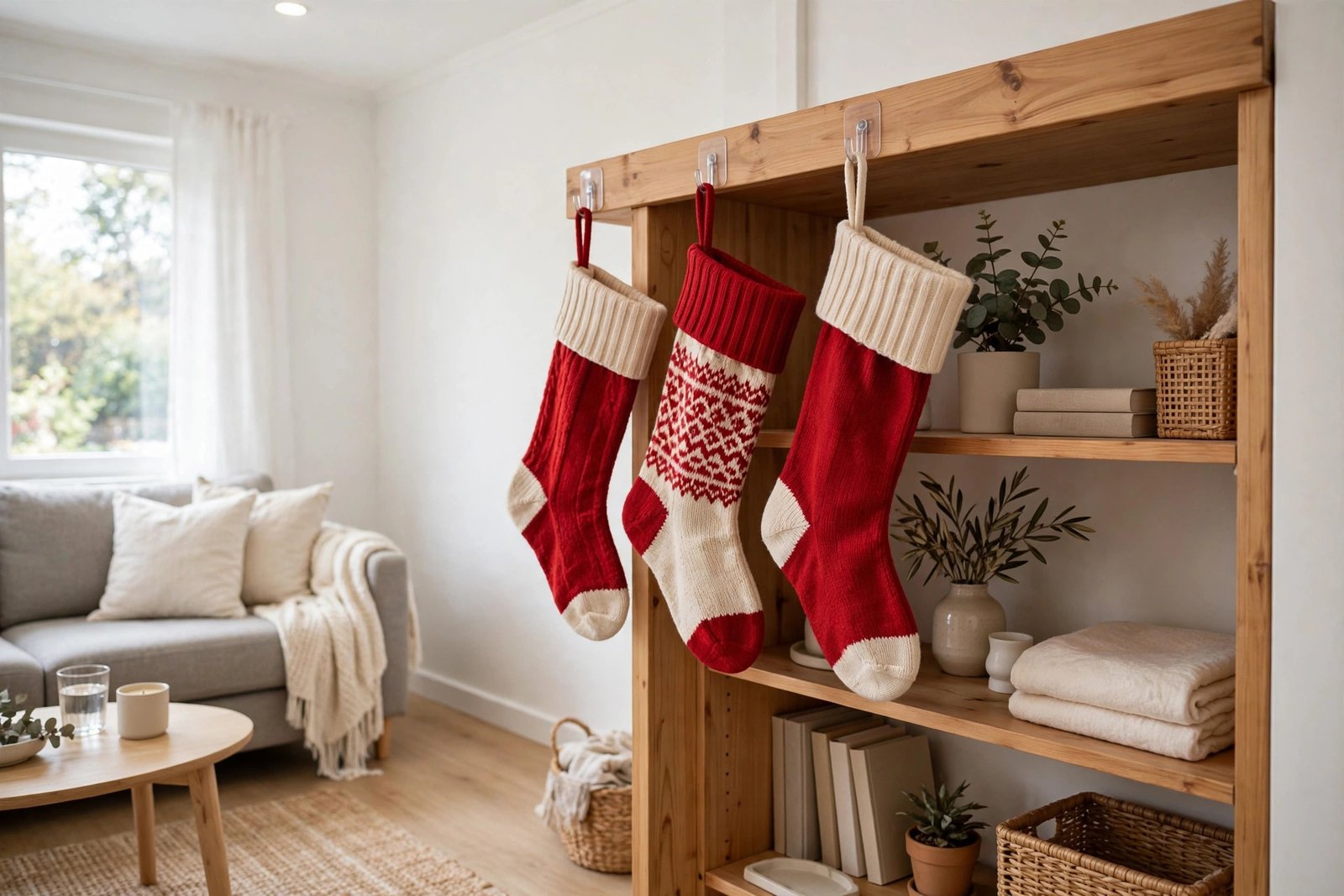
Most rentals have no mantel, so hang stockings from removable hooks on a shelf edge, bookcase side or wall by the tree. They fold flat, cost little, and carry the Christmas signal even in a studio. Fill lightly — sweets, not bottles.
Cost: ~$10-18 for stockings, plus hooks • Best for: a mantel-free rental that still wants the stocking ritual • Measure first: stocking length, usually 40 to 45 cm (16 to 18 in), and the drop from hook to floor or shelf below • Watch out: check each hook’s rating, usually 1 to 2 kg (2 to 4 lb); hang empty until Christmas Eve.
The table and the box that holds it all
14. Build the centrepiece on a tray you already own

A centrepiece on your everyday tray — spare baubles, tea lights, a garland offcut — looks gathered, costs almost nothing, and lifts away in one move. Nothing needs its own storage: every piece belongs to another idea here.
Cost: ~$0-10, using pieces you own • Best for: a Christmas table centre that clears in seconds • Measure first: tray size against your table; leave at least 20 cm (8 in) of clear table on each long side for plates • Watch out: keep paper and garland away from any real candles on the table.
15. Pack it all into one clear, lidded box
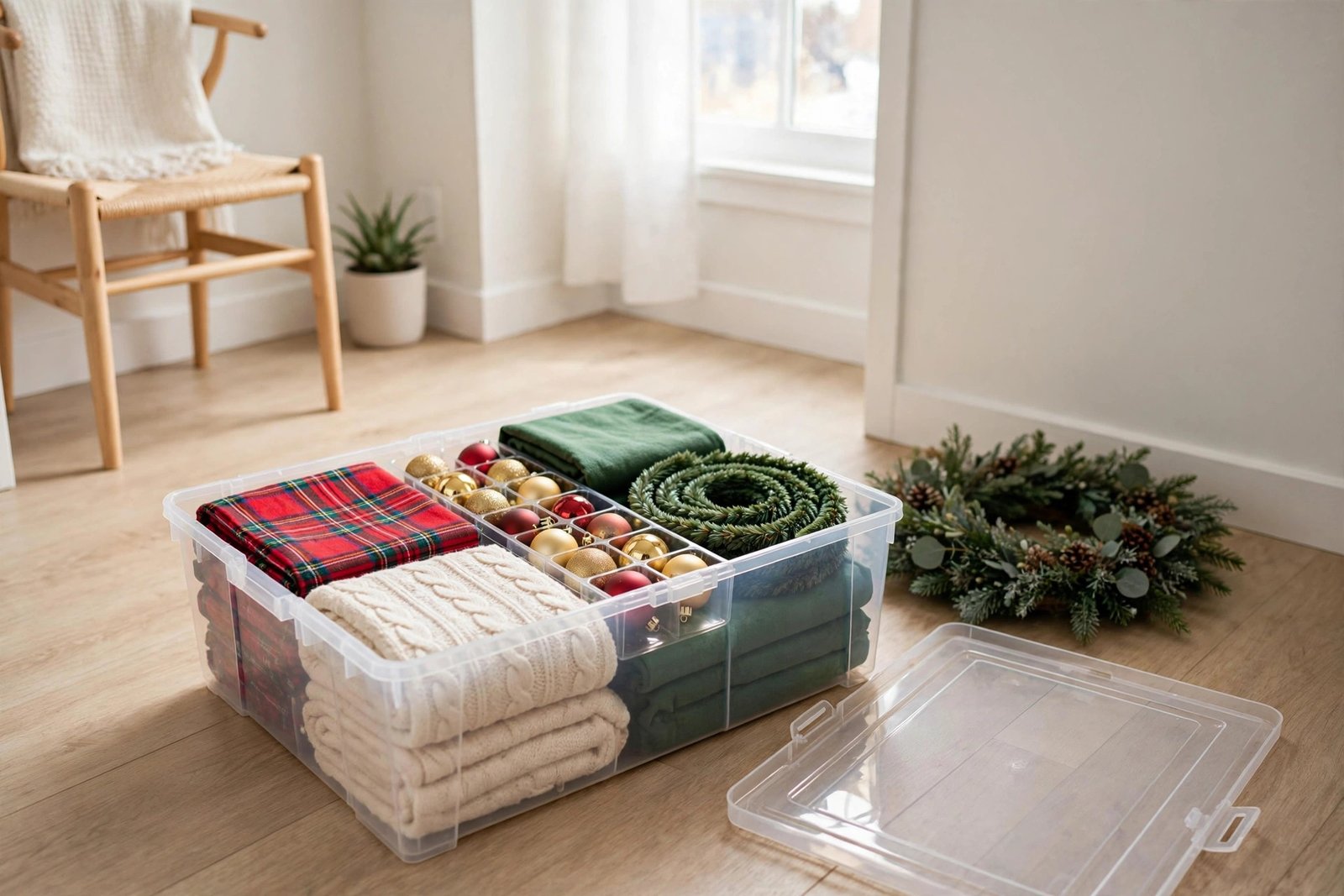
This keeps the other fourteen honest: one clear box, about 64 litres, bought first and treated as a hard limit. Pack in layers — throw at the bottom, covers and runner folded, bauble tray level, lights bagged, honeycombs in their envelope, garland coiled on top, tree diagonally, wreath upright at the side. List the contents inside the lid. If a new piece does not fit, an old piece leaves.
Cost: ~$10-16 • Best for: storing the whole Christmas set in one labelled, visible place • Measure first: the box itself, about 60 by 40 by 32 cm (24 by 16 by 13 in), against under-bed clearance or wardrobe top before buying • Watch out: do not size up ‘just in case’; that is how one box becomes three.
Common mistakes we’d skip
- Buying a floor tree for a tabletop room. If the tree takes the only reading chair’s place for a month, it is too big.
- Buying decor before the box. The box is the budget and the limit. Buy it first, not as a January afterthought.
- Choosing glass, glitter and bulk. All three fail the one-box test, however pretty in the shop.
- Storing soft things dirty or damp. Wash covers and the throw first, and remove every battery. A sealed box keeps smells in as well as dust out.
The short version
Scale the tree down, swap the textiles, hang only flat pieces, coil the lights and garland, and let one 64-litre box set the limit. In January the whole season packs into that box, under the bed.
Questions renters ask
Will 15 Christmas pieces really fit in one box?
Yes, at the sizes here: flat textiles, a folded 90 cm tree, a flat wreath, paper that folds to an envelope and one bauble tray, in a box about 60 by 40 by 32 cm. Oversized pieces break the system, not the count.
Where does the box live in a small rental?
Under a bed with 32 cm of clearance, on a wardrobe top, or at the back of the deepest cupboard. One clear, lidded box can also sit in a hallway crate stack without looking like clutter.
Are adhesive hooks and window clings really deposit-safe?
Clings use static only and leave nothing behind. Hooks are deposit-safe at the right weight rating, set for 24 hours, and removed with the pull-tab as directed — never twisted off.
What should I buy first on a tight budget?
The box, the tabletop tree and the cushion covers, about $51 to $89 together: focal point, sofa change, and the storage rule from day one. Add the bauble tray next.
Found this useful?
Save it to Pinterest for later, or tell us your smallest-space problem in the comments — the best posts here started as a reader’s awkward cabinet.
📌 Pin this post🖨 Print this post
Tell us your smallest-space problem in the comments.
📌 PIN THIS FOR LATER